



ADDRESS
Blog/2026.09.08
A transparent LED screen has to achieve something that a conventional LED display does not. It must deliver bright, high-quality visual content while allowing the physical space behind the screen to remain visible. This combination of digital imagery and physical scenery is what makes transparent LED technology particularly valuable for concerts, festivals, live events, exhibitions, commercial spaces, and modern stage design. However, achieving a convincing level of visual openness is only one part of the engineering challenge. A professional transparent LED display must also maintain structural integrity, installation stability, and the flexibility required for complex real-world applications.
This creates a fundamental design question: How can an LED display remain visually open without compromising structural performance? The answer is not simply to use less material or increase the transparency percentage as much as possible. A well-designed transparent LED screen needs to find the right balance between the amount of visual space it leaves open and the structural framework required to support the display. For rental and staging applications, this balance becomes even more important because the screen may need to be transported, installed, dismantled, reconfigured, suspended at considerable heights, or integrated into unconventional stage structures.
The YES TECH MT II series illustrates this approach by combining high transparency with a magnesium-alloy hollow dual-frame structure and a modular installation system. Instead of treating transparency and structural strength as opposing objectives, MT II is designed to use structural engineering to expand the possibilities of transparent LED display applications.
Transparency Is More Than a Percentage
When comparing transparent LED screens, transparency is often reduced to a single number. A higher transparency percentage may appear to be automatically better, but the practical value of transparency depends on how the display is used. The purpose of a transparent LED display is not simply to allow people to see through it. Its real advantage is that it allows digital content and the physical environment to coexist. On a concert stage, for example, a transparent LED screen can display graphics and video while allowing performers, lighting fixtures, scenic elements, or architectural structures behind the screen to remain visible. Instead of replacing the physical stage with a digital surface, the screen becomes another visual layer within the stage.
This distinction changes the way transparency should be evaluated. A screen with high transparency but limited structural or installation flexibility may not provide the design freedom that a production team actually needs. In contrast, a transparent LED screen that combines sufficient openness with reliable structural performance can become an active part of the stage rather than simply a transparent backdrop. The most useful question is therefore not simply, “How transparent is the LED screen?” It is, “How effectively can the screen preserve visual openness while supporting the requirements of the installation?”
This is especially relevant to large-scale LED video walls. As the screen grows in size, structural elements become increasingly important. The cabinet needs to remain rigid enough to maintain alignment across the entire display while the supporting structure must handle the mechanical demands of the installation. At the same time, the frame should not unnecessarily reduce the open visual area that makes transparent LED technology attractive in the first place. A professional transparent LED display is therefore an exercise in controlled balance. Transparency creates the visual effect, while structural engineering determines how far that effect can be taken in practical applications.
Why Higher Transparency Does Not Always Mean a Better LED Display
There is a natural temptation to assume that increasing transparency automatically improves a transparent LED screen. In reality, every display design involves trade-offs between optical openness, mechanical performance, pixel configuration, brightness, cabinet construction, and installation requirements. A transparent LED screen designed for a permanent architectural installation may have very different structural priorities from a rental LED screen designed for concerts and touring productions. A rental display needs to withstand repeated handling and installation while remaining easy to transport and configure. If structural components are reduced without considering the overall cabinet architecture, the result may be a screen that looks open but is less suitable for demanding production environments.
The same principle applies to large suspended displays. When an LED screen is installed high above a stage, structural performance becomes part of the system's overall reliability. The cabinet connections, frame, rigging interface, and supporting components all have to work together. The screen therefore needs an engineered structure that provides support without turning the transparent display into an unnecessarily heavy or visually obstructive construction. This is why the best transparent LED technology does not pursue transparency in isolation. It seeks an optimized relationship between visual openness, structural strength, weight, installation flexibility, and display performance. That relationship becomes particularly important when the screen is expected to perform multiple roles. A modern stage LED screen may be used as a flat backdrop for one event, a curved visual surface for another, and part of a three-dimensional scenic structure for a third. The more configurations the screen can support, the more valuable its structural design becomes.
Structural Design Can Expand Creative Freedom
The most interesting advantage of a well-engineered transparent LED screen is not necessarily that it can carry more load. It is that structural capability can give designers more freedom. Traditional LED video walls are often associated with a flat rectangular surface. Although modern rental LED screens can support curved configurations, their role is still commonly understood as a digital wall placed behind the performers. Transparent LED technology introduces another possibility: the display can become a spatial element.
A curved transparent LED screen can wrap around a performer or stage area while maintaining visibility of the scenery behind it. A corner configuration can turn a flat display into a three-dimensional visual surface. Staggered cabinet arrangements can introduce different depths and create layered visual effects. Suspended screens can move the visual content above the traditional stage backdrop and contribute to the vertical composition of the venue. In these applications, structural flexibility is directly connected to creative flexibility. This is an important distinction because stage designers do not necessarily want the LED screen to disappear. They want to control how it interacts with the surrounding environment. Sometimes the screen needs to be visually dominant; at other times, it needs to blend into the physical stage. Sometimes the content should appear to float in space, while in other situations it needs to form a defined architectural boundary.
A transparent LED display provides the visual openness required for these effects, but its structural system determines how freely the designer can position and shape the screen. This is why features such as curved splicing, corner configurations, and different installation methods should not be treated as isolated specifications. They are part of a larger design philosophy in which the LED display becomes a flexible component of the stage architecture.
MT II: Designing Openness Into the Structure
The MT II series from YES TECH is designed around this balance between openness and structural performance. Rather than relying on a conventional solid cabinet architecture, MT II uses a magnesium-alloy hollow dual-frame structure designed to maintain a lightweight and open construction while providing the structural support required for professional rental and staging applications.
The hollow frame is particularly relevant to transparent LED display design because the structure itself occupies part of the visual field. By using a hollow dual-frame architecture, the cabinet can provide structural reinforcement while maintaining the open character expected from a transparent screen. MT II provides at least 50% transparency, allowing the screen to integrate more naturally with the physical environment behind it. This can be valuable for concert stages, festivals, exhibitions, corporate events, and other productions where lighting, performers, scenery, or architectural elements need to remain visible through the LED display.
The magnesium-alloy construction also addresses another important consideration: structural efficiency. For rental applications, the objective is not simply to build the strongest possible cabinet. The objective is to achieve the required structural performance while keeping the system practical for transportation, handling, installation, and repeated deployment. This is where material selection and frame architecture work together. A transparent LED screen needs enough structural material to remain stable, but excessive material can increase weight and reduce the visual openness of the display. MT II's hollow dual-frame approach is intended to find a more efficient middle ground. The result is a transparent LED display designed not only to look open but also to function as a professional rental LED screen in demanding production environments.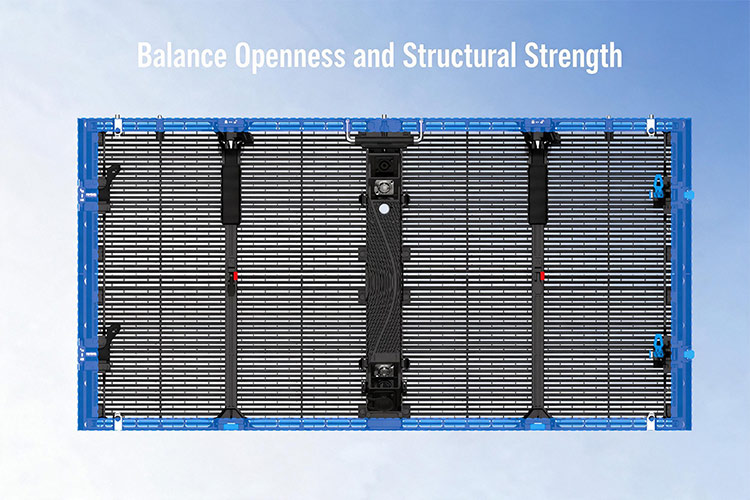
From a Transparent Screen to a Three-Dimensional Stage Element
One of the strongest arguments for transparent LED technology is that it changes the relationship between the screen and the stage. A conventional LED display can act as a digital background. A transparent LED screen can become a layer within the stage itself. Consider a stage with performers in front of the display, lighting equipment positioned behind it, and physical scenery extending across the background. With a conventional LED video wall, the display may visually dominate the entire rear surface. With a transparent LED display, the content can be layered over the physical environment. Lighting can interact with the LED content, performers can remain visually connected to the background, and physical structures can become part of the composition. This layered approach can create a stronger sense of depth without requiring the stage to be completely enclosed by LED panels.
MT II is designed to support this type of application through its flexible cabinet architecture. Its ±15° curved splicing, 90-degree corner configurations, and staggered splicing allow production teams to move beyond a simple flat LED wall. These configurations can help create curved scenic surfaces, angular structures, and layered visual compositions while retaining the transparency that distinguishes the display from a conventional LED screen.
The significance of these capabilities is not simply technical. They give stage designers more control over the relationship between digital content and physical space. For example, a curved transparent LED screen can follow the shape of a stage rather than forcing the stage to conform to a rectangular screen. A 90-degree corner can connect two visual planes and create a more architectural structure. Staggered cabinets can create depth between different sections of content. Each configuration changes how the audience perceives the screen and the physical environment around it. In this sense, structural flexibility becomes a design tool.
Hanging Capability and the Vertical Dimension
The structural balance of a transparent LED screen becomes even more important when the display is suspended. Large-scale stage productions increasingly use LED screens above the performers, behind scenic structures, or as elevated visual elements. These installations can dramatically increase the perceived scale of a stage, but they also place greater demands on the screen's mechanical structure and installation system.
MT II supports hanging installations of up to 20 meters, allowing the transparent LED display to be used in tall stage structures and elevated visual installations. The value of this capability is not limited to the maximum height itself. It is the additional design space that becomes available when the LED screen can be integrated into higher and more complex structures. A transparent LED screen suspended above a stage can maintain the visibility of the space behind it while adding another layer of digital content. Multiple screens can also be positioned at different heights or depths, creating a multi-layered stage environment.
This is where transparency and structural performance work together particularly well. Transparency preserves the sense of openness, while the structural system provides the capability needed to position the display within the three-dimensional stage environment. For rental companies and production teams, this also means that a transparent LED screen can serve applications that would otherwise require several different types of display equipment.
Flexibility Matters as Much as Strength
Structural strength alone does not make a professional rental LED screen successful. A screen also needs to be practical to install, dismantle, transport, and reconfigure. MT II uses a quick-lock installation system and large handles designed to simplify handling and installation. The series also supports both 1000 × 500 mm and 500 × 500 mm cabinet formats, giving production teams greater flexibility when building different screen dimensions and configurations.
The smaller cabinet format can be particularly useful when the display needs to adapt to corners, irregular structures, or specific stage dimensions. Meanwhile, larger cabinets can help accelerate the construction of larger LED video walls. MT II also supports both hanging and stacking applications using the same beam system. For LED rental companies, this type of common installation architecture can reduce the need for specialized accessories and make the same transparent LED display more adaptable across different events. This is an important part of the overall balance. A transparent LED screen should not only be structurally strong enough for a particular application; it should also be flexible enough to be reused across many applications. The more efficiently the cabinet can transition between different configurations, the greater its value as a rental asset.
Display Performance Still Matters
Structural design is only one part of a professional LED display. The screen also needs to deliver the visual performance expected from modern live-event and staging applications. MT II supports a 7680Hz refresh rate, which is particularly relevant for camera-facing environments where LED displays may be captured by professional cameras. Depending on configuration, the series can also reach up to 4500 nits brightness, while its IP65 protection supports both indoor and outdoor applications.
These specifications matter because transparency does not eliminate the basic requirements of LED display technology. A transparent LED screen still needs sufficient brightness for its environment, stable image reproduction, high refresh performance, and appropriate protection when used outdoors. For an outdoor festival, for example, transparency may help integrate the screen with the stage environment, but the display still needs enough brightness to remain visible under ambient daylight. For a televised concert, visual openness can create a sophisticated stage effect, but the LED display must also provide camera-friendly performance. A professional transparent LED screen therefore has to operate on two levels simultaneously: it needs to perform as an LED display and function as part of a physical structure.
The Real Meaning of Balance
The balance between openness and structural strength should not be understood as a compromise in which one feature is sacrificed to improve another. In a well-engineered transparent LED display, the goal is to make these characteristics work together. Transparency creates visual openness. Structural engineering makes that openness usable in real-world installations. Flexible cabinet configurations turn structural capability into creative freedom. Efficient installation systems make the technology practical for rental applications. High brightness, high refresh rate, and environmental protection ensure that the display can perform as an LED screen under demanding conditions.
This is the difference between simply making an LED panel transparent and developing a complete transparent LED display solution. For stage designers, the question is not whether the screen is transparent enough in isolation. The more important question is whether the display can provide the openness, structural reliability, and configuration flexibility needed for the intended production. For rental companies, the same principle applies from an operational perspective. A transparent LED screen becomes more valuable when it can support multiple installation methods, adapt to different stage geometries, and remain practical to transport and deploy. MT II is designed with this broader requirement in mind.
A More Flexible Approach to Transparent LED Display Design
The evolution of transparent LED technology is moving the category beyond the idea of a see-through LED wall. As stage production becomes more spatial, dynamic, and integrated with lighting and scenic design, transparent LED displays are increasingly being treated as structural and visual components of the stage. The challenge is to preserve the openness that defines the technology without allowing the structure to become a limitation.
MT II approaches this challenge with a magnesium-alloy hollow dual-frame structure, at least 50% transparency, flexible cabinet formats, ±15° curved splicing, 90-degree corner configurations, staggered splicing, and support for hanging installations up to 20 meters. Combined with a 7680Hz refresh rate, up to 4500 nits brightness, IP65 protection, and both hanging and stacking capabilities, these features allow the display to address the practical and creative requirements of professional rental and stage applications. Ultimately, the strongest advantage of a transparent LED screen is not transparency alone. Its real value lies in the ability to combine visual openness with structural performance and creative flexibility.
When those elements are designed together, an LED display no longer has to function simply as a surface for displaying content. It can become a curved scenic element, a suspended visual layer, a three-dimensional architectural structure, or an integrated part of the stage itself. That is the direction in which professional transparent LED display technology is evolving: not simply making LED screens easier to see through, but making them more capable of becoming part of the space they occupy.
For modern concerts, festivals, live events, and creative stage productions, the right transparent LED screen is therefore not necessarily the one with the highest transparency specification. It is the one that provides enough openness to create visual depth, enough structural performance to support demanding installations, and enough flexibility to turn creative concepts into practical stage structures. MT II brings these requirements together in a transparent LED display platform designed for the realities of professional rental and staging.


+86-(0)731-84539619


Hunan Yestech Optoelectronic Co., Ltd. Terms of Service Privacy Policy Powered by szweb


