



ADDRESS
Blog/2026.10.14
Outdoor concerts place LED displays in conditions that are difficult to reproduce in a controlled environment. Wind can change direction, rain can arrive shortly before a performance, and a temporary stage structure may face unexpected pressure when the production team has little time to respond. For rental companies and event production professionals, these situations highlight an important distinction: an outdoor LED display must deliver more than visual performance. Its structural design, environmental protection, and integration with the complete stage system all matter when conditions change.
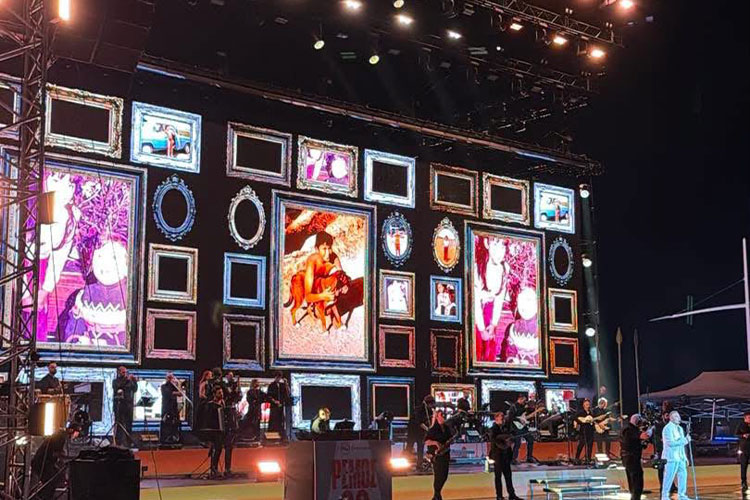
The 30th anniversary concert of Greek singer Antonis Remos offers a useful example of the challenges involved. Held on September 12, 2026, at Thessaloniki’s New Waterfront, the free outdoor concert attracted more than 300,000 people. D&P Audiovisual supplied 640 m² of YES TECH LED displays, including 380 m² of MT P3.9–7.8 transparent LED displays and 260 m² of MG9 P3.9 displays.
The weather deteriorated shortly before the performance. Heavy rain began at around 18:00, and the wind increased. According to D&P Audiovisual, the floor truss used to brace the MT screen broke, leaving the screen moving in the wind for approximately 15 minutes. Several cables were cut, including a power cable, a Cat6 cable, and a signal loop cable. After the damaged cables were replaced and the system was checked, the concert started shortly after 21:30, with all LED panels working normally.
The event demonstrates why outdoor LED display reliability must be considered from several perspectives. The condition of the cabinets matters, but so do the supporting structure, cabling, installation design, inspection procedures, and the team's ability to respond to an unexpected incident. It also provides a useful starting point for understanding the design considerations behind outdoor transparent LED displays such as the YES TECH MT II Series.
When Outdoor Weather Becomes a Real Production Challenge
An outdoor LED display operates in an environment that cannot always be controlled. Even when a production team has completed its installation plan, changing weather can introduce new demands on the equipment and the supporting structure.
Rain is an obvious concern because outdoor electronic equipment must be appropriately protected against water exposure. Wind presents a different challenge. A large LED display interacts with moving air, and the resulting forces are transferred through the display structure and its connections to the supporting framework.
The scale of the installation makes a difference. A large stage may include several display walls, each with its own dimensions, position, and connection requirements. Suspended screens and temporary stage structures introduce additional engineering considerations, particularly when weather conditions change during preparation or operation.
The Antonis Remos concert illustrates how quickly these factors can converge. The failure of the floor truss used to brace the MT screen was a structural incident, while the damaged power and signal cables created additional work before the performance could proceed. The event should not be interpreted as evidence that an LED cabinet can independently withstand every extreme weather condition. Instead, it shows why the reliability of an outdoor LED installation depends on both the display and the complete system around it.
For rental companies, this distinction is essential. Choosing an outdoor-rated product is only one part of preparation. The screen must also be installed with suitable supporting structures, correctly connected, inspected, and operated according to the conditions and requirements of the project.
What the Antonis Remos Concert Reveals About LED Screen Reliability
The most significant detail in the project report is not simply that the screen was exposed to rain and wind. It is the sequence of events: the supporting truss failed, the display was displaced by the wind, several cables were damaged, and the production team replaced them before the concert began.
D&P Audiovisual described its initial concern that multiple panels might not return to operation. After the cables were replaced, however, all panels were reported to be working when the concert started.
This result needs to be understood in context. It does not establish that the display itself caused the structural incident, nor does it mean that every LED display can recover from the same event. It demonstrates the importance of assessing the condition of the complete installation after an unexpected incident and verifying that the equipment is ready before resuming operation.
For an outdoor concert with a large audience, operational decisions have consequences beyond image quality. Production teams must determine whether the supporting structure is safe, whether cables and connections need replacement, and whether the display system can be returned to service. Structural safety and electrical inspection must take priority over maintaining the original schedule.
This is why outdoor LED reliability should not be reduced to a single claim about waterproofing or wind resistance. A suitable display needs appropriate environmental protection and a structure designed for its intended application, while the supporting system must be engineered for the actual installation.
Transparency Is Only One Part of Outdoor Performance
Transparent LED displays are often selected for creative stage designs because they allow lighting, scenic elements, performers, and other structures to remain visible behind the screen. Their open construction can also allow air to pass through the display, potentially reducing the wind-blocking effect compared with a conventional solid wall of similar dimensions.
However, transparency does not automatically make a display suitable for every outdoor installation. The screen's dimensions, mounting height, configuration, supporting structure, and local wind conditions all influence the engineering requirements.
A transparent display still experiences wind forces. Those forces must be assessed as part of the complete installation rather than estimated from transparency alone. Cabinet rigidity, connections, supporting trusses, bracing arrangements, and installation procedures remain important.
This distinction is particularly relevant when a display forms part of a large concert stage. A screen may be installed in a flat configuration, curved around a stage, or arranged in multiple sections. Each configuration creates its own requirements for connections and support.
The practical lesson from outdoor production is straightforward: transparency should be evaluated alongside structural design and environmental protection. A display intended for demanding outdoor use needs to balance all three rather than relying on a single specification.
How MT II Addresses the Requirements of Outdoor Transparent LED
The YES TECH MT II Series is designed for transparent LED rental and staging applications where structural performance, environmental protection, and installation efficiency must work together.
MT II uses a magnesium-alloy hollow dual-frame structure with integrated reinforcing ribs. This architecture is intended to combine the visual openness of a transparent display with the rigidity and load-bearing characteristics required for professional stage applications.
The hollow structure allows air to pass through the display, while the reinforcing design contributes to cabinet rigidity. This combination is relevant to outdoor stages where large display surfaces may be exposed to changing wind conditions. It does not remove the need for site-specific wind-load calculations or an appropriately engineered supporting structure.
MT II provides at least 50% transparency. This helps preserve visibility through the screen and can reduce the wind-blocking effect compared with a conventional solid LED wall of the same overall dimensions. The actual effect on wind loading depends on the complete configuration and must be assessed for the installation in question.
The series also carries an IP65 rating for outdoor applications. Under the standardized IP classification, the rating indicates that the enclosure is dust-tight and protected against water jets under specified test conditions. It is not a guarantee against every form of water exposure, and it does not mean the display can be submerged.
These design characteristics address different aspects of outdoor use. The cabinet structure contributes to mechanical performance, transparency affects the open configuration of the display, and IP65 protection addresses defined forms of dust and water exposure. Their benefits must be considered together with installation engineering, cable management, and appropriate inspection procedures.
Structural Design Must Be Considered Alongside the Supporting System
A reliable outdoor LED installation is not determined by the cabinet alone. The supporting framework, connection points, rigging equipment, and bracing arrangement all contribute to the performance of the assembled display.
This is particularly important for large suspended screens. MT II supports hanging installations up to 20 meters under the specified configuration, offering flexibility for elevated stage designs. However, that figure should not be interpreted as a guarantee that every screen can be suspended safely at that height under all conditions.
The permitted installation depends on the complete system, including screen dimensions, load distribution, connection methods, supporting structures, local wind conditions, and the applicable engineering requirements. Qualified professionals must assess these factors before the display is installed.
The Antonis Remos incident is a reminder of why the supporting system deserves particular attention. The reported failure involved the floor truss used to brace the screen. It would therefore be inaccurate to attribute the incident solely to the LED cabinets or to suggest that a different cabinet design would necessarily have prevented it.
For production teams selecting MT II or another outdoor LED display, the correct approach is to assess the product's specifications and the supporting system together. Cabinet design can contribute to the overall solution, but it cannot replace appropriate structural engineering.
IP65 Protection and the Management of Outdoor Exposure
Rain can reach different parts of an outdoor installation, including the display enclosure, cable connections, power distribution equipment, and other electrical components. A suitable IP rating provides an important indication of the enclosure's protection, but the entire installation must be considered.
MT II's IP65 rating is relevant to outdoor concerts and festivals where exposure to rain and dust may occur. The rating establishes protection under defined test conditions, not unrestricted waterproofing.
Before an outdoor event, production teams should check the display and its connections according to the manufacturer's instructions. Cable routing, power distribution, connector protection, drainage, and supporting equipment need to be suitable for the venue and expected conditions.
If a display experiences unexpected weather or mechanical movement, it should not simply be switched back on because the enclosure is outdoor-rated. The supporting structure, cabinets, power connections, signal cables, and other affected components need to be inspected. Damaged components should be replaced or repaired as required, and the system should be verified before operation resumes.
These procedures are relevant to every outdoor rental display. Environmental protection is an important part of product design, while safe operation depends on how the product is installed, inspected, and maintained.
Installation Efficiency and Incident Response
Outdoor productions often operate under strict schedules. A large display may need to be installed, connected, tested, and prepared for content playback within a limited period. If unexpected weather or equipment damage occurs, the team must also determine what needs to be inspected or replaced before the event can continue.
MT II incorporates a quick-lock system and large handles designed to simplify cabinet handling and connections. These features are intended to support efficient installation and dismantling, including workflows designed for one-person cabinet operation.
MT II is available in 1000 × 500 × 83 mm and 500 × 500 × 83 mm cabinet formats. Its configuration options include curved splicing with ±15° adjustment, 90-degree corner applications, and staggered cabinet splicing. An optional shutter system allows the display to switch between transparent and solid modes.
These features can make the display more adaptable to different stage designs and rental workflows. They should not, however, be confused with a guarantee of faster recovery after a weather incident. Actual recovery time depends on the nature of the problem, the availability of replacement components, access to the installation, and the inspection and repair work required.
For rental companies, efficient handling and clear maintenance procedures are complementary. A practical cabinet design can help crews manage installation, while a structured inspection process helps them identify problems and determine whether equipment is ready for operation.
From a Single Concert to the Broader Requirements of Outdoor Rental
The Antonis Remos concert is a specific example involving the original MT Series and MG9 displays. Its value for discussing MT II lies in the broader production challenges it illustrates, not in establishing MT II's performance at that event.
For MT II, the relevant product considerations are its magnesium-alloy hollow dual-frame structure, integrated reinforcing ribs, at least 50% transparency, IP65 protection, and connection and handling design. These characteristics are intended to address the requirements of outdoor transparent LED rental and staging applications.
A product should be evaluated against the actual conditions of the planned deployment. A waterfront concert, an open-air festival, and a touring stage may involve different combinations of moisture exposure, wind conditions, installation height, and structural complexity. The appropriate display configuration and supporting system must be selected accordingly.
Real-world event reports are valuable because they show how production challenges can emerge. Product specifications are equally important because they define the capabilities and limits that should guide equipment selection. Neither should be used to make claims that go beyond the available evidence.
Choosing an Outdoor LED Display for Demanding Events
For event production companies, choosing an outdoor LED display means balancing image requirements with environmental protection, structural design, installation efficiency, and the demands of the venue.
Start by identifying the conditions the screen will face. Consider the display dimensions, installation height, supporting structure, exposure to rain and wind, and the time available for assembly and testing. Check that the product's specifications are appropriate for the intended application.
Next, assess the complete system. The cabinet, connections, supporting structure, cabling, and power distribution all influence operational readiness. Make sure the installation is appropriately engineered and that inspection and maintenance procedures are included in the production plan.
Finally, consider the practical requirements of rental use. Cabinets need to be transported, handled, assembled, dismantled, and prepared for future deployments. A design that balances structural performance with practical handling can be valuable when the same equipment is used across different events.
The YES TECH MT II Series brings together a reinforced magnesium-alloy structure, outdoor protection, transparency, and flexible cabinet configurations for professional rental and staging applications. Its capabilities should be matched to the project's actual requirements and supported by appropriate installation engineering.
MT II: Designed for Outdoor Rental and Staging Requirements
The Antonis Remos concert demonstrates how quickly weather and structural problems can complicate an outdoor production. Although the project used MT rather than MT II, it illustrates why outdoor LED reliability requires more than good image quality or a single environmental rating.
MT II addresses several of the same broader design considerations through its reinforced hollow dual-frame structure, at least 50% transparency, IP65 protection, and installation features designed for rental use. These characteristics can help production teams plan transparent LED stages for outdoor applications, provided that the complete installation is engineered for its intended environment.
For rental companies and event producers, the most important question is not whether a display can withstand every unexpected event. It is whether the product is appropriate for the planned conditions, whether the supporting structure has been properly designed, and whether the team can inspect and operate the system safely.
By evaluating those factors together, production teams can make more informed decisions when selecting an outdoor LED display. MT II provides a platform designed around the combined requirements of transparency, structural performance, outdoor protection, and rental practicality.


+86-(0)731-84539619


Hunan Yestech Optoelectronic Co., Ltd. Terms of Service Privacy Policy Powered by szweb


