



ADDRESS
Blog/2026.10.09
A touring stage rarely enters the same room twice. An arena places seats above and beside the performers; an outdoor stadium adds distance, daylight, and wind. Every stop has different rigging limits and a narrow window for setup and teardown.
There is no universal concert LED screen configuration. A tour needs a concert LED screen configuration suited to its venues, stage concept, and working schedule.
This guide explains the factors shaping touring layouts, compares three configurations using YES TECH displays, and shows how to select one for the most demanding stop.
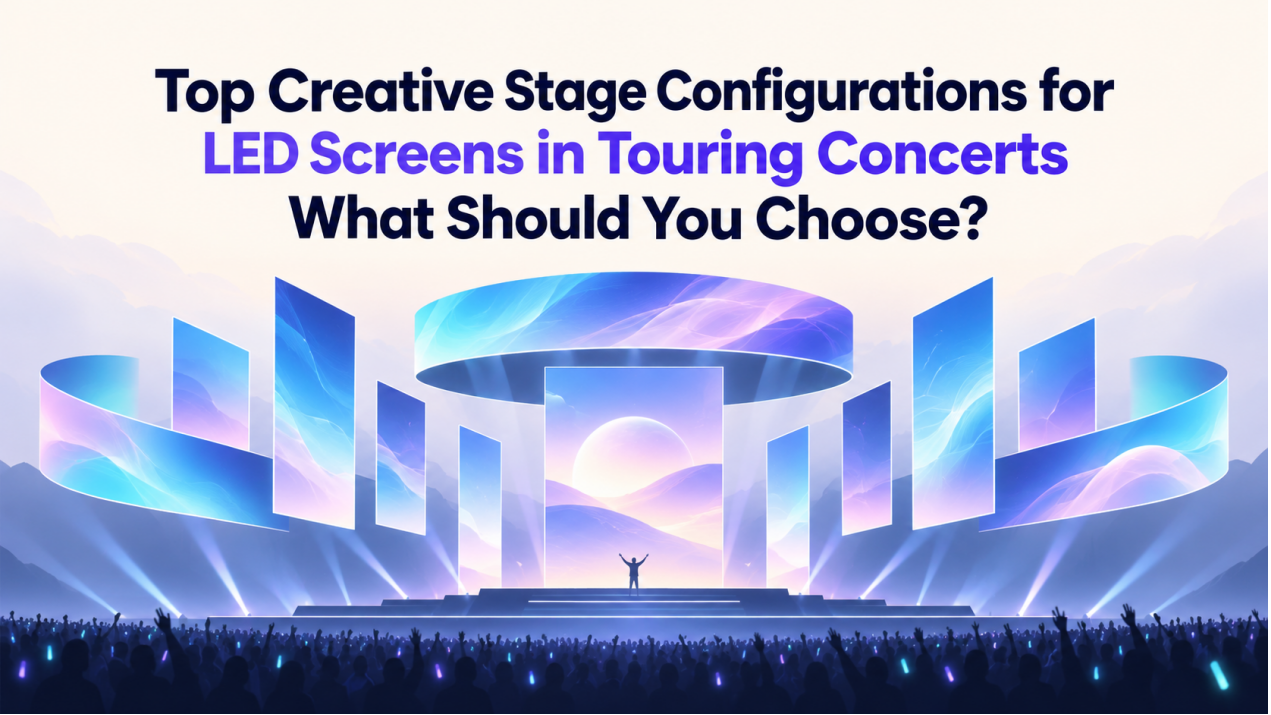
Venue geometry, installation conditions, and visual design shape the concert LED screen configuration at each tour stop. Together, these three factors determine which layouts can deliver the intended effect across arenas and outdoor stages.
l Venue Size and Sightlines
Venue size changes viewing distance for a concert LED screen, while seating position changes the angle from which people see it. Main-screen height and tilt affect views from upper stands; angled or curved side screens can bring imagery into clearer view for side sections. Stage width and viewing distance also influence screen size, image scale, and pixel pitch.
l Setup Efficiency and Rigging Safety
Tour schedules set different limits on loading, rigging, teardown, and transport for a rental LED screen. Cabinet weight, locking hardware, and beam compatibility affect assembly time, while suspended weight and available rigging points affect the possible layout. Outdoor stages add structural and weather considerations: ANSI E1.21-2024 addresses documented operating limits for temporary structures within its scope, and Event Safety Alliance standards cover rigging and weather planning.
l Visual Creativity and Modular Versatility
Show content may call for a concert LED screen as the main backdrop, suspended layers for depth, curved side screens, segmented corners, or floor-to-wall imagery. Each form uses a different combination of cabinet sizes, connections, and mounting arrangements. A system’s modular range affects how easily the stage design can be adapted between tour stops.
Three concert LED screen configurations address different touring priorities. A wide backdrop with side screens serves large audiences; suspended screens add visual depth and suit frequent changeovers; a modular backdrop creates dimensional shapes and can be coordinated with a dedicated LED floor.
Top Pick 1: Main Backdrop With Flexible Side Screens for Large Venues
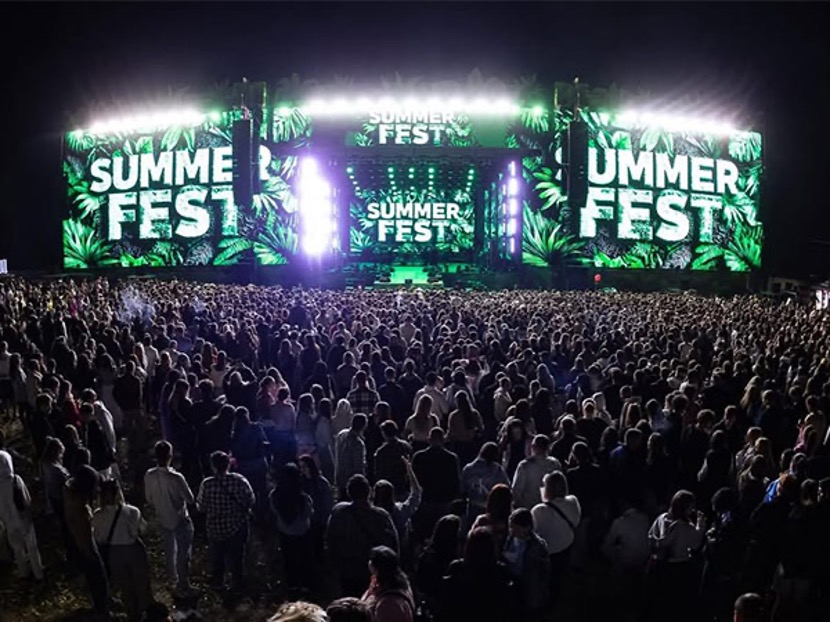
Configuration and scene: In a large arena or outdoor stadium, the central concert LED screen carries close-ups and main show visuals. Side screens extend the imagery toward wider seating sections. Their angle or curvature depends on the seating plan, stage width, and content design.
→ Recommend: YES TECH Mega Series
YES TECH Mega Series is an outdoor rental LED screen system designed for large stage walls and repeated assembly.
Why it fits:
◉ Supports creative transitions to side screens: Its 500 × 1,000 mm cabinets connect horizontally or vertically and form ±10° curves in 2.5° steps.
◉ Supports large outdoor builds: The central load-bearing design has a maximum hanging height of 25 m. Reinforced folding wind braces measure 114 mm folded and 410 mm extended.
◉ Simplifies repeated assembly and transport: Positioning pins, magnetic alignment, a central quick lock, and a lower automatic latch support cabinet handling. A shared hanging and stacking beam and 12-in-1 dolly support touring logistics.
Planning check:
Compare flat and curved side-screen layouts against side-seat sightlines, then confirm the supporting structure and outdoor wind procedure for each venue.
Top Pick 2: Fast-Deploy Hanging Screens for Multi-City Tours
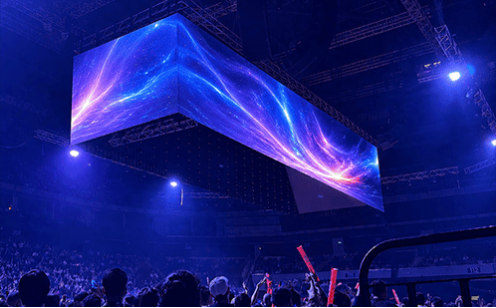
Configuration and scene: Screens hung above or behind the performance area add depth while leaving the main stage area open. This concert LED screen arrangement suits tours with frequent rigging changes and short changeovers.
→ Recommend: YES TECH MT II Series
YES TECH MT II Series is a transparent rental display with a magnesium-alloy frame and flexible connections for suspended stage designs.
Why it fits:
◉ Makes overhead builds easier to handle: Its hollow double-frame construction combines a lightweight cabinet design with a maximum hanging height of 20 m.
◉ Creates varied suspended shapes: Integrated locks support ±15° curves, 90° corners, and staggered cabinet layouts. The mesh configuration provides at least 50% transparency.
◉ Speeds recurring setup and teardown: Large handles and quick locks support one-person cabinet installation, while the same beam serves hanging and ground stacking. An optional shutter system enables one-button switching between transparent and solid visual modes.
Planning check:
Confirm the selected MT II cabinet size and weight, venue hanging points, and clearances. Include the optional shutter system if the show requires transparent-to-solid switching.
Top Pick 3: Modular 3D Backdrop With Floor-to-Wall Visuals
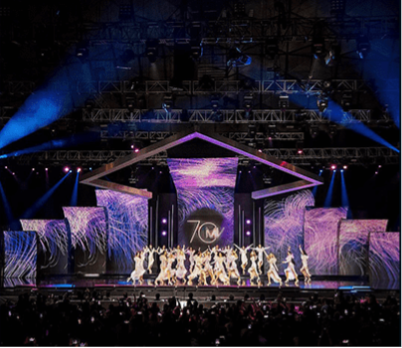
Configuration and scene: A curved, angled, or segmented backdrop gives a pop show or festival stage a dimensional setting. For floor-to-wall imagery, content mapping connects two surfaces: a dedicated LED floor beneath performers and a vertical backdrop behind them.
Recommend: YES TECH MU Series
YES TECH MU Series is a modular rental and staging display suited to large backdrops and varied wall shapes.
Why it fits:
◉ Adapts to changing backdrop shapes: Its 500 × 500 and 500 × 1,000 mm cabinets combine vertically. MU supports ±7.5° curved splicing, with ±15° available as an option.
◉ Adds defined corner transitions: Compatible Rubik Series cabinets enable 90° corners within the wall design.
◉ Connects wall and floor visuals: MU carries the backdrop imagery, while a separately supported MG Dance Floor fitted with its designated dance floor mask carries imagery beneath performers. MU offers IP50 indoor and IP65 outdoor-capable variants for different tour stops.
Planning check:
Specify the wall and floor installations separately, then test their visual alignment from audience and camera positions.
After choosing a stage layout, compare the cabinets against the tour’s viewing distances, rigging limits, transport plan, and indoor or outdoor stops. The table brings the three recommended series together on the specifications that affect those decisions: pixel pitch, cabinet size and weight, IP grade, refresh rate, and shape options.
|
Specification |
Mega Series |
MT II Series |
MU Series |
|
Pixel pitch |
3.91 / 4.63 / 5.68 mm |
H3.9–V7.8 mm |
1.9 / 2.6 / 2.9 / 3.9 mm |
|
Cabinet face size |
500 × 1,000 mm |
1,000 × 500; 500 × 500 mm |
500 × 500; 500 × 1,000 mm on listed variants |
|
Cabinet weight |
12.5 kg |
1,000 × 500: 7.9 kg mesh / 8.7 kg solid; 500 × 500: 5.8 kg |
7.6 or 12.6 kg by variant |
|
IP grade |
IP65 |
IP65 |
Indoor IP50; outdoor IP65 |
|
Refresh rate |
≥7,680 Hz |
7,680 Hz |
≥3,840 Hz |
|
Shape options |
±10° curves |
±15° curves; 90° corners; staggered panels |
±7.5° curves; optional ±15°; corners with Rubik |
Touring concert LED configurations can be compared by venue conditions, visual goals, and installation priorities. The table applies these criteria to common concert scenarios and lists a suitable LED screen for each.
|
Venue and project condition |
Main creative need |
Setup priority |
Suitable LED screen |
|
Large stadium; broad seating |
Main image for front and side sections |
Wide build, outdoor loads, wind plan |
Mega Series for main and side screens |
|
Multi-city tour; short changeovers |
Suspended layers or transparent effects |
Repeated hanging, handling, transport |
MT II Series for hanging screens |
|
Arena or festival; changing scenic forms |
Curved, segmented, or corner backdrop |
Cabinet combinations and stage width |
MU Series; add Rubik for corners |
|
Performers on a displayed floor |
Floor and backdrop imagery working together |
Floor loading and independent installation |
MU Series backdrop plus dedicated MG Dance Floor |
MU variant note: P1.9 and P2.6 are indoor IP50 versions. P2.9 and P3.9 have IP65 versions; P3.9 also has an indoor IP50 version.
Choose the concert LED screen layout by starting with the venue, then matching its sightlines and build constraints to the creative design: Mega serves large main screens and side wings; MT II supports repeatedly hung visual layers; MU forms modular backdrops and works alongside a dedicated LED floor.
Explore YES TECH’s Rental & Staging range to build a rental LED screen package around the tour’s venues and stage concept.
References
[1] ANSI. “ANSI E1.21-2024: Temporary Structures for Outdoor Events.” https://blog.ansi.org/ansi/ansi-e1-21-2024-temporary-structures-outdoor-events/
[2] Event Safety Alliance. “Importance of Standards.” https://eventsafetyalliance.org/importance-of-standards


+86-(0)731-84539619


Hunan Yestech Optoelectronic Co., Ltd. Terms of Service Privacy Policy Powered by szweb


