



ADDRESS
Blog/2026.09.14
For a large LED stage, putting a display 20 meters above the ground may sound like a simple question of height. In practice, it is not. Once a transparent LED display is lifted high above the audience, the challenge is no longer simply whether the screen can be suspended. The real question is whether the display, its cabinet structure, connection system, supporting structure, and installation process can work together reliably at that height.
This distinction matters particularly for transparent LED screens used in rental, staging, concerts, festivals, and large-scale outdoor events. A conventional solid LED wall and a blow-through LED display may serve a similar visual purpose, but they do not present exactly the same physical conditions to the supporting structure or the surrounding environment. A transparent LED display is intentionally designed with an open structure that allows air and visual sightlines to pass through. That openness creates valuable advantages for stage design, but it also means that the engineering of the LED cabinet cannot be treated as an afterthought.
A 20-meter hanging height, therefore, should not be viewed as an isolated product specification. It is better understood as an indication of how the display structure has been designed to perform within a complete rigging system. The higher the LED screen is installed, the more important it becomes to consider the relationship between structural strength, load distribution, cabinet connections, installation procedures, environmental conditions, and the supporting structure. In other words, 20 meters is not simply a height. It is a test of the entire system.
The First Challenge Is Not Getting the Screen Up. It Is Keeping the System Stable.
An LED cabinet is only one part of a suspended display system. In a high-level LED screen installation, the load has to be transferred through a series of connected elements. The LED cabinet connects to the hanging structure; the hanging structure transfers the load to the rigging points; and the rigging system ultimately connects to the venue or stage structure designed to support it. That means the structural question is not simply, “How much does one LED panel weigh?” A more useful question is, “How is the load carried through the complete system?”
This becomes increasingly important as transparent LED displays are scaled up. A large LED video wall may consist of hundreds or thousands of individual cabinets, but once those cabinets are assembled into a large suspended screen, they need to function as a coordinated structure rather than as independent units. Cabinet geometry, frame design, connection points, load-bearing paths, and the supporting beam all become part of the same engineering consideration.
For this reason, a lightweight LED screen should not automatically be equated with a structurally simpler screen. Reducing cabinet weight can make handling and transportation easier, but the cabinet still needs sufficient structural integrity for the intended configuration. In a high-level rigging application, the objective is not simply to make the LED display lighter. It is to achieve an appropriate balance between weight, structural strength, connection reliability, and operational requirements. This is one of the fundamental engineering challenges behind a high-rise transparent LED display.
Why Transparent LED Requires a Different Structural Approach
The defining characteristic of a transparent LED screen is its open visual structure. Unlike a conventional solid LED display, a transparent LED display allows part of the environment behind the screen to remain visible. Depending on the design, this can also allow air to pass through the display structure. This is why terms such as transparent LED display, transparent LED screen, blow-through LED display, and see-through LED screen are often used when discussing applications where airflow and visual openness matter.
But transparency is not created simply by removing material from a conventional LED cabinet. The structural design has to account for the fact that the cabinet needs to remain sufficiently rigid while maintaining an open configuration. If too much structural material is added simply to increase rigidity, the cabinet can become heavier and less visually open. If the structure is made excessively open without sufficient reinforcement, the mechanical requirements of a large suspended LED display can become more difficult to address. The engineering challenge is therefore one of balance.
A well-designed transparent LED cabinet needs to provide a defined structural path for the loads while preserving the open architecture that gives transparent LED its visual and environmental advantages. This is particularly relevant to rental LED displays, because rental screens are repeatedly transported, assembled, dismantled, stacked, and reconfigured. Structural performance has to exist alongside practical handling. For a high-level installation, these requirements become even more closely connected. The screen needs to be structurally appropriate for the intended rigging configuration, while the cabinet connections need to allow installers to build the display accurately and efficiently.
The Connection Between Cabinets Becomes Critical at Height
When an LED display is installed close to the ground, installers have relatively easy physical access to the cabinets. They can work around the screen, adjust connections, check alignment, and make corrections without dealing with the same access constraints associated with a high-level installation. At 20 meters, the situation changes. Installation becomes a sequence that has to be planned and controlled. Each cabinet connection matters because a large suspended transparent LED video wall is assembled as a connected structure. The efficiency and precision of the connection system can therefore influence the overall installation process. This is where practical details that may appear small at first—such as cabinet handles, quick locks, connection mechanisms, and handling procedures—become relevant to a large-scale LED rigging application.
A quick-lock system is not merely a convenience feature. In a rental staging environment, faster and more controlled cabinet connection can reduce the amount of manual handling required during assembly and dismantling. Large handles can also make individual cabinets easier to position and manipulate. These details do not replace structural engineering, but they can contribute to a more efficient installation workflow. The distinction is important: installation efficiency and structural safety are related, but they are not the same thing. A quick connection system can make a cabinet easier to install; it does not by itself determine whether a particular rigging structure is suitable for a particular project. The supporting structure, rigging equipment, configuration, and site conditions still need to be evaluated as part of the complete installation.
Twenty Meters Also Changes the Importance of Wind
For outdoor LED staging, height introduces another variable: environmental exposure. A large LED display installed outdoors can be exposed to changing wind conditions, rain, temperature changes, and other site-specific factors. The effect of wind on a display cannot be evaluated simply by looking at the height of the screen. The physical configuration of the display, the surrounding structure, the local environment, and the characteristics of the screen all influence the actual engineering conditions.
This is one area where transparent LED technology can offer a meaningful difference from a conventional solid LED wall. A blow-through LED display has an open structure that allows air to pass through the display. YES TECH states that MT II has around 50% transparency, and its current product positioning specifically combines this open structure with a magnesium-alloy hollow dual-frame designed for high transparency and structural load capacity. In the Kharkhorum Festival application, YES TECH also described the 50% transparent, blow-through configuration as helping reduce the wind-blocking effect compared with a conventional solid screen. However, transparency should never be interpreted as meaning that wind is no longer an engineering consideration.
A transparent LED screen is still a large physical installation. Wind conditions still need to be considered together with the display configuration, supporting structure, rigging system, installation environment, and project-specific engineering requirements. The advantage of a blow-through LED display is not that it eliminates wind-related considerations. Rather, its open structure can change how air interacts with the display compared with a solid LED wall. That distinction is essential when discussing outdoor transparent LED displays professionally.
The Supporting Structure Matters as Much as the LED Screen
One common mistake when discussing high-level LED screens is to focus almost entirely on the LED product itself. In reality, a 20-meter hanging application cannot be evaluated from the cabinet specification alone. The LED display is part of a larger system. The supporting beam, rigging points, lifting equipment, venue structure, cabinet configuration, total screen dimensions, and environmental conditions all contribute to the actual installation. For example, two screens using the same transparent LED cabinet may have very different engineering requirements if one is installed as a relatively small indoor display while the other forms a large outdoor video wall suspended high above a festival stage.
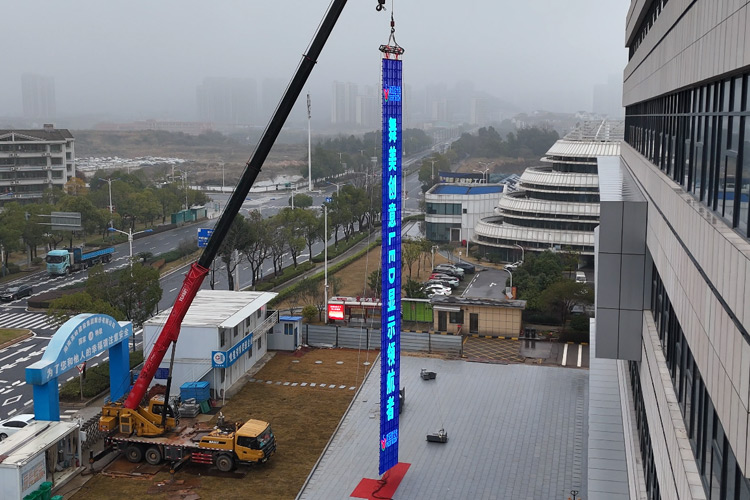
This is why a manufacturer's stated hanging capability should be read as a product capability within its intended engineering context—not as a universal statement that every possible configuration can be suspended to the same height without further evaluation. For professional LED rental and staging projects, the correct question is therefore not simply whether a 20m LED screen exists. The question is whether the complete LED rigging system is appropriately designed for the intended screen configuration, venue, environment, and installation method. That is the difference between a product specification and an engineered application.
Installation at 20 Meters Is Also an Operational Challenge
The engineering of a high-level transparent LED display does not end once the structural calculations are complete. The installation process itself can affect project efficiency. Large-scale rental productions operate under strict schedules. A concert, festival, corporate event, or outdoor performance may have only a limited installation window before technical testing, lighting programming, content calibration, rehearsals, and the final event. This makes the physical handling of the LED cabinets important.
A cabinet that is difficult to handle can increase installation time and create unnecessary manual operations. A cabinet designed for practical handling can make the assembly process more straightforward. For a transparent LED rental screen, this becomes particularly relevant when the display is configured into large suspended structures or complex stage shapes. MT II addresses this aspect with a quick-lock system and large cabinet handles designed to support one-person operation. Its current product specifications also include 1000 × 500 × 83 mm and 500 × 500 × 83 mm cabinet sizes, giving rental teams different cabinet formats for configuring transparent LED video walls.
Again, these features should not be confused with the structural requirements of the rigging system. Their role is operational: they are intended to make the LED screen easier and faster to assemble and dismantle, which becomes increasingly valuable when working within a demanding event schedule. The relationship between structure and installation is therefore straightforward: the structural system needs to support the display, while the cabinet design needs to allow the production team to build that system efficiently.
Why Cabinet Architecture Matters More Than a Single Weight Figure
Weight is an important parameter in LED rental, but it is rarely sufficient on its own to describe a cabinet. A cabinet can be lightweight because it uses less material, but that does not automatically tell you how its structure handles mechanical loads. Conversely, adding material may increase structural strength but also increase weight and affect transportation and handling. The more useful question is how the cabinet architecture distributes these competing requirements. MT II uses a magnesium-alloy hollow dual-frame structure. YES TECH describes this structure as combining high transparency with load-bearing capacity, while the product's published specifications position it for indoor and outdoor applications and standard hanging installations up to 20 meters.
This approach is particularly relevant to transparent LED panels, because the frame has to perform its structural role without turning the display into a conventional solid structure. The cabinet architecture therefore becomes part of the transparency strategy as well as part of the mechanical design. This is an important distinction between simply reducing the amount of material in an LED cabinet and deliberately engineering an open structural system.
A High-Level Transparent LED Screen Still Has to Perform as a Display
Structural engineering is only one side of the equation. At the end of the day, an LED screen is still a display system. It needs to deliver the visual performance required by the production. A transparent LED display used on a concert stage, festival stage, live event, or large outdoor production may need to function as a large-format visual surface while preserving visibility of the stage environment behind it. This means transparency has to work together with image quality rather than being considered separately.
MT II is based on an H3.9–V7.8 pixel-pitch platform and provides approximately 50% transparency. YES TECH also lists indoor and outdoor operation, while the product supports transparent and solid modes through an optional shutter system. The same platform can also be configured for curved LED displays with ±15° adjustment, 90° corner applications, and staggered cabinet splicing. These capabilities are relevant because a transparent LED screen is rarely used only as a flat rectangular wall. In modern stage production, the display may become part of a larger spatial composition. Curves, corners, staggered configurations, and different screen orientations can change how the audience perceives the stage. At that point, the value of transparent LED is not simply that it is “see-through.” It is that the display can occupy a visual position without completely separating the audience from the physical environment behind it.
20 Meters Is a System Requirement, Not a Marketing Number
This is perhaps the most important point. When a transparent LED display is advertised with a hanging height of 20 meters, the number itself is easy to communicate. The engineering behind that number is much more difficult. A high-level LED rigging application requires the interaction of multiple elements: cabinet structure, load-bearing paths, cabinet connections, hanging beams, rigging equipment, supporting structures, installation procedures, environmental conditions, and the actual screen configuration.
The screen's transparency can influence airflow characteristics. Its weight can influence handling and supporting requirements. Its frame architecture can influence structural performance. Its connection system can influence installation efficiency. Its configuration can influence the loads and forces acting on the overall structure. None of these factors should be considered independently.
This is also why “20 meters” should not be treated as a universal installation instruction. A manufacturer's rated or stated hanging height does not replace project-specific structural assessment, rigging design, venue requirements, or qualified installation practice. The appropriate installation method depends on the complete system and the conditions of the project. For professional LED screen rental, LED stage rental, and transparent LED display applications, that system-level approach is what separates a meaningful specification from a simple marketing number.
MT II: Engineering Transparency for High-Level LED Applications
This is where the design philosophy behind MT II becomes relevant. YES TECH developed MT II as an upgraded transparent LED platform for rental, staging, and live-event applications. The series uses a magnesium-alloy hollow dual-frame structure designed to combine high transparency with structural load capacity. It supports H3.9–V7.8 pixel pitches and comes in 1000 × 500 × 83 mm and 500 × 500 × 83 mm cabinet sizes. YES TECH specifies a standard hanging capability of up to 20 meters for the platform.
The significance of MT II is not simply the 20-meter figure itself. It is the combination of the structural architecture and the requirements of a transparent LED rental system. With around 50% transparency, MT II is designed as a blow-through LED display, allowing air to pass through its open structure while maintaining the visual function of an LED video wall. Its quick-lock system and large handles are intended to support faster handling and one-person operation, while its cabinet architecture supports curved, corner, and staggered configurations.
The practical relevance of these characteristics can be seen in large outdoor production. At the 2026 Kharkhorum Art & Visual Festival in Mongolia, YES TECH supplied nearly 2,000 m² of MT II across 13 transparent LED video walls. The configuration included an 11-meter-high curved central screen, two irregularly shaped main side screens, and additional side and rear screens. Installation was completed between August 14 and August 18, ahead of the August 22–23 event.
The project demonstrates an important point about transparent LED technology: large-scale deployment is not simply a matter of putting more LED cabinets together. At this scale, the display becomes part of a temporary engineered stage structure that has to address installation efficiency, environmental conditions, structural requirements, power, configuration, and operation as a complete system. YES TECH's project documentation specifically notes the outdoor site's changing wind and rain conditions and describes MT II's blow-through structure and approximately 50% transparency as helping reduce the wind-blocking effect of a conventional solid LED screen. That is the more useful way to understand a 20-meter transparent LED screen. It is not simply an LED cabinet that happens to be capable of being lifted higher. It is a display platform designed around the interaction between transparency, structural architecture, rigging, installation, and real-world stage production.
20 Meters Is Not the End of the Engineering Question
A high-level transparent LED display raises a deceptively simple question: how high can it go? But for professional LED staging, that is not the question that matters most. The more meaningful questions are: How is the load transferred? How is the display connected? How does the open structure interact with the surrounding environment? How will the cabinets be installed and dismantled? How does the supporting structure accommodate the complete system? What happens when the screen becomes hundreds or thousands of square meters? And how do all these elements continue to work together when the display is suspended high above the audience? Those are the questions that define a serious transparent LED screen, transparent LED display, blow-through LED display, or see-through LED video wall.
At 20 meters, the screen is no longer just a visual surface. It becomes part of the architecture of the stage. And that is why the real challenge of 20-meter LED rigging is not simply reaching the height. It is designing a system in which structural strength, transparency, installation efficiency, environmental performance, and visual requirements can work together at that height. For MT II, this principle is reflected in the combination of a magnesium-alloy hollow dual-frame, approximately 50% transparency, up to 20-meter standard hanging capability, practical quick-lock handling, and flexible configurations for transparent LED stage applications. The number “20 meters” may be what catches the eye. But the engineering behind it is what makes the number meaningful.


+86-(0)731-84539619


Hunan Yestech Optoelectronic Co., Ltd. Terms of Service Privacy Policy Powered by szweb


