



ADDRESS
Blog/2026.10.19
Large-scale hanging LED screens must do more than display bright, sharp images. They have to remain stable above the stage, stay visible in changing light, fit the venue's rigging plan, and move through installation and teardown without slowing the production team.
The best choice is therefore not simply the screen with the highest brightness or the finest pixel pitch. It is a rental and staging system whose structure, cabinet format, image performance, geometry, control system, and workflow fit the complete project brief.
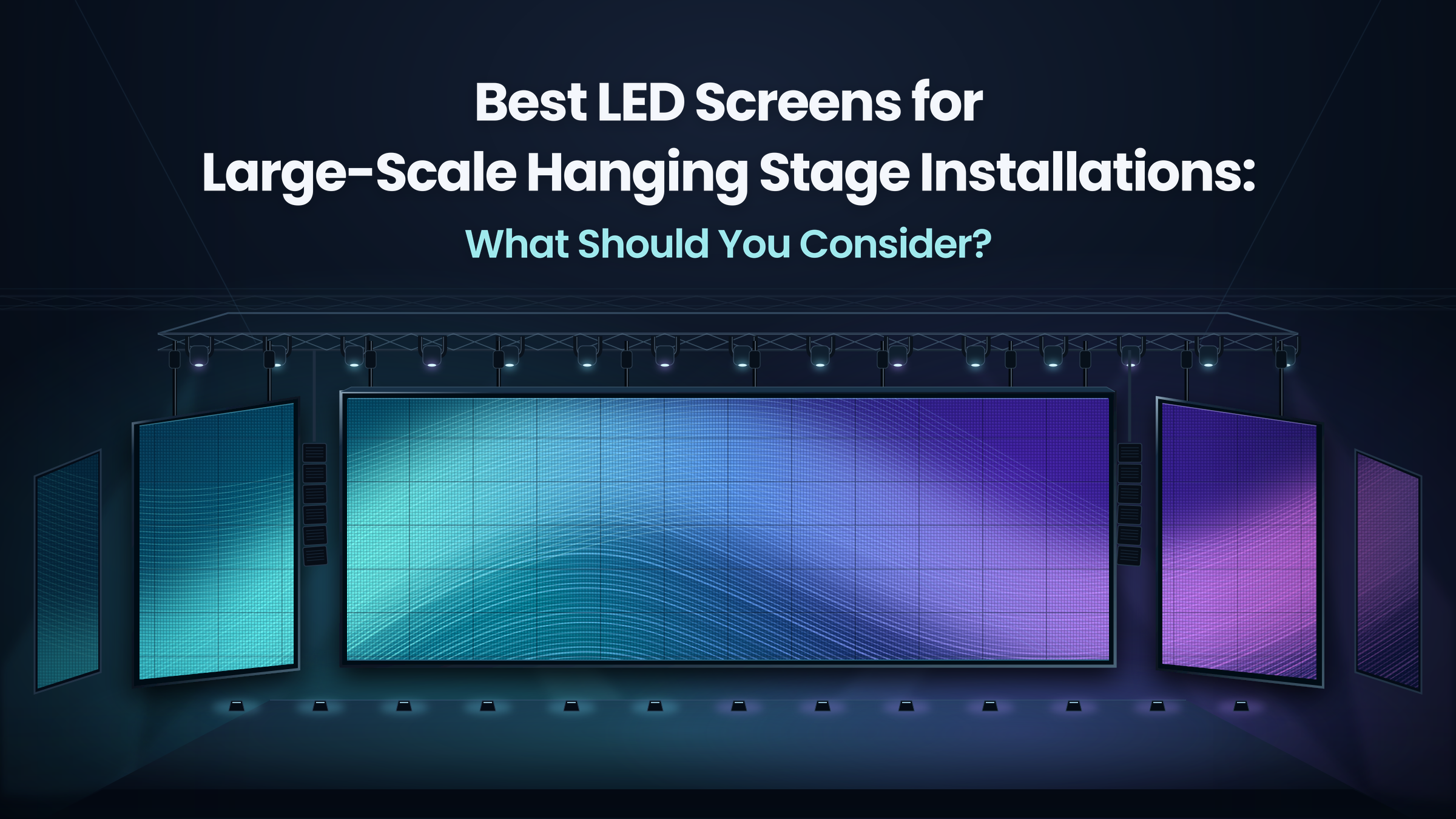
The best LED screen for a large-scale hanging stage is a purpose-built rental and staging platform selected against the complete rigging and show plan. It should combine structural protection and hanging stability with manageable cabinet weight, outdoor protection, strong image performance, fast installation, creative flexibility, service access, control compatibility, and the certifications required by the project.
l Structural Protection and Hanging Stability
The screen must work with the planned load path, hanging height, span, and venue rules. A suitable system should provide a defined hanging method and a stable way to manage the screen's center of gravity, while the final assembly remains subject to project-specific engineering and venue approval.
l Cabinet Weight and Handling
A large canvas can become a difficult touring asset if each cabinet is awkward to lift, align, service, transport, or store. Cabinet dimensions, weight, connection hardware, transport equipment, and maintenance access should be evaluated as one workflow rather than as separate purchasing details.
l Outdoor Protection and Image Performance
Outdoor stages bring wind, daylight, long viewing distances, and changing sightlines. Pixel pitch should be matched to the audience and content, while brightness, contrast, grayscale, refresh rate, viewing angles, and ingress protection should be checked together.
l Fast Installation, Shape Flexibility, and System Readiness
Touring productions benefit from fast locks, clear alignment features, flexible flat or curved configurations, practical transport, and a control system that fits the existing production environment. These details often influence schedule reliability as much as the display image itself.
A ground-stacked wall and a suspended stage screen may use similar display technology, but they create different operational demands. Once a screen is lifted above performers and audiences, the project has to account for structural loading, wind exposure, access at height, and the consequences of repositioning or servicing equipment during a live schedule.
l Confirm the Load Path and Venue Requirements
The selection process should start with the structure that will carry the screen. Hanging height, total span, allowable load, rigging points, wind conditions, and local venue requirements determine whether a cabinet system can be used safely and efficiently.
l Plan for Wind and Changing Light
Outdoor screens must remain usable as daylight changes and weather conditions develop. Structural protection and wind-resistance features matter alongside brightness and contrast, because visual performance is only useful when the screen can remain stable in its operating environment.
l Protect Audience Sightlines
A high-hung screen may be visible from a wide audience area, but its position and viewing angles still need to match the stage layout. The screen should support legible content without blocking scenic elements or forcing the audience into a narrow viewing zone.
l Reduce Touring Workflow Friction
Installation, testing, maintenance, transport, storage, and dismantling all affect the time available for rehearsals and changeovers. A system that connects quickly and moves efficiently can reduce avoidable pressure between venues and support more consistent production planning.
A useful comparison should connect each specification to a real stage requirement. The following criteria help buyers separate a screen that looks strong on paper from one that can support a demanding hanging installation in practice.
l Structure and Stability
Look for a defined hanging and stacking system, a load-bearing strategy, wind-resistance features, and a practical method for balancing the assembled screen. These features do not replace venue engineering, but they show whether the product has been designed for suspended and touring use.
l Cabinet Size and Weight
Cabinet format affects both the size of the visual canvas and the number of handling steps required on site. Buyers should compare the cabinet's physical dimensions and weight with the available crew, access route, storage plan, transport equipment, and maintenance process.
l Image Performance
Pixel pitch should follow the intended viewing distance and content requirements rather than being selected in isolation. Brightness, contrast, grayscale, refresh rate, and viewing angles then determine how well the display performs under daylight, stage lighting, and camera-facing production conditions.
l Geometry and Creative Flexibility
A stage brief may call for a flat wall, a wide panoramic canvas, a vertical element, or a curved surface. Confirm how the cabinet supports horizontal and vertical splicing, arc adjustment, and repeatable alignment before assuming that a standard rectangular layout will be enough.
l Environment, Control, and Compliance
Operating environment, ingress protection, controller compatibility, certifications, and power planning all affect project readiness. A good shortlist makes these checks early, so the production team can identify integration or approval issues before the equipment reaches the venue.
Once the evaluation criteria are clear, the selection process can follow the order in which the project will actually operate. This keeps the decision grounded in the venue and production plan instead of allowing one attractive specification to dominate the shortlist.
l Start with Venue Geometry and the Hanging Plan
Record the intended hanging height, span, load allowance, wind exposure, audience position, rigging points, and production schedule. This information defines the conditions that the screen and its support equipment must meet.
l Match the Cabinet Format and Pixel Pitch
Choose a cabinet arrangement that creates the required canvas while remaining practical for the crew. Use the expected viewing distance, content detail, and camera requirements to compare pixel-pitch options, then confirm that the control workflow can support the planned configuration.
l Plan Installation, Service, and Approval Together
Before ordering, map the installation sequence, alignment method, cabling, maintenance access, transport, storage, accessories, controller, certifications, and final venue approval. The most suitable screen is the one that remains workable across the full project lifecycle.
The YES TECH Mega Series is a stable, fast-deploy LED platform designed for outdoor touring applications. Its feature set aligns with the main requirements of large hanging stages: structural protection, outdoor image performance, creative geometry, fast installation, transport support, and control-system compatibility.
l Stage and Touring Fit
YES TECH Mega Series is positioned for large-scale concerts, music festivals, stage performances, commercial exhibitions, press conferences, and other high-end outdoor rental projects. That application range makes it relevant to productions where the screen must be deployed, moved, and reused across demanding event environments.
l Hanging Structure and Wind Protection
A central load-bearing design supports maximum hanging heights of 25 m, while a reinforced wind-bracing system is designed to resist wind pressure. One beam supports both hanging and stacking, and an adjustable center of gravity is intended to improve screen stability and safety during setup.
l Cabinet Options for Scale and Handling
The cabinet measures 500 × 1000 × 86 mm and weighs 12.5 kg per cabinet. Pixel-pitch options are 3.91 mm, 4.63 mm, and 5.68 mm. The system supports indoor and outdoor operation and carries an IP65 rating, giving planners a defined starting point for both canvas design and environmental review.
l High-Brightness Visual Performance
For demanding outdoor lighting, Mega Series combines more than 5000 nits of high brightness using black LED with a 5000:1 contrast ratio, a refresh rate of at least 7680 Hz, and 16-bit grayscale. The published horizontal and vertical viewing angles are 160° and 120°, respectively.
l Creative Shapes
The cabinet supports horizontal and vertical splicing and an adjustable arc design of ±10°, with 2.5° per step. This gives stage designers a way to move beyond a flat wall while keeping the screen system within a repeatable cabinet-based workflow.
l Fast Installation and Touring Logistics
Top positioning pins with magnetic design assist alignment, a patented middle fast-lock system supports single-person operation, and bottom automatic latch locks allow easy release. A 12-in-1 dolly system supports direct stacking, transport, and storage, while the listed accessories include a dolly, hanging beam, and base beam.
l Control, Certification, and Planning Details
YES TECH Mega Series supports Nova or Brompton control systems and is specified with CE, FCC, ETL, and CB certifications. Its published specifications also include a 250 × 500 mm module, cabinet resolutions of 128 × 256, 108 × 216, or 88 × 176 depending on pixel pitch, and power consumption of 800 ± 15% / 267 ± 15% W/m².
l What makes an LED Screen Suitable for a Large-Scale Hanging Stage Installation?
The screen should combine a defined hanging and stability system with manageable cabinet weight, outdoor protection, strong image performance, fast installation, creative flexibility, practical transport, compatible control, and the certifications required by the venue and project.
l Which Mega Series Pixel Pitch Should a Project Choose?
YES TECH Mega Series offers 3.91 mm, 4.63 mm, and 5.68 mm options. The choice should follow the viewing distance, content detail, screen scale, and production requirements.
l Can the YES TECH Mega Series be Used Outdoors?
Yes. Mega Series supports indoor and outdoor operation, carries an IP65 rating, and is specified with more than 5000 nits of high brightness. The final weather, wind, power, and rigging plan remains specific to the venue and production.
l How High Can the YES TECH Mega Series be Hung?
The central load-bearing design supports maximum hanging heights of 25 m. That figure should be treated as a product specification, not as a substitute for the venue's structural review, rigging design, and operating limits.
l Can the Mega Series Create Curved LED Walls?
Yes. Horizontal and vertical splicing can be combined with an adjustable arc design of ±10°, using 2.5° per step. This supports curved LED wall concepts while retaining a modular cabinet structure.
l What are the cabinet size, weight, and control options?
Each cabinet measures 500 × 1000 × 86 mm and weighs 12.5 kg. The control-system options listed for Mega Series are Nova and Brompton.
Choosing an LED screen for a large-scale hanging stage starts with the complete brief: hanging structure, viewing conditions, weather exposure, deployment workflow, creative geometry, control, and approval. Brightness or pixel pitch alone cannot answer that decision.
The YES TECH Mega Series is a candidate for large touring and outdoor stage installations because it brings together a central load-bearing design, reinforced wind bracing, high-brightness image performance, fast deployment, curved-screen flexibility, hanging and stacking support, and transport accessories.1 For project-specific confirmation, please contact YES TECH!


+86-(0)731-84539619


Hunan Yestech Optoelectronic Co., Ltd. Terms of Service Privacy Policy Powered by szweb


