



ADDRESS
Blog/2026.09.17
Transparent LED displays have become an important option for live event production because they allow digital content to exist alongside the physical stage environment. Unlike a conventional LED wall, which creates a comparatively solid visual surface, a transparent LED display can preserve visibility through the screen and create a closer relationship between LED content, lighting, scenic structures, performers, and the surrounding environment.
For rental companies and production teams, however, choosing a transparent LED display is not simply a question of how transparent the cabinet looks. A professional rental LED display must also meet requirements for brightness, refresh rate, structural strength, installation, transportation, environmental protection, maintenance, and repeated deployment. This makes transparent LED selection different from choosing an LED display for a permanent indoor installation. The screen has to work as part of a temporary production system. It may be transported between venues, installed at different heights, configured into different shapes, exposed to outdoor conditions, and dismantled again after the event. The practical question is therefore not “How transparent is the LED screen?” It is “How will transparency contribute to the stage design, and what engineering characteristics are required to make that concept work in a real rental production?”
What Does Transparent LED Actually Add to a Stage?
The main value of transparent LED is not simply that the audience can see through it. Its value comes from changing the relationship between the digital display and the physical space behind it. A conventional LED wall can create a strong and visually controlled background. This is useful when the production needs a continuous image surface. Transparent LED introduces another layer. Lighting fixtures, scenic structures, performers, architectural elements, or the surrounding environment can remain visually connected to the audience even when LED content is playing.
This can be particularly useful for concerts and festivals where the stage is designed as a three-dimensional environment rather than a single flat backdrop. Instead of treating the LED screen as a wall placed in front of the stage, designers can use transparent LED as one layer within the overall stage architecture. The effect is especially relevant when the stage concept depends on depth. A transparent LED backdrop can display video content while allowing physical structures behind the screen to remain visible. A transparent ceiling or elevated LED structure can also provide digital content without creating the same visual enclosure as a fully solid screen.
This does not mean transparent LED is automatically better than conventional LED. The two technologies perform different visual functions. If a production needs maximum image coverage and a continuous digital surface, a conventional LED display may be more appropriate. Transparent LED becomes relevant when the relationship between the screen and its surrounding environment is part of the design objective. YES TECH's own recent technical guidance makes this distinction: conventional LED is generally used when full visual coverage is the priority, while transparent LED is suited to productions where the display needs to interact with the space around it.
What Should a Rental Company Check Before Choosing Transparent LED?
For a rental application, transparency should be considered together with mechanical and operational requirements. The first factor is the transparency level itself. A higher transparency rate can allow more of the background environment to remain visible, but transparency should not be considered in isolation. The visual result also depends on the content being displayed, ambient lighting, the structure behind the screen, viewing distance, and the physical design of the stage.
The second factor is brightness. Outdoor stages require considerably more light output than many indoor environments because ambient illumination can reduce perceived image contrast. A transparent LED display therefore needs sufficient brightness for its intended application. At the same time, the brightness specification should be evaluated together with the pixel pitch, content, viewing distance, and actual lighting conditions of the production.
The third factor is refresh rate and camera performance. Live events are frequently recorded or broadcast using professional cameras. A sufficiently high refresh rate can help reduce visible scan artifacts in camera footage, although camera shutter settings and the complete video system also influence the result. This is why rental LED selection should consider the complete production workflow rather than one specification in isolation.
The fourth factor is structural design. A transparent LED cabinet has to maintain its physical geometry while being transported, assembled, suspended, and operated. Large rental installations can place substantial mechanical demands on the cabinet and supporting structure. A visually transparent cabinet that cannot meet the mechanical requirements of the production is not a practical rental solution. The fifth factor is installation method. Production teams should determine whether the display will be hung, stacked, integrated into a scenic structure, curved, or configured into corners. The cabinet and connection system need to support the planned installation method.
The sixth factor is outdoor protection. For outdoor events, ingress protection and the complete installation structure need to be considered. An IP rating describes protection against specific environmental ingress conditions; it does not replace proper structural engineering, weather planning, or safe rigging.
When Should a Production Use a Large Transparent LED System?
Large outdoor touring productions create a specific set of requirements. The display may cover a substantial area while being transported between venues. Setup windows can be limited, and the screen may need to be suspended above the stage. The production may also require curved or corner configurations to follow the geometry of the stage.
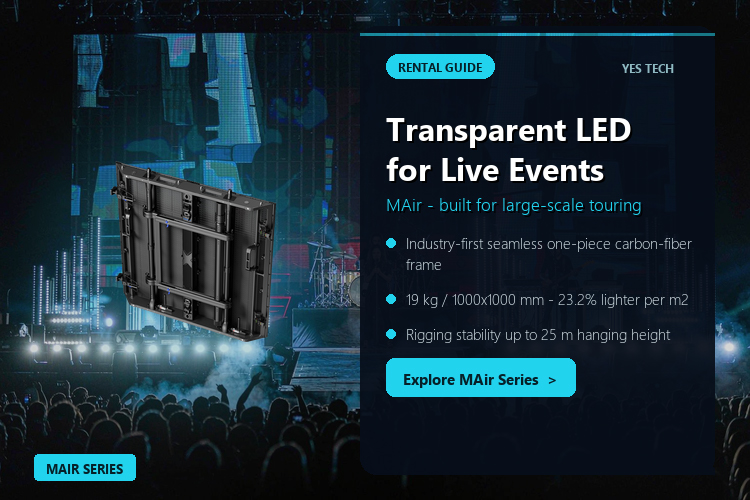
In this environment, cabinet size, weight, structural design, transparency, weather protection, and installation speed all become important at the same time. YES TECH MAir is designed specifically for large-scale touring applications. Its current specification uses a 1000 × 1000 × 102 mm cabinet with a 19 kg cabinet weight and a 6 kg air frame. The system is designed for outdoor use with IP65 protection, supports P5.9 and P7.8 configurations, and provides a transparency level of up to 50% on the P7.8 configuration according to the current product page. The cabinet uses a seamless integrated carbon-fiber frame with central metal support rods and supports ±15° concave and convex curves, 90° corners, and half-box offset configurations.
These characteristics address a specific rental requirement: using a transparent LED display on a large stage without treating the display as a fixed architectural installation. For touring productions, installation efficiency is also significant. MAir uses large positioning pins and magnetic elements at the top, a patented curved blade lock in the middle, and an automatic latch lock at the bottom. The system is designed for single-person operation, while its 6-in-1 dolly system supports transportation and storage. The purpose of these features is practical. A touring LED display has to move efficiently through repeated production cycles. Reducing unnecessary handling and simplifying connection can affect the amount of time and labor required at every venue.
When Does a More Flexible Transparent LED Configuration Make Sense?
Not every transparent LED application requires the same cabinet format or structural approach. Some productions need the display to work in several visual modes. For example, a stage may require transparency during one part of the event and a more solid LED surface during another. Other installations may require smaller cabinet dimensions, curved sections, 90-degree corners, or a combination of hanging and stacking. This is where a flexible transparent LED rental platform can be useful.
YES TECH MT II is designed around this type of application. The system is available in 1000 × 500 × 83 mm and 500 × 500 × 83 mm cabinet sizes, uses a hollow double-frame magnesium-alloy structure, and offers an optional shutter system that switches between transparent and solid modes. The current specification lists ≥50% transparency, 7680 Hz refresh rate, IP65 protection, and brightness of 4000–4500 nits for the listed configurations.
The installation system supports hanging and stacking with the same beam, while the quick-lock structure supports curved configurations of ±15°, 90-degree corner configurations, and staggered cabinet splicing. The product page also states a 20 m hanging height capability. The significance of this design is not that one cabinet should be used for every possible event. Rather, it gives production teams more control over how the transparent LED display functions within a particular stage. For a creative stage design, transparency may be the main visual effect. For another part of the production, a denser visual surface may be required. A system that supports both transparent and solid modes can accommodate these different visual requirements without requiring two completely separate screen systems.
Transparent LED for Outdoor Events Requires More Than Transparency
Outdoor use changes the technical requirements considerably. Wind, rain, temperature, ambient light, structural loading, and installation height all become part of the LED display planning process. A transparent structure can allow more air to pass through than a solid wall, but this should not be interpreted as eliminating wind-loading considerations. The actual wind behavior of the complete screen, supporting structure, rigging system, and venue must still be evaluated by qualified professionals.
For this reason, an outdoor transparent LED display should be assessed according to its complete mechanical design rather than its transparency percentage alone. MT II, for example, uses a hollow double-frame architecture intended to combine transparency with structural capability. YES TECH specifies IP65 protection and a 20 m hanging height for the system. MAir takes a different engineering approach for large-scale outdoor touring, using an integrated carbon-fiber frame and central metal support rods. The current product information specifies IP65 protection, wind resistance up to 20 m/s, and a maximum hanging height of 25 m.
These specifications should always be evaluated against the actual site conditions and structural requirements of the event. Product specifications define the capabilities of the LED display system; they do not replace project-specific engineering or safe rigging practices.
Installation and Transportation Matter as Much as Image Quality
A transparent LED display may look visually light, but rental companies still have to move and install physical equipment. This is why cabinet weight, dimensions, locks, handles, connection systems, and transportation accessories are important when selecting a rental LED display. Frequent touring creates repeated labor requirements, so even small improvements in installation efficiency can become significant over many events.
MAir's 1000 × 1000 mm cabinet format is designed for large-scale deployment, while its 6-in-1 dolly system is intended to improve transportation and storage efficiency. MT II takes a different approach with 1000 × 500 mm and 500 × 500 mm cabinet formats and one-person operation. The product page states that its quick-lock system is designed to make installation and disassembly faster and more comfortable. For a rental company, these characteristics should be evaluated over the entire equipment lifecycle. A screen that is easy to install but difficult to transport, or easy to transport but difficult to maintain, may still create operational challenges.
How to Match Transparent LED to the Event
The right transparent LED display depends on the role the screen needs to play. For a large outdoor touring stage where transparency, large-format deployment, lightweight construction, and repeated transportation are major considerations, a system such as MAir is designed around that requirement. Its large cabinet format, carbon-fiber frame, outdoor protection, curved configurations, and touring-oriented installation system provide a technical foundation for large-scale transparent LED deployment.
For a stage requiring more configuration flexibility, including transparent and solid modes, smaller cabinet options, curved installations, 90-degree corners, hanging and stacking, MT II addresses a different set of rental requirements. This distinction is useful because transparent LED should not be selected simply because it is a newer or more visually distinctive technology. The display needs to solve a specific production requirement. A useful selection process starts with five questions: Does the stage need visual transparency? Will the display be used indoors or outdoors? How will it be installed? How frequently will it be transported and reused? Does the stage require a fixed flat surface, curved configuration, corner, ceiling, or another structure? Once these questions are answered, the technical requirements become much clearer.
Choosing a Transparent LED Rental Solution
Transparent LED has expanded the role of LED displays in live event production. It allows digital content to coexist with physical scenery, lighting, architecture, and performers, creating opportunities that are difficult to achieve with a completely solid LED wall. But the technology should be selected based on production requirements rather than visual appeal alone. Transparency, brightness, refresh rate, cabinet structure, weight, installation, weather protection, rigging requirements, maintenance, and transportation all influence whether a transparent LED display is appropriate for a rental project.
For large-scale outdoor touring, MAir provides a transparent LED platform designed around lightweight construction, large-format deployment, structural strength, outdoor protection, and repeated installation. For productions that require more flexible configurations and the ability to switch between transparent and solid visual modes, MT II provides another approach to rental stage design. For rental companies and production teams, the objective is not simply to find the most transparent LED screen. It is to select a transparent LED display whose optical performance, mechanical design, installation method, and operating environment match the actual production. That is what turns transparent LED from a visual feature into a practical rental solution.


+86-(0)731-84539619


Hunan Yestech Optoelectronic Co., Ltd. Terms of Service Privacy Policy Powered by szweb


