



ADDRESS
Blog/2026.09.17
Choosing a rental LED display is not simply a matter of selecting a pixel pitch or comparing cabinet specifications. For a stage production, an LED display is part of a larger production system that has to be transported, installed, operated, dismantled, and reused, sometimes across multiple venues within a short period. The right rental LED display therefore needs to match not only the visual requirements of the show, but also its stage structure, installation method, operating environment, transportation plan, and production schedule.
This is particularly important for concerts, festivals, touring productions, sports events, award ceremonies, corporate events, and other temporary installations. A display that performs well as a fixed video wall may not necessarily be the right choice for rental and staging. Rental LED displays need to be designed around repeated deployment, mechanical handling, installation efficiency, maintenance access, and different stage configurations. For rental companies and production teams, the more useful question is not simply “Which LED screen is the best?” It is “What does the LED display need to do in this production?” Once that question is answered, the appropriate LED display solution becomes much easier to determine.
Start With the Stage Requirement, Not the LED Screen
The first step in choosing a rental LED display is to define the role of the screen within the stage. A conventional LED wall normally creates a continuous visual surface. This is useful when the production requires a strong video backdrop, high image coverage, clear branding, live camera feeds, or large-format content. A transparent LED display serves a different purpose. Instead of completely separating the digital image from the physical environment, it allows elements behind the display to remain visible. This can be valuable when lighting, scenic structures, performers, or the surrounding environment are part of the visual composition.
The installation environment is another fundamental consideration. Indoor and outdoor productions can have very different requirements for brightness, weather protection, mechanical structure, and installation. A touring outdoor stage may also require a display system that can handle repeated transportation and fast deployment, while an indoor corporate event may place greater emphasis on pixel pitch, viewing distance, weight, and installation flexibility.
For rental companies, the economics of repeated deployment matter as well. Cabinet dimensions, weight, locking mechanisms, maintenance access, installation method, and transportation efficiency all affect the amount of labor and equipment required for each project. These are not secondary details. Over the service life of a rental LED display, they directly influence how efficiently the equipment can be used across different productions. YES TECH's Rental & Staging portfolio is designed around these different requirements, covering indoor, outdoor, and mixed-use applications across concerts, sports, stage productions, and other temporary events.
When a Transparent LED Display Is the Right Rental Solution
Transparent LED becomes relevant when the display needs to coexist with the physical stage environment rather than simply cover it. For example, a stage may include lighting structures, scenic elements, performers, architectural features, or other visual layers that designers want the audience to see through the LED display. In this situation, using a conventional solid LED wall can create a visual barrier. A transparent LED display provides another design approach by allowing part of the environment behind the screen to remain visible.
However, transparency should not be treated as a specification that automatically makes a display suitable for rental. Production teams still need to evaluate cabinet structure, transparency, brightness, refresh rate, outdoor protection, installation method, hanging capability, and maintenance. This is where transparent rental LED solutions can differ significantly from one another.
For large outdoor touring productions, a transparent LED system needs to combine optical transparency with mechanical performance and deployment efficiency. YES TECH MAir, for example, uses a 1000 × 1000 × 102 mm cabinet with a one-piece carbon-fiber frame and central metal support rods. The current product specification lists a 19 kg cabinet weight, IP65 protection, up to 50% transparency on the P7.8 configuration, ±15° concave and convex curves, 90° corners, and support for hanging heights up to 25 m with a wind-resistant structure rated for wind speeds up to 20 m/s. These specifications are designed around large-scale outdoor rental and touring requirements rather than fixed indoor installation.
For productions that need greater flexibility between transparent and solid visual configurations, the requirement is different. MT II uses a hollow double-frame magnesium-alloy structure and provides an optional shutter system that switches between transparent and solid modes. It supports 1000 × 500 × 83 mm and 500 × 500 × 83 mm cabinets, IP65 protection, ≥50% transparency, 7680 Hz refresh rate, hanging and stacking installation, ±15° curved configurations, and 90° corner configurations. The important distinction is not that one transparent LED display replaces another. It is that the stage requirement determines which type of transparent LED solution makes technical sense.
When a Conventional Rental LED Display Makes More Sense
Not every stage needs transparency. When the primary objective is to create a solid, high-coverage visual surface, a conventional rental LED display can provide a more direct solution. This is common for concert backdrops, main screens, side screens, sports displays, award ceremonies, corporate events, and large-format outdoor stages.
In these applications, the production team may prioritize brightness, image consistency, viewing angles, pixel pitch, screen size, installation speed, and structural stability rather than visual permeability. A conventional rental LED display also provides greater control over the visual surface itself. Because the LED modules form a more continuous screen, the display can be used for full-screen graphics, live camera feeds, branded content, motion graphics, and other content that depends on a consistent image area.
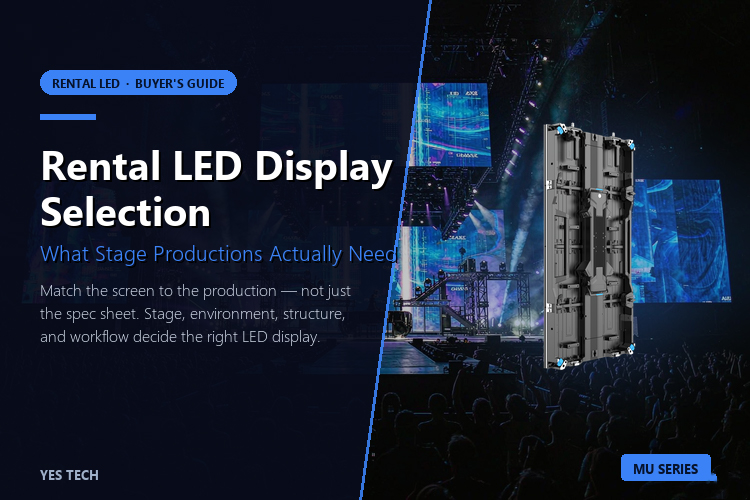
For flexible event rental applications, cabinet format becomes particularly important. YES TECH MU, for example, uses 500 × 500 mm and 500 × 1000 mm cabinets and supports indoor and outdoor configurations depending on pixel-pitch and cabinet specification. Its design supports single-person installation, hanging and stacking, front and rear maintenance, and curved configurations of ±7.5° with an optional ±15° configuration. The range includes pixel pitches from P1.9 to P4.8, with outdoor configurations available at selected pitches. This type of platform is useful when one rental LED system needs to cover different event formats without turning every project into a completely different technical setup.
Large-Scale Touring Requires a Different LED Display Approach
Scale changes the way an LED display should be evaluated. A large touring production may involve thousands of cabinet movements, repeated rigging and dismantling, multiple trucks, tight venue schedules, outdoor exposure, and substantial screen areas. In this environment, installation speed and transportation efficiency become engineering considerations rather than simple convenience features. For large outdoor touring applications, the cabinet format can have a direct effect on deployment. A 500 × 1000 mm cabinet, for example, can create a large screen area with fewer cabinet connections than smaller-format cabinets. The effect is particularly relevant when the production needs to build large screens under a limited setup window.
YES TECH Mega is designed specifically around this type of requirement. Its 500 × 1000 × 86 mm cabinet is available in P3.91, P4.63, and P5.68 configurations. The system uses a central load-bearing design supporting hanging heights up to 25 m, reinforced wind bracing, a unified hanging and stacking beam, and a 12-in-1 dolly system for transportation and storage. It also supports horizontal and vertical splicing and ±10° curved configurations. These features matter because touring efficiency is determined by the entire workflow. A rental LED display has to move from storage to truck, from truck to stage, from stage to venue, and eventually back into storage. The cabinet itself is only one part of that process.
How to Evaluate a Rental LED Display Before Purchase
A professional rental LED display assessment should therefore cover several areas at the same time. The first is visual performance. Pixel pitch should be selected according to viewing distance and content requirements rather than treated as a universal indicator of image quality. Brightness should match the operating environment, particularly for outdoor stages. Refresh rate and grayscale performance also become important when the screen is captured by professional cameras.
The second is mechanical design. Rental cabinets are repeatedly transported, connected, lifted, stacked, dismantled, and stored. Locking mechanisms, cabinet rigidity, protective structures, connection systems, and maintenance access all affect long-term usability. The third is installation efficiency. Production schedules are often fixed, and a display system that requires excessive manual work can increase labor requirements and extend setup time. Single-person operation, quick-lock mechanisms, accessible power boxes, and flexible hanging or stacking methods can simplify deployment.
The fourth is transportation. Cabinet size and weight affect packing density, handling, truck utilization, and crew requirements. For touring rental companies, transportation should be considered during product selection rather than after the equipment has been purchased. The fifth is environmental protection. Outdoor rental LED displays need appropriate ingress protection and structural design for the intended environment. IP ratings should be evaluated together with the actual installation conditions, including exposure to rain, dust, wind, temperature, and the structural system supporting the display.
The sixth is maintenance. Front and rear maintenance capabilities can affect where the display can be installed and how quickly a rental team can replace components. A modular design can also make troubleshooting and component replacement more manageable.
The Role of the LED Display Manufacturer and Supplier
Product specifications are only one part of a rental LED purchase. A rental company also needs to evaluate the manufacturer behind the display. Manufacturing experience, quality control, testing capability, certification, spare parts availability, technical support, logistics, and after-sales service can all affect the operational value of the equipment.
This is especially important for rental businesses because the same equipment may be used across many different projects. The supplier therefore needs to understand not only how an LED display performs in a laboratory or showroom, but also how it behaves in repeated real-world deployment. YES TECH was founded in 2001 and currently identifies itself as a professional LED display manufacturer serving more than 100 countries and regions. The company states that it has delivered more than 10,000 projects and operates a CNAS-accredited laboratory, with more than 180 granted patents and certifications including CE, RoHS, FCC, ETL, RCM, and BIS.
For rental customers, this type of manufacturing infrastructure is relevant because rental equipment is expected to operate repeatedly over a long service life. The evaluation should therefore extend beyond a single project and consider the manufacturer's ability to support the product after deployment.
Choosing the Right Rental LED Display for the Production
There is no single LED display configuration that is appropriate for every rental stage. The correct solution depends on how the display interacts with the stage, how it will be installed, how frequently it will be transported, and what environmental conditions it will face. If the production requires a solid visual surface across concerts, sports events, ceremonies, or general stage applications, a conventional rental LED platform such as MU can provide flexible cabinet formats and installation options.
If the production is a large outdoor touring project where screen scale, structural protection, hanging capability, transportation, and deployment speed are major considerations, a platform such as Mega is designed around those requirements. If the stage concept requires transparency and a strong connection between digital content and the physical environment, transparent LED becomes more relevant. MAir is designed for large-scale outdoor touring, while MT II LED display provides a different approach with transparent and solid modes, multiple cabinet sizes, and flexible stage configurations.
The most effective way to choose a rental LED display is therefore to work backward from the production: define the stage function, determine the installation environment, establish the required screen geometry, calculate transportation and crew requirements, and then select the LED display platform that meets those conditions. For rental companies and production teams, this approach turns LED display selection from a simple product comparison into a practical production decision. The goal is not simply to install an LED screen. It is to choose a display system that can perform reliably through the complete rental cycle—from transportation and installation to operation, dismantling, and the next event.


+86-(0)731-84539619


Hunan Yestech Optoelectronic Co., Ltd. Terms of Service Privacy Policy Powered by szweb


