



ADDRESS
Blog/2026.08.19
Transparent LED displays are no longer limited to architectural façades or visually open installations. They are increasingly being used in concerts, festivals, touring productions, brand activations, and other temporary environments where the display itself must become part of the stage structure. This shift is changing the way transparent LED technology needs to be evaluated. Transparency remains important, but for professional rental applications, it is only one part of the equation. Weight, rigidity, wind resistance, installation efficiency, maintenance, transportation, and repeated-use reliability can have an equally significant impact on the overall value of a transparent LED system.
This is where carbon fiber has emerged as an important material in the development of next-generation rental LED displays. Unlike conventional engineering approaches that focus primarily on reducing the amount of material used, carbon fiber enables manufacturers to rethink the structural relationship between weight and strength. Its high strength-to-weight ratio makes it particularly interesting for large-format transparent LED displays, where every kilogram can affect transportation, rigging, installation, and the physical demands placed on supporting structures. YES TECH’s MAir series is an example of this approach, using a carbon fiber seamless one-piece molded frame to create a transparent rental LED display designed around portability, structural performance, and deployment efficiency.
The Real Engineering Challenge Behind Large Transparent LED Displays
The apparent simplicity of a transparent LED screen can be misleading. From the front, viewers mainly see LED modules and the visual content displayed on them. From an engineering perspective, however, the cabinet must perform several functions simultaneously. It needs to maintain the relative position of the modules, provide sufficient mechanical rigidity, accommodate power and signal components, withstand transportation and installation forces, and remain stable when assembled into a larger screen.
This becomes particularly important as cabinet dimensions increase. A larger cabinet can reduce the number of individual units required for a given screen area, potentially improving installation efficiency. At the same time, a larger structural span can create greater mechanical demands. The cabinet must control deformation while maintaining accurate module alignment. If structural rigidity is insufficient, even a technically capable LED module cannot compensate for cabinet movement or unevenness.
Rental applications make the problem more demanding because the same cabinet is expected to survive a continuous cycle of transportation, assembly, disassembly, storage, and reinstallation. A fixed LED display may be installed once and remain in the same location for years. A touring LED display has a very different operating profile. Its mechanical structure becomes part of a repeated logistics and deployment system.
For transparent LED displays, this challenge is amplified by the requirement for an open visual structure. The cabinet cannot simply become a conventional solid enclosure without compromising the visual characteristics that make transparent displays attractive in the first place. Engineers therefore need to achieve structural performance through material selection, load paths, connection systems, and cabinet architecture rather than relying solely on additional mass.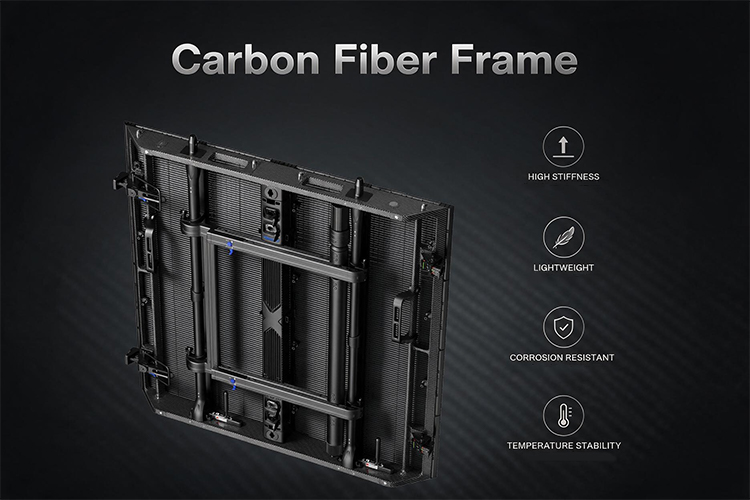
Why Material Selection Matters More as Cabinets Get Larger
Weight is often discussed as a transportation issue, but its influence extends throughout the entire lifecycle of a rental LED display. Consider a touring production using hundreds of square meters of LED. The difference of several kilograms per cabinet can become a substantial difference at system level. More weight can affect the number of cabinets transported per vehicle, the equipment required for handling, the physical workload of installation crews, and the requirements placed on temporary structures.
This does not mean that the lightest cabinet is automatically the best cabinet. In professional LED engineering, structural efficiency is more meaningful than weight alone. A cabinet needs sufficient stiffness and strength for its intended load conditions. Reducing mass without controlling deformation can create a product that is easy to carry but difficult to install accurately or maintain reliably.
This is one reason carbon fiber is attracting attention in advanced LED display design. Carbon fiber reinforced structures can deliver high mechanical performance at relatively low mass because the material's strength and stiffness can be engineered through fiber orientation, composite construction, and structural geometry. The benefit is not simply that the material is light. The more important advantage is that it can provide a high level of structural performance without requiring the same mass associated with some traditional metal structures. For a transparent rental LED display, this distinction is critical. The objective is not to replace metal with carbon fiber for marketing value. The objective is to use material properties as part of a broader structural design strategy.
From Material to Structure: Why Carbon Fiber Alone Is Not Enough
It is important to avoid another oversimplification: carbon fiber does not automatically make an LED cabinet structurally superior. The final performance of a composite cabinet depends on the entire engineering system, including material formulation, molding process, geometry, joints, load distribution, connection points, and manufacturing consistency.
For this reason, the significance of MAir lies not simply in the use of carbon fiber, but in the way the material is incorporated into the cabinet architecture. MAir uses a carbon fiber seamless one-piece molded frame, creating a structural concept in which the frame is designed as an integrated component rather than a collection of loosely connected structural pieces.
An integrated frame can help simplify the structural path between different areas of the cabinet. Fewer structural interfaces can also reduce mechanical complexity and create a cleaner cabinet architecture. In a rental environment, this matters because every connection, component, and assembly step introduces another potential point of operational complexity.
The one-piece approach also supports the broader objective of creating a cabinet that can be handled and deployed efficiently. A professional rental display is not evaluated only when it is operating on stage. It is evaluated when technicians are loading trucks, moving cabinets through venues, assembling large structures, making connections, checking alignment, and eventually dismantling the system after an event. That is why structural engineering and operational engineering increasingly overlap in modern rental LED design.
Large Cabinet Size Changes the Installation Equation
MAir uses a 1000 × 1000 mm cabinet format, which illustrates another important trend in rental LED display design: larger cabinet dimensions can reduce the number of units required to build a screen of a given area. For example, a 100-square-meter display assembled from 1-square-meter cabinets requires roughly 100 cabinet positions before accounting for the specific screen configuration. A larger cabinet format can therefore simplify the physical assembly process by reducing the number of individual units that need to be positioned and connected.
But larger cabinets also require careful structural design. As cabinet dimensions increase, handling ergonomics, frame rigidity, connection accuracy, and transportation systems become increasingly important. This is where a lightweight structural platform can create practical advantages. MAir's cabinet weighs approximately 19 kg at the 1000 × 1000 mm size, allowing the larger cabinet format to remain manageable for professional rental workflows.
The value of this combination is not simply a specification on a product sheet. It changes how installation teams interact with the screen. Fewer cabinet units can mean fewer physical positioning operations, while lower individual cabinet weight can make handling less demanding. Together, these factors can contribute to a more efficient deployment process. For touring productions, where setup time is frequently constrained by venue schedules, this type of efficiency can be commercially significant.
Transparency Should Be Evaluated Together With Viewing Environment
The term “transparent LED display” generally describes the visual permeability of the screen, but transparency should not be treated as an isolated performance metric. The usefulness of a transparent LED display depends on how effectively it interacts with the surrounding environment.
In stage applications, transparent LED can allow lighting, scenery, performers, and architectural elements behind the screen to remain visible. This creates possibilities that conventional opaque LED walls cannot easily reproduce. Designers can use the display as a digital layer rather than a completely solid visual barrier.
Outdoor applications introduce another consideration: the physical environment. A large LED surface installed on a temporary stage or structure can be exposed to wind and changing weather conditions. An open transparent structure may offer advantages in terms of airflow compared with a solid display surface, but the complete installation still needs to be engineered according to the actual environment, mounting method, screen configuration, and applicable safety requirements.
MAir addresses this broader engineering requirement with a structure designed for demanding rental applications, including support for installations up to 25 meters in height and a stated wind-resistance capability of 20 m/s under specified conditions. These figures should always be considered within the complete installation design rather than interpreted as standalone guarantees for every project.
This is an important distinction for professional users. Product specifications provide engineering parameters, but safe deployment depends on the interaction between the display, supporting structure, rigging system, environmental conditions, and installation method.
Installation Efficiency Is Becoming a Core Performance Metric
The next generation of rental LED displays is increasingly being judged by more than image quality. Installation efficiency has become a practical performance metric because labor, setup time, and venue access windows directly influence project economics. MAir's structural concept is therefore complemented by an integrated, cable-free cabinet approach and quick-lock technology. Reducing unnecessary cabling and simplifying mechanical connections can shorten the sequence required to assemble the display. More importantly, it can reduce the number of individual tasks technicians need to perform during installation.
This matters particularly in touring environments. A screen may need to be installed in a different venue every few days, sometimes under significant schedule pressure. A cabinet that looks impressive when fully assembled but requires complicated preparation can create operational costs that are invisible in a conventional product comparison.
A well-designed rental LED display should instead be considered as part of a complete workflow: transport, unpacking, positioning, connection, assembly, testing, operation, dismantling, and repacking. Every stage presents an opportunity for engineering improvements. MAir's design philosophy reflects this approach. The cabinet is not treated simply as a container for LED modules. It is designed as a structural and operational platform intended to reduce complexity across the rental cycle.
Why Maintenance Design Matters in Touring Applications
Repeated use also makes serviceability a critical part of LED display engineering. Rental equipment is exposed to physical handling far more frequently than permanently installed systems. Modules, power components, connectors, and mechanical interfaces may eventually require inspection or replacement.
A display designed for touring therefore needs to consider maintenance access alongside structural performance. Easy access to serviceable components can reduce downtime and make it easier for technicians to return equipment to operation. This is particularly important when a display is being used across multiple events. A small technical issue that can be resolved quickly on site may have very different consequences from an issue that requires extensive cabinet disassembly or specialized service procedures.
For this reason, integrated structural design should not mean inaccessible construction. The ideal cabinet combines structural integration with practical serviceability. This is a recurring principle in professional equipment design: simplify the system where possible, but preserve access to the components that technicians need to inspect or replace.
A More Complete Way to Evaluate Transparent Rental LED Displays
The development of MAir illustrates a broader change in how transparent rental LED displays should be evaluated. Transparency remains essential because it determines how naturally the display can integrate with the surrounding visual environment. But professional users should also consider structural rigidity, cabinet dimensions, cabinet weight, installation method, environmental requirements, maintenance access, transportation efficiency, and repeated-use reliability.
A useful evaluation framework therefore starts with the application rather than a single specification. For a touring concert, transportation and installation speed may carry significant weight. For an outdoor festival, structural performance and environmental adaptability become more important. For architectural or commercial applications, visual integration, transparency, and long-term operating requirements may take priority. The strongest transparent LED solutions are those that address these requirements as a system rather than optimizing one specification at the expense of others. This is also why the use of advanced materials such as carbon fiber should be viewed as part of a larger technological evolution. The objective is not simply to make LED cabinets lighter. It is to make the entire display system more efficient.
MAir and the Evolution of Rental LED Display Engineering
The development of transparent LED displays is moving from a competition centered primarily on transparency toward a more comprehensive engineering discipline. As screens become larger, more mobile, and more frequently deployed in demanding environments, cabinet architecture becomes increasingly important.
MAir represents this transition through the combination of a carbon fiber seamless one-piece molded frame, a 1000 × 1000 mm cabinet format, approximately 19 kg cabinet weight, integrated structural design, cable-free architecture, and quick-lock installation. Together, these elements demonstrate a design philosophy in which material science, structural engineering, and rental workflow are considered as one system.
For the rental LED industry, that shift is significant. The future of transparent LED displays will not be determined by transparency alone. It will depend on how effectively manufacturers can combine optical performance with mechanical reliability, portability, installation efficiency, and long-term usability.
Ultimately, the most advanced transparent LED display is not necessarily the one with the highest transparency or the lowest weight. It is the one that delivers the right engineering balance for the application. By applying carbon fiber to an integrated cabinet structure and designing around the realities of touring and temporary installation, MAir demonstrates how transparent LED technology can move toward a more efficient, structurally intelligent generation of professional rental displays.


+86-(0)731-84539619


Hunan Yestech Optoelectronic Co., Ltd. Terms of Service Privacy Policy Powered by szweb


