



ADDRESS
Blog/2026.07.15
The live entertainment industry is continuously pushing the boundaries of stage design. Modern concerts and music festivals are no longer built around a simple combination of performers, lighting, and a traditional LED backdrop. Instead, stage environments are becoming fully integrated visual experiences where digital content, physical structures, lighting systems, and performances interact as one immersive space.
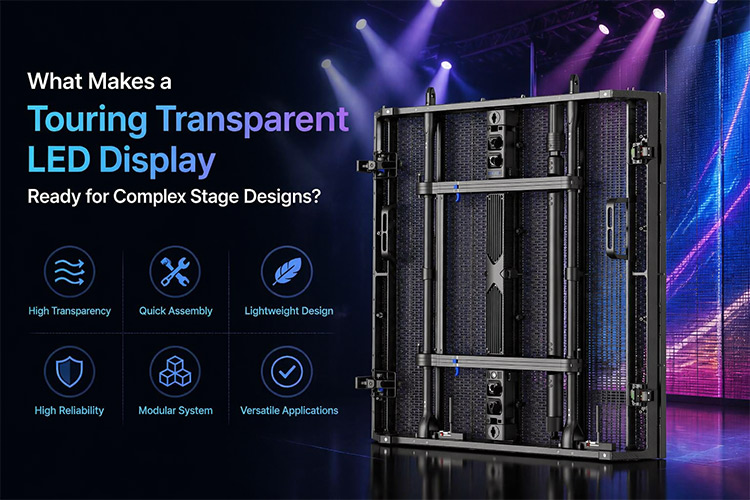
This evolution has created new demands for LED display technology. While traditional rental LED screens remain a fundamental part of large-scale productions, stage designers are increasingly exploring transparent LED displays to create more open, dynamic, and visually layered environments.
A transparent LED display provides a unique advantage: it delivers high-impact visual content while maintaining a sense of depth and transparency. Performers, lighting fixtures, stage structures, and background elements can remain visually connected, allowing designers to create effects that are difficult to achieve with conventional LED walls.
For outdoor concerts, music festivals, and touring productions, this capability opens new creative possibilities. Transparent LED screens can become part of the stage architecture rather than simply serving as a flat visual background. However, when transparent LED technology moves from fixed installations into professional touring environments, the requirements become significantly more demanding.
A transparent LED display used in a commercial building may be installed once and optimized for a specific location. A touring transparent LED display must repeatedly travel between venues, withstand transportation, adapt to different stage structures, and be installed under strict production schedules. This difference changes the entire engineering approach.
For touring applications, transparency alone is not enough. A professional system must achieve the right balance between visual performance, structural strength, installation efficiency, and creative flexibility. One of the most challenging areas in this development is the ability to create large-scale curved and corner structures while maintaining the reliability required for touring productions.
Why Touring Applications Require a Different Approach
Outdoor touring productions place unique demands on LED technology. A festival stage may be built in one city and completely reconstructed in another location only a few days later. Rental companies and production teams need equipment that can perform consistently through hundreds of installation cycles. Unlike permanent installations, touring LED displays must consider the entire lifecycle of the product: transportation, assembly, operation, dismantling, and redeployment.
Every component of the system must support this workflow. The cabinet structure must be strong enough to maintain accuracy after repeated handling. The connection system must allow fast installation without compromising alignment. The overall weight must remain manageable because transportation and rigging efficiency directly affect production costs and stage design possibilities. This creates a fundamental engineering challenge for transparent LED displays.
The technology behind transparency requires an open and lightweight structure. However, large touring applications require mechanical stability and precision. The challenge is not simply creating a transparent LED screen. The challenge is creating a transparent LED display that can survive the realities of touring. For this reason, professional touring transparent LED displays are increasingly evaluated by their structural design as much as their image performance.
The Engineering Challenge Behind Curved Transparent LED Displays
Curved LED structures have become increasingly common in modern stage design. Large concerts and festivals often use curved screens to create more immersive environments, allowing visual content to surround performers and extend beyond traditional flat stage layouts.
With conventional LED rental screens, curved installation has become a relatively mature application. Many rental cabinets are designed with strong metal frames and mechanical locking systems that allow different angles to be achieved. However, transparent LED displays face a more complex engineering challenge.
The defining advantage of transparent LED technology comes from its lightweight and open structure. By reducing traditional solid components, transparent displays achieve higher transparency and lower weight. However, this also means that manufacturers must carefully manage structural rigidity. When a large transparent LED screen is installed into a curved shape, every cabinet connection becomes important. Small mechanical deviations between cabinets can accumulate across a large surface. Over several meters or even dozens of meters, minor alignment differences can affect the overall appearance of the curve.
A professional touring transparent LED system must maintain:
· accurate cabinet alignment
· consistent visual performance
· stable mechanical connections
· repeatable installation results
The challenge becomes even greater outdoors, where environmental factors such as wind, temperature changes, and frequent transportation can influence structural performance. A curved transparent LED display is therefore not simply a flexible visual surface. It is a precision-engineered structure that must maintain both mechanical and visual integrity.
Why 90-Degree Corner Solutions Are Even More Challenging
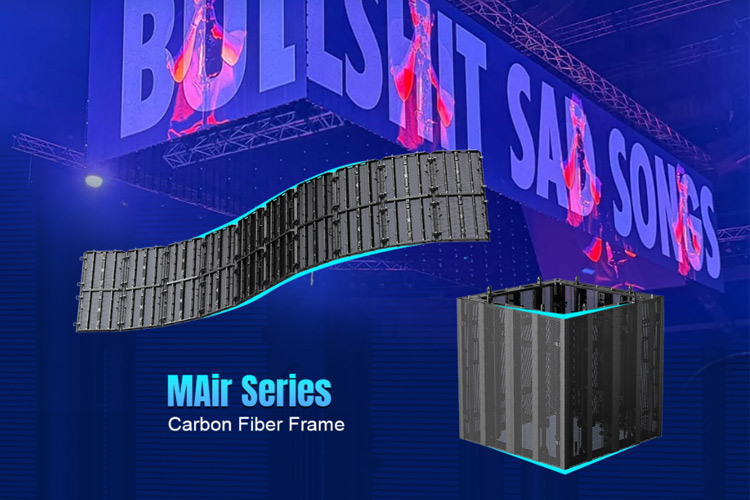
While curved installation already requires advanced engineering, creating reliable 90-degree corner solutions represents an even higher level of difficulty. Modern stage designers are increasingly moving toward three-dimensional environments. Instead of a single front-facing LED wall, productions often require screens that wrap around performers, connect front and side structures, or create immersive stage spaces.
For traditional LED displays, corner solutions are widely available. However, transparent LED displays introduce additional challenges. At a right-angle connection, the system must maintain structural strength while preserving the visual characteristics that make transparent LED technology unique.
The corner area must address several technical factors simultaneously. The mechanical structure must provide sufficient reinforcement without adding excessive weight. The visual transition between two directions must remain smooth, avoiding obvious gaps or inconsistencies. The transparent appearance must also be maintained so that the corner does not become a visually heavy structural point.
For touring applications, the solution must also withstand repeated assembly and transportation. A corner design that performs well in a permanent installation may not necessarily meet the requirements of a touring production. Rental equipment must deliver the same precision and reliability every time it is deployed. This is why advanced corner solutions have become an important indicator of a professional touring transparent LED platform.
The Importance of Lightweight and High-Rigidity Design in Touring LED Systems
Weight has always been a critical factor in touring productions. Large-scale concerts and festivals involve complex logistics. Every kilogram affects transportation planning, rigging requirements, installation time, and overall production efficiency. Transparent LED technology naturally provides advantages in this area because its open structure reduces overall weight compared with many conventional LED solutions.
However, lightweight design alone is not enough. A touring LED display must also maintain rigidity.
Without sufficient structural stability, lightweight systems may face challenges such as:
· cabinet deformation
· inconsistent alignment
· increased installation adjustment time
· reduced long-term reliability
The future of touring transparent LED displays depends on finding the optimal balance between these two requirements. Advanced materials and integrated structural design have become increasingly important because they allow manufacturers to reduce weight without sacrificing mechanical performance. This balance is especially valuable for large creative stage designs where designers want larger transparent surfaces, more complex shapes, and faster installation processes.
What Defines a Professional Touring Transparent LED Display?
For rental companies and production teams, the value of a transparent LED display is measured by much more than image quality. A professional touring system must become a reliable production tool.
It needs to provide creative freedom while also supporting the practical realities of live events. The most capable touring transparent LED solutions are designed around several core principles: lightweight transportation, structural durability, installation efficiency, and flexible stage integration.
A successful system allows designers to explore new stage concepts without creating additional complexity for production teams. This is particularly important as the entertainment industry continues moving toward more immersive experiences. The LED display is no longer just a screen. It becomes part of the stage structure itself. The ability to create curved surfaces, corner connections, and unique spatial designs will increasingly influence how production teams choose transparent LED technology.
MAir: Advancing Transparent LED Solutions for Touring Stage Applications
As the demand for more creative and reliable touring solutions continues to grow, YES TECH developed MAir with the practical challenges of outdoor rental productions in mind. Rather than focusing only on transparency and visual effects, MAir was designed as a complete touring-oriented transparent LED system that addresses the structural requirements of professional stage environments.
A key element of MAir is its integrated carbon fiber frame design, which provides a balance between lightweight performance and structural rigidity. This approach helps reduce transportation and installation challenges while maintaining the stability required for large-scale touring applications.
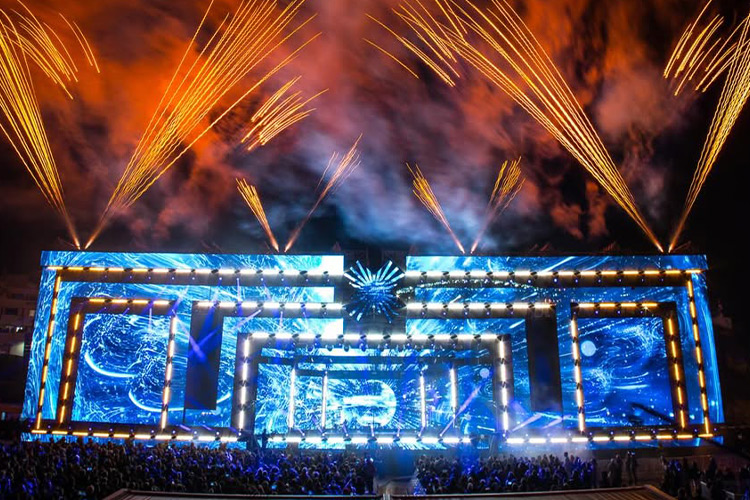
For stage designers and rental companies, this structural advantage creates more possibilities for creative configurations. MAir supports curved installations with up to ±15° adjustment and enables 90-degree corner applications, allowing transparent LED structures to move beyond traditional flat layouts.
These capabilities give production teams greater freedom to create immersive stage environments for concerts, festivals, and touring performances while maintaining the reliability expected from professional rental equipment.
In a touring environment, creative possibilities only become valuable when they can be reproduced consistently from one venue to another. A successful transparent LED solution must not only inspire designers but also support the operational demands behind every show.
The Future of Touring Transparent LED Displays
As stage production continues to evolve, the role of LED displays will continue changing. Future touring stages will require systems that are lighter, more adaptable, and capable of integrating seamlessly into increasingly complex designs. Transparent LED technology represents an important step in this direction because it allows digital content to become part of the physical stage environment.
However, the next generation of touring transparent LED displays will not be defined only by transparency or pixel performance. The real innovation will come from systems that combine creative flexibility with engineering reliability.
Curved structures, corner solutions, lightweight materials, and efficient installation methods will become increasingly important as productions demand more immersive and sophisticated stage designs.
For outdoor concerts, music festivals, and touring productions, the future of transparent LED is not simply about creating larger screens. It is about creating smarter stage structures that expand what is possible in live entertainment.


+86-(0)731-84539619


Hunan Yestech Optoelectronic Co., Ltd. Terms of Service Privacy Policy Powered by szweb


