



ADDRESS
Blog/2026.09.16
Choosing the right LED display for an event is about much more than selecting a screen with a small pixel pitch or high brightness. A concert, sports event, corporate conference, outdoor festival, and touring production can all require completely different LED display solutions, even when they appear to use similar LED screens. The right LED display for an event needs to match the viewing distance, venue environment, screen size, content, camera requirements, installation method, and production schedule. For rental and staging applications, the LED display also needs to handle repeated installation, transportation, maintenance, and changes in stage configuration.
This is why choosing an LED screen for events should start with the event itself rather than with a product specification sheet. Once the application is clear, technical requirements such as LED pixel pitch, brightness, refresh rate, cabinet size, installation method, and maintenance access become much easier to evaluate. For rental companies and event production teams, this approach is particularly important. A versatile rental LED display may be used for concerts one week, a corporate event the next, and an outdoor sports event after that. Instead of looking for one specification that works for everything, it is more useful to understand how different requirements change from one event scenario to another.
Start With the Event Scenario, Not the LED Screen
Every event creates a different visual environment. The audience may be standing a few meters from the LED wall at a corporate launch, while spectators in a stadium may be dozens of meters away. A concert LED screen may need to appear on camera during a live broadcast, while an outdoor festival LED display needs enough brightness to remain visible in daylight. The first questions should therefore be practical: Where will the LED display be installed? How far will the audience be from the screen? Will cameras capture the LED screen? How large does the screen need to be? How quickly must it be installed? Will the screen be hung, stacked, curved, or integrated into a more creative stage structure? These questions define the requirements of the LED display much more effectively than simply comparing one LED panel with another.
For example, a small indoor conference may prioritize fine image detail and close-range viewing, while a large outdoor concert may prioritize screen size, brightness, structural protection, and fast deployment. A touring production adds another layer of requirements because the LED screen may need to be assembled and dismantled repeatedly at different venues. This is where rental LED screens differ from many fixed LED display systems. A rental LED display is not only a visual surface. It is also part of the production workflow.
Pixel Pitch: Match the LED Display to Viewing Distance
LED pixel pitch is one of the most commonly discussed specifications when selecting an LED display. It refers to the distance between the centers of adjacent pixels, measured in millimeters. A smaller pixel pitch means that more pixels can be packed into the same physical area, which generally allows the LED display to reproduce finer image detail at closer viewing distances. However, smaller pixel pitch does not automatically mean a better LED screen for every event. If the audience is far away, the additional pixel density of a very fine-pitch LED display may provide little practical benefit compared with a suitably selected larger pixel pitch. At the same time, if an LED screen is used in a conference room or close to the stage, a finer pixel pitch can help preserve image detail in text, graphics, faces, and other content viewed from nearby.
This is why LED pixel pitch and viewing distance should be considered together. For example, an indoor corporate event with an audience positioned relatively close to the LED video wall may require a finer pixel pitch than a large outdoor festival where the nearest audience members are several meters away. Concerts can fall anywhere in between depending on the stage design, audience area, camera positions, and size of the LED screen. There is no single pixel pitch that is universally suitable for every event. A practical selection should consider the closest important viewing position, rather than only the average or maximum viewing distance. Content type also matters. Fine text and detailed graphics can place greater demands on pixel density than large moving video content.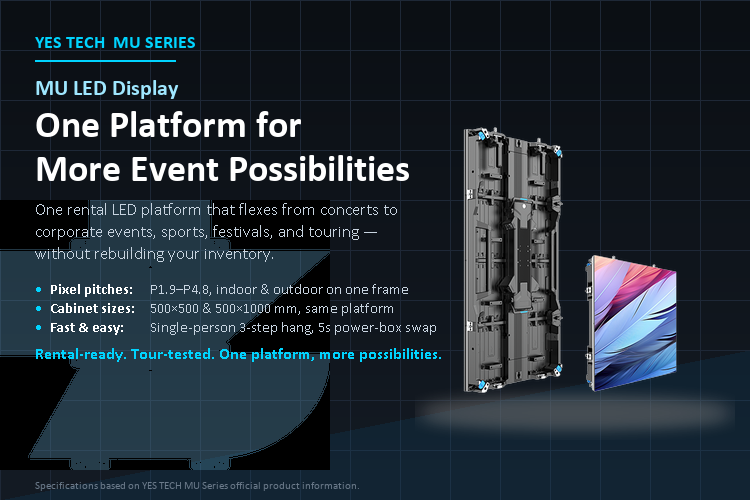
For rental companies, this creates another consideration: inventory flexibility. A company serving corporate events, concerts, sports events, and festivals may need multiple LED display pixel pitches to cover different applications. A platform-based LED display design can help reduce that complexity. The YES TECH MU Series, for example, covers P1.9, P2.6, P2.9, P3.9, and P4.8 configurations, with indoor and outdoor options within the series. Its platform design allows different pixel pitches in the MU range to use the same frame, giving rental companies more flexibility when configuring LED screens for different event requirements.
Indoor or Outdoor: The Environment Changes the Requirements
The next major consideration is the installation environment. An indoor LED display and an outdoor LED display may look similar, but they face different operating conditions. Indoor event spaces usually provide controlled lighting and protection from weather. Outdoor LED screens may need to deal with direct sunlight, changing weather conditions, dust, moisture, and greater environmental exposure. For outdoor events, LED display brightness becomes particularly important. An LED screen needs sufficient brightness to maintain image visibility under ambient daylight. However, maximum brightness alone should not be treated as the deciding factor. The actual requirement depends on the event schedule, installation position, ambient light, content, and whether the screen will also operate at night.
Outdoor applications also place greater importance on protection and structural reliability. An outdoor rental LED display should be selected according to the environmental conditions and installation requirements of the project rather than simply choosing the highest brightness specification. For indoor events, excessive brightness can be unnecessary and may affect visual comfort. In a controlled venue, image quality, contrast, color performance, pixel pitch, and camera performance may be more relevant.
This distinction becomes particularly useful for rental companies because the same event production business may work across indoor theaters, exhibition halls, stadiums, outdoor festivals, and temporary stages. A rental LED display platform that offers both indoor and outdoor configurations can provide more options when planning inventory. The YES TECH MU Series is designed for both indoor and outdoor rental applications, with P2.9 and P3.9 options available for indoor & outdoor use according to the current product specification.
Concerts and Touring Productions: Installation Speed Matters
Concerts and touring productions are among the most demanding applications for rental LED displays. The LED screen is often part of a large stage system that must be installed, tested, operated, dismantled, transported, and rebuilt within a tightly controlled production schedule. For this type of application, image quality is only one part of the equation. The production team also needs to consider cabinet size, connection method, hanging and stacking, maintenance access, transportation, crew size, and installation time. A large LED wall may contain hundreds or thousands of cabinets. Even a small difference in the installation process can become significant when repeated across a large screen. This makes fast connection, easy alignment, practical handling, and efficient maintenance important considerations for a professional concert LED screen.
Cabinet dimensions also influence installation efficiency. A 500×1000 mm LED cabinet, for example, covers twice the area of a 500×500 mm cabinet when used in the same configuration. This can reduce the number of cabinet connections required when building certain large rectangular LED screens. The YES TECH MU Series uses both 500×500 mm and 500×1000 mm cabinets, specifically supporting fast large-screen installation. The manufacturer positions the series around large-format rental applications and provides single-person installation features, hanging and stacking options, and front and rear maintenance. For touring productions, the value of this type of design is not simply that the LED screen can be installed quickly once. The same LED display may need to go through the installation and dismantling cycle many times, potentially at different venues and under different stage layouts. Therefore, installation efficiency becomes part of the total operating value of a rental LED display.
Sports Events: Think About Screen Size and Viewing Distance
Sports events create a different set of requirements for an LED display. Unlike a small conference room, a stadium or large sports venue may have thousands of viewers distributed across a wide area. The LED screen therefore needs to provide clear visual information across a broad viewing range. Large LED displays may be used for live video, instant replays, player information, event graphics, sponsor content, and other real-time visuals. Depending on the venue, LED screens can appear as large central displays, side screens, scoreboards, ribbon displays, or other visual systems.
For a large-format sports LED screen, pixel pitch should be considered together with the physical screen size and audience distance. There is little value in choosing a very fine pixel pitch without considering whether the audience can actually benefit from the additional pixel density. Installation is another consideration. Temporary sports events may have limited load-in windows, while touring competitions may require equipment to move between venues. In these situations, a rental LED screen needs to balance visual performance with deployment efficiency. A modular LED display platform can also make it easier for rental companies to configure screens of different sizes without maintaining an entirely different cabinet system for every project.
Corporate Events and Product Launches: Image Detail Becomes More Important
Corporate events, conferences, exhibitions, and product launches often place the audience closer to the LED display than large outdoor festivals do. The content can also be more detail-intensive. Presentation slides may contain text, product specifications, charts, logos, and fine graphics. Product launches may use close-up product imagery where image detail and color reproduction are important. This makes pixel pitch, image quality, contrast, and camera performance important factors when selecting a corporate event LED display.
Screen geometry also matters. A corporate stage may use a simple rectangular LED wall, while a product launch may require curved or segmented screens to create a more distinctive stage environment. For these projects, flexibility can be more valuable than simply maximizing screen size. The production team may need to adapt the LED display to a stage backdrop, presentation area, side screen, or creative installation. This is where modular rental LED displays can create more possibilities. Rather than treating an LED cabinet as a fixed building block, a modular system allows production teams to think about the LED screen as part of the overall stage design.
Festivals and Large Outdoor Events: Visibility and Deployment
Outdoor festivals combine several of the challenges discussed above. The LED display may need to be large enough for audiences spread across a large area, bright enough for daylight conditions, protected against outdoor exposure, and quick enough to install within a limited event schedule. A festival may also use multiple LED screens for the main stage, side stages, audience areas, sponsor content, and other visual functions. As a result, rental companies need to consider not only the performance of one LED panel but also how efficiently the entire LED display system can be transported and deployed.
For these applications, outdoor rental LED screens with suitable brightness, protection, installation flexibility, and appropriate pixel pitch can provide a practical solution. The physical layout of the screen should also be considered. A conventional flat LED wall may be sufficient for a main stage, while curved or angled screens can be useful when the stage design calls for a more dynamic visual structure. The MU Series supports ±7.5° curved splicing, with ±15° available as an option, and its 500×500 mm and 500×1000 mm cabinets can be vertically spliced. It can also be combined with the Rubik Series to create configurations including 90° corners and other multi-faceted structures. That means the question is no longer simply “Which LED screen should we use?” but also “How should the LED screen become part of the stage?”
Refresh Rate and Camera Performance for Live Events
For concerts, sports events, conferences, and other productions where cameras are involved, LED display refresh rate deserves careful consideration. The audience sees the LED screen directly, but cameras may capture it under completely different conditions. An LED display that looks acceptable to the eye can produce visible flicker, scan lines, or other artifacts on camera if the display and camera settings are not properly matched.
This is particularly relevant to concerts and sports events with live broadcasting, IMAG, livestreaming, or professional event recording. Refresh rate should therefore be considered alongside the LED display's processing system, camera shutter settings, scanning architecture, and overall calibration. It should not be treated as a single number that automatically guarantees camera performance. For a professional stage LED screen, the production team should test the actual display configuration with the cameras and content that will be used during the event whenever possible.
Installation Method Is Part of LED Display Selection
Another factor that is sometimes overlooked is how the LED display will physically be installed. A rental LED screen may be hung, ground-stacked, curved, integrated into a stage structure, or combined with other LED display configurations. The right choice depends on the venue, screen size, stage design, structural requirements, and production plan. For large concert backdrops, hanging installation may provide a clean stage structure. Ground stacking can be useful when the screen needs to be supported from the floor. Curved configurations can help create a wider or more immersive visual field.
A professional rental LED display should therefore provide installation flexibility without making the setup unnecessarily complicated. The MU Series supports both hanging and ground stacking. Its single-person operation design uses a three-step hanging process, while the modular design supports both front and rear maintenance. YES TECH also states that the power box can be changed in five seconds. These features are more meaningful when considered in the context of an actual production workflow: the less time a crew spends on basic installation and maintenance tasks, the more time they have for signal testing, content preparation, stage integration, and show operation.
Maintenance Should Be Considered Before the Event
An LED display is not finished when the last cabinet is installed. For rental applications, maintenance access can have a direct effect on the production workflow. If a module, receiving card, power supply, or other component needs attention during preparation, the service method can affect how quickly the issue is resolved. Front maintenance can be particularly useful when the rear of the LED display is difficult to access. Rear maintenance can be practical when the screen structure allows technicians to work from behind.
A modular design that supports both approaches gives production teams more options depending on the installation. The MU Series uses a modular structure supporting front and rear maintenance, which allows technicians to select the more practical service method for the specific installation. For rental companies, maintenance should also be evaluated over the full life of the equipment. A rental LED display may be assembled and dismantled repeatedly, so protection, serviceability, replacement procedures, and compatibility between cabinets and components all contribute to the practical value of the system.
Think Beyond One Event: Flexibility Matters for Rental Inventory
For an event organizer buying or renting an LED screen for one specific project, the main question may be whether the selected configuration meets that project's requirements. For a rental company, the question is broader: How many different projects can this LED display support? This is where platform design becomes particularly valuable. A rental inventory may need to support indoor concerts, outdoor festivals, corporate events, sports events, award ceremonies, product launches, and touring productions. Maintaining a completely different cabinet platform for every application can increase inventory complexity.
A platform-based LED display can approach the problem differently. If different pixel pitches can use the same cabinet frame, the rental company has more flexibility when configuring screens for different viewing distances and environments. The YES TECH MU Series was designed around this concept. Its platform design accommodates the different pixel pitches in the MU range on the same frame, while the series covers multiple pixel pitches and both indoor and outdoor applications. YES TECH also states that MU can be used with the MG9, MG10, and Xtra Series to create additional creative configurations. This does not mean one LED display configuration is automatically suitable for every event. Rather, it means the LED display platform can provide a broader range of configuration possibilities. That distinction is important when evaluating a professional rental LED display. Flexibility is not simply about having many features. It is about whether those features help the equipment adapt to the actual work performed by rental and production teams.
Choosing the Right LED Display Is About the Whole Production
There is no single “best LED display” for every event. The right LED screen for an event depends on the relationship between the audience, venue, content, camera system, stage design, installation method, and production schedule. Pixel pitch should be selected according to viewing conditions. Brightness should match the environment. Refresh rate and image performance should be considered when cameras are involved. Cabinet size and installation systems matter when the production schedule is tight. Maintenance access matters when the LED display must be serviced quickly.
For rental applications, the decision should go one step further. The LED display should also be evaluated according to how often it will be transported, how many different event scenarios it can support, how easily it can be installed and maintained, and whether the same platform can serve different projects. This is the reason a modular rental LED display can be valuable beyond the individual event. The goal is not simply to find an LED panel with impressive specifications, but to build an LED display system that works efficiently across real production environments.
The YES TECH MU Series is designed around this practical approach, combining multiple pixel pitch options, 500×500 mm and 500×1000 mm cabinet sizes, indoor and outdoor configurations, single-person operation, front and rear maintenance, hanging and stacking installation, and creative splicing options. Ultimately, selecting an LED display for concerts, sports events, corporate events, festivals, or touring productions should begin with the same question: What does this event actually require from the screen? Once the scenario is clear, the technical specifications become easier to understand—and the right LED display becomes much easier to choose.


+86-(0)731-84539619


Hunan Yestech Optoelectronic Co., Ltd. Terms of Service Privacy Policy Powered by szweb


