



ADDRESS
Blog/2026.08.11
When comparing rental LED displays, cabinet weight is often one of the easiest specifications to notice. A heavier LED cabinet can feel more substantial in the hands, and it is natural to associate that extra weight with a thicker frame, more material and greater durability. This creates a common assumption in the LED display industry: if two cabinets have a similar size, the heavier one must be stronger. It sounds logical, but structural engineering is more complicated than that. The weight of an LED display cabinet is influenced by its material, dimensions, internal components and construction, while its ability to withstand loads depends on much more than mass alone. For rental LED displays in particular, where cabinets are transported, installed, dismantled and reused repeatedly, understanding the difference between weight and structural performance is important when evaluating a cabinet.
Why Do LED Cabinets Have Different Weights?
The weight of an LED cabinet can vary significantly even when two products have similar dimensions. One of the most obvious reasons is the material used to construct the cabinet. Steel, aluminum alloy, magnesium alloy and composite materials all have different densities and mechanical characteristics, meaning that two frames with similar dimensions can have very different weights. A manufacturer may also change the weight of a cabinet through the thickness of its frame, the amount of reinforcement used, the design of its internal support structure and the way components such as power supplies and control boxes are integrated. Protection around LED modules can also add material. Cabinet size is another straightforward factor: a 500 × 1000 mm cabinet naturally contains more display area and structural material than a 500 × 500 mm cabinet. As a result, simply comparing the number on a specification sheet does not tell us whether one LED cabinet has better structural performance than another.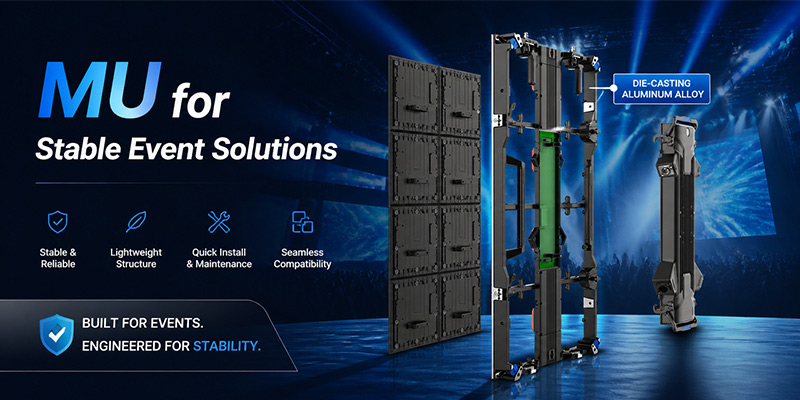
Material choice deserves particular attention because weight and mechanical performance do not increase at the same rate. A material with a higher density will generally produce a heavier structure if the same volume is used, but that does not mean its structural performance will automatically be proportionally higher. Engineers select materials according to a combination of properties, including stiffness, strength, impact resistance, durability and manufacturability. The objective is not necessarily to put as much material as possible into the cabinet. Instead, the goal is to use an appropriate material and structure for the loads and conditions the cabinet is expected to encounter. This is one reason why modern LED cabinet design often focuses on balancing structural performance with practical weight rather than treating weight itself as the primary indicator of quality.
Weight, Strength and Rigidity Are Different Things
To understand why a heavier LED cabinet is not automatically stronger, it helps to separate three concepts that are often used interchangeably in everyday conversations: weight, strength and rigidity. Weight simply describes the mass of the cabinet. Strength refers to how much stress or load a structure can withstand before it reaches a failure condition. Rigidity, sometimes referred to as stiffness, describes how effectively a structure resists deformation when a force is applied. A cabinet can therefore be heavy without being particularly rigid, while another cabinet can be relatively lightweight but maintain its shape very effectively under a specific load. These characteristics are related through engineering design, but one cannot be used as a simple substitute for another.
Rigidity is especially important for LED display cabinets because an LED wall is not a collection of independent boxes. Multiple cabinets are connected to form one large visual surface, and the alignment between those cabinets affects the appearance of the finished display. If a cabinet bends or twists under load, the resulting deformation can create uneven seams, steps or misalignment between adjacent cabinets. Even when the deformation is not severe enough to cause structural failure, it may still affect the visual consistency of a large LED wall. This is why a good LED display cabinet needs to maintain its geometry under the conditions for which it was designed. The question is therefore not simply whether the cabinet can “hold more weight,” but whether its structure can resist the forces it encounters while maintaining the dimensional accuracy required for a seamless display.
This distinction also explains why adding material is not always the most efficient solution. If a frame is made thicker, its weight will generally increase, but the resulting improvement in structural performance depends on where that additional material is placed and how the overall structure is designed. Structural engineers consider the geometry of a frame, the direction of expected forces and the way those forces move through the structure. In some situations, changing the shape or reinforcement of a structural member can produce a significant improvement in rigidity without simply adding large amounts of material. In other words, structural efficiency is often about using material intelligently rather than using more of it.
What Actually Determines the Structural Performance of an LED Cabinet?
The material itself is still an important part of the equation. Aluminum alloys, for example, are widely used in display structures because they can provide a useful combination of mechanical performance, relatively low density, corrosion resistance and manufacturability. But specifying an aluminum alloy does not automatically determine how strong or rigid the finished cabinet will be. The final performance depends on the alloy selected, the way the material is formed, the geometry of the frame, the thickness of structural sections and the way different parts are connected. Two cabinets can both be described as “aluminum cabinets” while having very different mechanical characteristics because their engineering approaches are different.
The geometry of the cabinet is particularly important because structures respond to forces according to their shape as well as their material. A well-designed frame provides clear load paths through which forces can be transferred from one part of the cabinet to another. Reinforcement can be placed in areas where higher stresses are expected, while other areas can be designed to avoid unnecessary material. Connection points also need to be integrated into this structural system rather than treated as separate components. For an LED rental cabinet, the design needs to account for how the cabinet behaves when it is lifted, stacked, connected to neighboring cabinets or subjected to handling during transportation. These conditions can produce different types of loads, so a cabinet designed around only one installation condition may not be suitable for the wider range of situations encountered in rental production.
Connection design becomes even more important when multiple cabinets are assembled into a large LED display. Locking mechanisms and connection points determine how accurately cabinets align with each other and how forces are transferred across the assembled structure. A cabinet might have a strong frame, but if the connection system allows excessive movement between cabinets, the final LED wall can still suffer from alignment problems. For this reason, the mechanical behavior of an LED display needs to be considered at both cabinet level and system level. The cabinet is the building block, but the finished LED wall is the structure that ultimately has to remain stable.
Why Rental LED Displays Put More Demands on Cabinet Design
The difference between fixed-installation and rental LED displays makes this issue even more relevant. A fixed LED display may be installed in a controlled environment and remain in the same position for a long period. Once the supporting structure is completed, the cabinets may experience relatively little mechanical handling. Rental LED displays operate under a very different set of conditions. A cabinet can leave a warehouse, travel to a venue, be unloaded, assembled into a large screen, operated for an event, dismantled and transported again, sometimes within only a few days. The same cycle can be repeated many times during the service life of the equipment.
Transportation alone introduces several potential sources of mechanical stress. Cabinets can experience vibration while being moved, pressure when packed with other equipment and accidental impacts during loading and unloading. During installation, technicians repeatedly handle the cabinets and engage or disengage connection systems. Ground-stacked displays introduce vertical loads through the lower cabinets, while hanging displays transfer loads through rigging points and the supporting structure. None of these conditions necessarily means that the cabinet has been poorly designed; they are simply part of the normal operating environment for rental equipment. The challenge is to design the cabinet so that it can tolerate these repeated conditions while remaining practical to transport and install.
This is also why making a rental LED cabinet heavier can create a trade-off rather than a universal improvement. More weight can mean more material, but it also means more equipment weight for the production team to move and more total mass to transport between venues. When a project requires hundreds of cabinets, a relatively small difference in individual cabinet weight can become a significant difference at system level. For rental companies and staging professionals, handling efficiency is therefore a real engineering consideration. The ideal cabinet is not necessarily the lightest one or the heaviest one; it is the one that provides the required structural and protective performance while keeping weight at a practical level.
Why Protection Is Just as Important as Structural Strength
Structural durability is only one part of the problem. An LED cabinet also has to protect the electronic components that create the display, and these components can be much more vulnerable to direct impact than the structural frame itself. LED lamp beads are located close to the surface of the cabinet, which means that the edges and bottom of the cabinet can become important protection zones during transportation and installation. A structurally strong frame does little to help if the LED modules are repeatedly exposed to direct physical contact.
This is particularly relevant in rental environments, where cabinets are frequently placed on the ground, moved into position or handled close to other equipment. The bottom edge may come into contact with the floor during installation, while the corners can encounter impacts when cabinets are transported or positioned. Protective structures can therefore serve a practical purpose by reducing the likelihood that these impacts will reach the LED modules. In a well-designed rental LED display, structural protection and component protection work together rather than being treated as separate concerns.
This also shows why there is no single specification that can define the durability of an LED display cabinet. Weight tells you how heavy the cabinet is. A material specification tells you what the cabinet is made from. A load rating describes performance under particular conditions. An IP rating, where applicable, describes resistance to ingress under defined testing conditions. Each provides useful information, but none of them alone tells the complete story of how a rental LED cabinet will perform during transportation, setup and repeated deployment. Real-world durability comes from the interaction of material selection, structural design, connections and protection.
Is a Lighter LED Cabinet Always Better?
Once the assumption that “heavier means stronger” is removed, it is easy to fall into the opposite assumption that lighter must therefore be better. That is not necessarily true either. Lightweight design has clear advantages for rental LED displays because it can reduce the physical effort required during installation and dismantling and can make transportation more efficient. But weight reduction only creates value when the cabinet continues to provide the mechanical performance required by the application.
The real engineering objective is balance. A cabinet needs sufficient rigidity to maintain its geometry, enough strength for its intended loading conditions, appropriate protection for its LED modules and enough durability to withstand repeated handling. At the same time, it should avoid unnecessary mass that increases transportation and installation demands. This is why the weight of a cabinet is better understood as one part of a larger engineering decision rather than a score that can be used to rank cabinets from “weak” to “strong.”
For a rental LED display, a more useful question is therefore how efficiently the cabinet converts its material and structural design into practical performance. If two cabinets have different weights, the heavier one may have an advantage in one specific area, while the lighter one may have an advantage in another. The right choice depends on the application, installation method, transportation requirements and the type of mechanical stress the equipment is expected to experience.
How MU Applies the Principle
MU provides a practical example of this approach. The series uses a die-cast aluminum alloy for both the cabinet and the power control box, providing a metal cabinet structure without relying simply on additional mass to create durability. Die-cast aluminum alloy allows the cabinet to combine structural performance with a weight that remains practical for rental applications, where equipment may need to be moved and installed repeatedly across different venues.
MU is offered in 500 × 500 mm and 500 × 1000 mm cabinet sizes, with weights of 7.6 kg and 12.6 kg, respectively. The difference reflects the different cabinet dimensions and display areas, but the more important point is that cabinet weight is considered together with the material and structural design rather than treated as a standalone measure of strength. For a rental LED display, keeping the cabinet manageable is valuable because installation crews may handle a large number of cabinets during a single project, while transportation teams may move the same equipment repeatedly between venues.
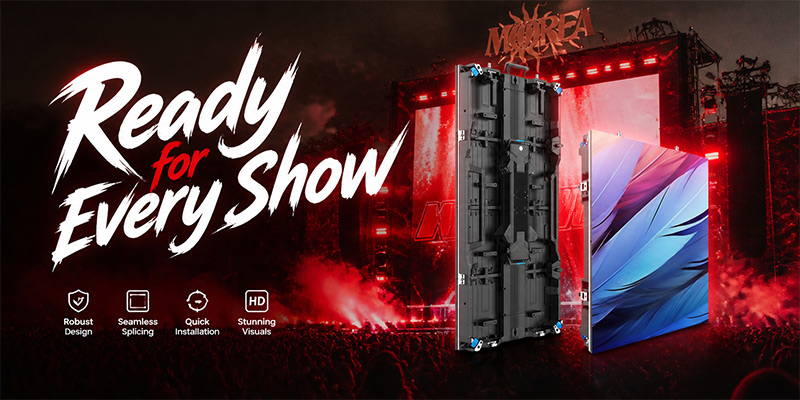
MU also addresses another part of the durability equation: protecting the LED lamp beads during handling. The cabinet incorporates an anti-collision design at the bottom, helping protect the lamp beads from direct impact in an area that can be exposed during installation and transportation. Optional corner guards are also available to protect the four corners of the cabinet. These guards help shield the cabinet edges and the LED lamp beads positioned close to those edges when the equipment is being installed, moved or transported.
These details are important because they demonstrate that durability does not have to come from simply making a cabinet heavier. A rental LED cabinet can instead be engineered around several practical requirements at the same time: the material needs to provide appropriate structural characteristics, the cabinet needs to maintain its geometry, the weight needs to remain manageable, and the most vulnerable parts of the display need protection during real-world handling.
What Should You Look for When Comparing LED Cabinets?
When comparing LED display cabinets, weight is still worth considering, but it should be placed in context. A specification such as 7.6 kg or 12.6 kg tells you something useful about transportation and handling, but it does not tell you the complete structural story. To understand the cabinet more accurately, it is better to look at the material, structural geometry, connection system, protection features and intended installation method alongside the weight.
This is particularly important when choosing a rental LED display. The equipment is expected to work not only when the screen is operating but also when it is being moved, installed, dismantled and stored. A cabinet that performs well in a showroom but is difficult to handle or poorly protected during transportation may not be the best practical solution for a busy rental operation. Conversely, an extremely lightweight cabinet may not provide the rigidity or protection required for a particular application.
The most useful evaluation therefore moves away from a simple question of “heavy versus light.” Instead, it considers whether the cabinet has the right combination of structural performance, weight, durability and protection for the conditions in which it will actually be used.
So, Does a Heavier LED Cabinet Mean a Stronger Cabinet?
Not by itself.
A heavier LED cabinet may contain more material or use a denser material, but weight alone cannot determine its structural strength or rigidity. The performance of an LED display cabinet depends on how its material, geometry, connections and protective features work together under real operating conditions.
For rental LED displays, this becomes particularly important because the cabinet has to cope with repeated transportation, installation, stacking, rigging and handling. The goal is not simply to build the heaviest cabinet possible. It is to develop a structure that provides the required performance without unnecessary weight and that protects the components most vulnerable to physical damage.
So the next time two LED cabinets are placed side by side and one is noticeably heavier, the better question is not simply, “Which one is stronger?”
Ask instead: What is the cabinet made from? How is its structure designed? How does it handle load and deformation? How is it protected during transportation and installation? And how well does that combination match the demands of the application? In LED display engineering, weight is a specification. Structural performance is the result of design.


+86-(0)731-84539619


Hunan Yestech Optoelectronic Co., Ltd. Terms of Service Privacy Policy Powered by szweb


