



ADDRESS
Blog/2026.08.11
When an LED display needs to be installed for a live event, every minute on site matters. A rental LED display may need to be assembled, tested and ready for showtime within a narrow production window, often while lighting, audio, staging and rigging crews are working around the same space. Under these conditions, installation speed is not simply a matter of how quickly a technician can connect two LED cabinets. It is a question of how efficiently the entire installation workflow can move from individual cabinets to a completed, aligned and serviceable LED display.
This is why “fast installation” can be misleading when it is treated as a single product feature. A quick-lock mechanism may shorten one operation, but if installers still need multiple people to hold each cabinet, spend time correcting alignment or partially dismantle the screen to access a component, the overall LED display setup may not actually be fast. Installation efficiency comes from reducing unnecessary operations throughout the workflow: handling, positioning, locking, connecting, configuring and maintaining the display.
For rental LED screens in particular, this distinction matters. Unlike a fixed LED display that may be installed once and remain in place for years, rental cabinets can be transported, assembled, dismantled and reconfigured repeatedly. A cabinet that is designed around this workflow can save time not only during the initial LED screen installation, but throughout the equipment's rental lifecycle.
Fast Installation Starts With the Installation Workflow
The first thing to understand is that LED display installation is a sequence of repeated operations rather than a single task. A typical rental LED display setup involves positioning cabinets, aligning them, securing the connection, connecting power and signal, checking the screen and making any necessary adjustments. Each individual operation may take only seconds or minutes, but a large LED wall can contain hundreds of cabinets and thousands of repeated actions.
This makes the number of operations per cabinet an important part of installation efficiency. If an installer has to hold a cabinet in position while another technician operates several locks, the process depends on coordination between two people. If a connection requires a tool, the installer must also stop to access that tool. If cabinets do not align accurately when connected, additional time is spent making corrections after the screen has already been assembled.
The principle is straightforward: the fewer repetitive actions required to complete each cabinet connection, the more efficient the overall LED display installation can become. This does not mean that every LED cabinet should simply have fewer components. It means that the components should be designed around the actual workflow of the people installing the display.
This is one reason rental LED display manufacturers increasingly focus on quick connection systems, accessible handles, tool-free mechanisms, modular components and service-friendly cabinet structures. Industry installation guides commonly treat cabinet connection, alignment and cabling as separate parts of the installation process, showing why cabinet design can influence more than just the physical act of joining panels.
Single-Person Operation Is About Workflow, Not Just Labor
One of the clearest ways to improve LED cabinet installation efficiency is to reduce unnecessary dependence on multiple installers. This does not mean every LED display should be installed entirely by one person, nor does it replace proper site safety procedures or the need for qualified crews. Rather, it means that individual cabinet operations should be manageable without requiring another person to perform a supporting action every time a cabinet is positioned or secured.
This becomes especially relevant in rental and touring environments. Event crews often work under compressed schedules, and several teams may be installing equipment simultaneously. A cabinet that requires one person to hold it continuously while another person operates the locking mechanism creates a dependency between two workers. Across a large LED wall, that repeated coordination can become a significant source of lost time.
Ergonomics therefore plays an important role in LED cabinet design. Handles need to provide a secure and natural grip. Holding points should be positioned where installers can control the cabinet while aligning it with adjacent cabinets. Locking mechanisms should be accessible without forcing the installer into an awkward position. The objective is to make the sequence of pick up, position, connect and secure as direct as possible.
Single-person operation is particularly valuable during hoisting installation. When a cabinet is being connected to a hanging structure, the installer may need to control the cabinet while simultaneously completing the connection. A locking mechanism that can be operated quickly and securely can allow the installer to release the cabinet sooner and move on to the next operation.
The important point is that single-person operation is not simply a marketing phrase. It reflects a broader principle of human-centered cabinet design: the physical interface between the technician and the LED cabinet should support the way the equipment is actually handled on site.
Quick-Lock Systems: Why the Mechanism Matters
Quick locks are now common on rental LED cabinets, but not all quick-lock systems deliver the same practical benefit. The value of a locking mechanism is not simply that it can be operated quickly. Its effectiveness depends on how many actions are required, how accessible the mechanism is, whether tools are needed and whether the lock helps maintain cabinet alignment during connection.
Consider a simplified installation sequence. The technician positions the cabinet, aligns the connection points, secures the lock and moves to the next cabinet. If the mechanism can be operated directly from the working position, the process is relatively straightforward. If the installer must manually hold the cabinet, reach behind it, use a tool or make repeated adjustments before the lock can engage, the nominal “quick lock” may not translate into a genuinely faster LED display installation. A well-designed locking system should therefore do more than connect two cabinets. It should help simplify the installation workflow by reducing the number of independent actions required to create a secure connection.
This is particularly important for large rental LED displays. A difference of only a few seconds per cabinet can become meaningful when multiplied across hundreds of cabinets. The same principle applies to dismantling. Rental equipment is installed and removed repeatedly, so a mechanism that is efficient in both directions can have a larger operational benefit than a feature optimized only for initial setup.
Alignment is also closely related to locking. If the connection system allows cabinets to be secured while maintaining accurate positioning, installers spend less time correcting the display after the structure has been assembled. Professional display installation systems often emphasize alignment precision and adjustment capability because the final surface needs to remain consistent across a large array.
Alignment Is Part of Installation Speed
It is easy to think of alignment as a finishing step rather than part of installation itself. In practice, alignment can have a significant impact on how quickly an LED wall can be completed. A rental LED display is assembled from multiple cabinets, but the audience sees one continuous screen. Small differences in cabinet position can become visible across a large surface, particularly when the display is viewed at close range or when the content contains high-contrast lines and geometric patterns. For this reason, installers need to control the relationship between adjacent cabinets as the screen is assembled.
If a cabinet connects but does not settle into the correct position, the technician may need to stop, inspect the seam, make an adjustment and check it again. Repeating that process across a large screen adds time even though the cabinet connection itself may be fast. This leads to an important distinction: Fast connection is not necessarily fast installation.
A genuinely efficient LED cabinet should make it easy to achieve accurate positioning during the connection process rather than requiring extensive correction afterward. The locking system, cabinet frame and connection points therefore work together as part of the alignment system. For large LED walls, this becomes even more important because small inconsistencies can accumulate across multiple rows and columns. Installation efficiency is ultimately measured by how quickly the crew can create a display that is not only assembled, but also properly aligned and ready for operation.
Cable and Component Access Also Affect Setup Time
The physical cabinet connection is only one part of an LED display installation. Power and signal connections also need to be completed, checked and, when necessary, accessed again. The cabinet architecture can influence how easily technicians reach these components.
This is where accessibility becomes an important engineering consideration. A component may be technically replaceable but still time-consuming to access if several surrounding parts have to be removed first. In a rental environment, that creates additional labor during both setup and troubleshooting. Power supplies and control components are particularly relevant because they are essential to the operation of the display. A design that allows a technician to reach a power box quickly can reduce the time required to resolve a component-level issue without disturbing the surrounding cabinet structure.
The same principle applies to service access. Front and rear maintenance options give technicians more flexibility because the appropriate access direction depends on the installation environment. A display installed close to a wall or structural element may have limited rear access, while a stage LED wall may provide convenient access from behind. Professional LED display systems therefore increasingly consider serviceability as part of the cabinet architecture rather than treating it as an afterthought. Front and rear access, magnetic modules and accessible power components are already used across professional LED display systems for this reason.
Fast Installation Should Include Maintenance
There is another important point that is often overlooked when discussing LED display installation: the job is not necessarily finished when the last cabinet is connected. For rental LED screens, installation and maintenance are closely connected. The equipment may be used for several hours or several days, and a module, power component or connection may need attention after the screen has already been built. If technicians can only access a component by dismantling a large portion of the LED wall, a minor issue can turn into a major interruption. This is why serviceability should be considered part of overall installation efficiency.
A front-service LED display can be valuable where rear access is restricted. Rear service can be convenient when the back of the display is accessible. Supporting both approaches gives technicians more options and reduces the need to design the entire installation around one maintenance direction.
Module positioning also matters. When LED modules use a defined positioning system, technicians can remove and reinstall them with less adjustment. Magnetic positioning can help guide the module into place, while an anti-lost mechanism can prevent the module from being separated from the cabinet during service.
Modular Design Can Simplify Configuration
Another factor that can improve LED display deployment efficiency is modularity. A modular LED display platform allows the same underlying cabinet architecture to support different configurations instead of requiring completely different cabinet structures for every application.
The concept is particularly useful for rental LED displays because rental inventories need to serve different venues and event formats. An indoor corporate event, an outdoor festival and a touring stage may have different requirements, but maintaining completely separate cabinet architectures for every use case can increase inventory complexity. A universal cabinet frame with interchangeable modules can provide another approach: keep the structural platform consistent while adapting the display configuration through the module. This type of platform design is already used in professional LED products where different cabinet configurations, service directions and module systems are designed to work within a common architecture.
What Makes an LED Cabinet Truly Installation-Friendly?
Putting all these factors together, an installation-friendly LED cabinet is not defined by one specification. It is a combination of several design decisions. The cabinet should be easy to handle and position. The connection mechanism should require as few actions as practical. The locking system should be accessible and intuitive. Cabinet alignment should be achievable during connection rather than corrected afterward. Power and signal components should be accessible when service is required. Modules should be easy to position and remove. And where possible, the same cabinet platform should support different configurations.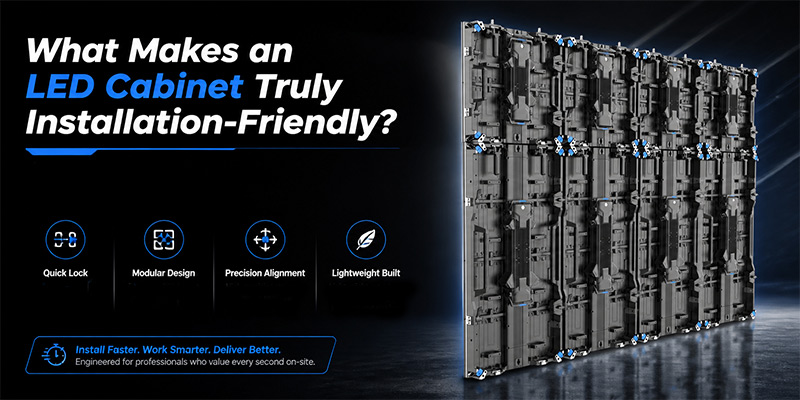
In other words, installation efficiency is the result of removing friction from the workflow. This is a useful way to evaluate rental LED displays because it moves the discussion beyond isolated product claims. Instead of asking whether a cabinet has a quick lock, a magnetic module or a removable power box, a professional buyer can ask a more meaningful question: How many operations does my crew need to complete before this LED display is ready for the show? That question considers the entire workflow rather than one feature. How MU Applies These Principles
MU takes this installation-oriented approach by combining a series of mechanisms designed around the actual workflow of rental LED display crews. Rather than relying on a single feature to make the cabinet “fast,” MU addresses several points where installers typically spend time: handling, hoisting, locking, component replacement, configuration and maintenance.
For cabinet handling, MU Series uses a large handle and enlarged holder design to provide a more convenient grip during installation. This is particularly useful when the installer needs to position the cabinet accurately before securing it. The design is intended to make the cabinet easier to control during the physical installation process rather than requiring installers to find improvised gripping points.
For hoisting installation, MU incorporates a quick-lock system designed for single-person operation. The hoisting lock can be operated in three steps, allowing the installer to secure the cabinet without continuously holding it throughout the locking process. The practical benefit is not simply a faster lock; it is the reduction of coordination required between installers during the hoisting workflow.
MU also applies the same efficiency principle to its power system. The control box uses an automatic pop-up design for easy disassembly and assembly, allowing the power box to be replaced in approximately 5 seconds. In practical terms, this reduces the amount of disassembly required to access the power component and helps technicians return the cabinet to service quickly when replacement is necessary.
The cabinet platform is also designed with flexibility in mind. MU uses a universal cabinet frame, allowing different configurations to be achieved by replacing the modules rather than redesigning the entire cabinet structure. The same platform can be adapted between indoor and outdoor applications through module replacement and can support different pixel pitches within the same series. For rental operators, this type of modular architecture can make equipment preparation and deployment more flexible.
Maintenance is another part of the MU installation philosophy. The cabinet supports both front and rear maintenance, giving technicians greater freedom to choose the appropriate access method for the installation environment. The LED module uses a magnetic positioning design with an anti-lost rope, helping technicians position the module accurately and quickly during replacement while keeping the module secured to the cabinet.
This becomes particularly useful when large LED walls are already assembled. According to the design, modules can be removed from a middle cabinet for replacement and maintenance without requiring the entire surrounding display to be dismantled. That matters because service time can become a significant part of the overall operational cost of a rental LED display.
Taken together, these features show a different way of looking at fast installation. MU does not treat installation speed as a single mechanical feature. The cabinet is designed to reduce small sources of friction throughout the workflow: making the cabinet easier to hold, simplifying hoisting, reducing locking operations, speeding up power box replacement, allowing flexible configuration and improving access for maintenance.
Fast LED Display Installation Is a System-Level Design Problem
The fastest LED display installations are not necessarily those with the most aggressively advertised “quick” features. They are the systems that make the entire workflow more predictable. A rental crew should be able to handle the cabinet, position it, secure it, connect the necessary components and move on without unnecessary interruptions. If a correction is required, the cabinet should provide a practical way to make that correction. If a component fails, the technician should be able to reach it without dismantling more of the display than necessary.
That is why fast LED display installation is better understood as a system-level design problem. Cabinet ergonomics, locking mechanisms, alignment, component accessibility, modular architecture and maintenance all contribute to the time required to build and operate an LED wall. For rental LED display users, the real measure of installation efficiency is therefore not simply how quickly one cabinet can be connected. It is how efficiently a complete LED display can be built, commissioned, maintained and returned to service.
MU applies this principle through a collection of installation-focused mechanisms, including single-person hoisting operation, quick locking, an automatic pop-up power box, a universal cabinet platform and flexible front-and-rear maintenance. Each feature addresses a different part of the workflow, but they work toward the same objective: less unnecessary handling, fewer repetitive steps and a more efficient LED display setup.


+86-(0)731-84539619


Hunan Yestech Optoelectronic Co., Ltd. Terms of Service Privacy Policy Powered by szweb


