



ADDRESS
Blog/2026.08.31
Outdoor transparent LED displays are increasingly used for concerts, festivals, sports events, architectural media, and large-scale outdoor stages. Their open structure and high transparency allow them to deliver large-format visuals without creating the same visual barrier as a conventional LED wall. However, the same design characteristics that make a transparent LED display visually distinctive also create specific engineering challenges when it is deployed outdoors.
Unlike an indoor LED display, an outdoor transparent LED display may be exposed to rain, wind, dust, humidity, temperature fluctuations, and prolonged operation in changing weather conditions. For large rental applications, the display may also be suspended above a stage or assembled into curved and irregular configurations, increasing the importance of structural stability and installation accuracy.
So, how does an outdoor transparent LED display handle harsh weather? The answer is not simply a higher IP rating or a higher transparency percentage. A reliable outdoor transparent LED display needs to combine environmental protection, structural engineering, airflow management, component protection, and a suitable installation system. IP ratings are an important part of this equation, but they specifically describe protection against the ingress of solids and water and should not be treated as a complete measure of outdoor performance.
Why Is Outdoor Protection Important for Transparent LED Displays?
The operating environment is one of the biggest differences between indoor and outdoor LED applications. An indoor display typically operates in a relatively controlled environment, while an outdoor display must continue to perform when environmental conditions change rapidly.
For a transparent LED display used at an outdoor concert or festival, rain may begin during installation or during the event itself. Strong winds can apply pressure to a large screen surface, particularly when the display is installed at height. Dust and airborne particles can enter exposed areas if the product is not properly protected. Temperature changes can also affect electronic components, materials, connectors, and the overall operating stability of the display.
The challenge becomes more significant as the display area increases. A small outdoor LED screen and a 2,000 m² transparent LED stage are not exposed to exactly the same engineering conditions. A large screen creates a much larger overall surface area and may involve multiple cabinets, connection points, support structures, and hanging positions. The performance of the complete installation therefore depends not only on the individual LED cabinet but also on how the cabinets, connectors, rigging system, and supporting structure work together. This is why choosing an outdoor transparent LED display should begin with the application environment rather than with visual specifications alone.
How Does Rain Affect an Outdoor Transparent LED Display?
Water is one of the most obvious environmental risks for outdoor electronic equipment. Rain can reach LED modules, PCBs, connectors, power components, and cabinet interfaces from different directions. During a temporary outdoor event, the display may be exposed to intermittent rain for several hours or even throughout multiple days of operation.
This is where the IP rating becomes an important specification. Under the IEC 60529 IP Code, the first digit relates to protection against solid foreign objects, while the second digit relates to water protection. An IP65 rating, for example, indicates dust protection at the first level and protection against water jets at the second level. The water-protection classification is based on standardized test conditions; it should not be interpreted as meaning that the equipment can be submerged.
For an outdoor transparent LED display, IP protection is therefore not simply a marketing number. It indicates how the enclosure and protected components are designed to resist defined forms of environmental exposure. However, IP protection should also be considered as part of a broader system. Cable interfaces, connectors, module interfaces, power boxes, cabinet joints, and other exposed components all need to be appropriately engineered for outdoor operation. A display can have a strong enclosure rating, but the installation still needs suitable cable routing, power protection, drainage considerations, and maintenance procedures. In other words, weather resistance starts with the display cabinet but does not end there.
Can a Transparent LED Display Withstand Strong Wind?
Wind is a particularly important consideration for outdoor transparent LED displays because large-format displays can be installed in locations where wind loads are significant.
Transparency can help improve airflow because a portion of the air can pass through the open areas of the display. Compared with a completely solid surface of the same overall dimensions, a permeable display structure can reduce the amount of surface area directly blocking airflow. This is one reason transparent LED technology is attractive for large outdoor stages and architectural installations. Outdoor transparent LED products in the market commonly emphasize airflow and reduced wind load as advantages of an open structure. But transparency alone does not determine wind performance.
A common misconception is that a display with a high transparency percentage is automatically a wind-resistant display. In reality, wind performance depends on the complete structural system. Transparency, cabinet geometry, frame strength, connection mechanisms, screen configuration, hanging method, installation height, supporting structure, and local wind conditions all influence the final result. This distinction is especially important for temporary event structures. A transparent LED screen may be installed as a flat wall, a curved screen, a suspended structure, or a 360° stage configuration. Each configuration can respond differently to wind loads.
Therefore, the correct question is not simply: “How transparent is the LED display?” It is: “How does the complete LED structure manage airflow and mechanical loads under the intended installation conditions?” For professional outdoor LED applications, wind-load assessment should be based on the actual installation and supporting structure rather than on transparency alone.
Does Higher Transparency Mean Better Outdoor Performance?
Higher transparency and outdoor reliability are related, but they are not the same thing. Transparency primarily describes how much of the background can remain visible through the display structure. It can also influence airflow and the amount of material exposed to wind. However, environmental protection involves a much broader set of engineering considerations.
A professional outdoor transparent LED display needs to balance several requirements at the same time: visual transparency, structural strength, weather protection, thermal management, component reliability, installation flexibility, and serviceability. This is why a product should not be evaluated based on one specification in isolation. A display with high transparency but insufficient structural reinforcement may not be appropriate for a large suspended stage. A display with a strong cabinet but inadequate environmental protection may face reliability issues during prolonged outdoor exposure. Likewise, a display with an appropriate IP rating still needs a correctly engineered supporting structure when installed at significant height. Outdoor reliability is a system, not a single specification. That principle is particularly important when selecting an outdoor transparent LED display for large-scale touring and event applications.
What Should You Look for in an Outdoor Transparent LED Display?
When selecting a transparent LED display for outdoor use, the first consideration should be whether the product has been engineered for the actual environmental conditions of the project. Weather protection is one fundamental requirement. A suitable IP rating provides a standardized indication of resistance to dust and water ingress, but the rating should be interpreted according to the actual exposure conditions. It is also important to understand that IP protection does not cover every environmental risk. The IP Code does not, for example, describe mechanical impact or corrosion resistance, which may require additional consideration depending on the application.
Structural design is equally important. The cabinet frame needs to provide sufficient rigidity for transportation, installation, operation, and dismantling. This becomes particularly relevant for rental LED displays that are repeatedly assembled and disassembled. The connection system also matters. Large outdoor screens may contain hundreds or thousands of individual cabinets. Quick locks, positioning systems, reinforcing structures, and accurate cabinet connections contribute to the stability and alignment of the overall screen.
Thermal management should not be overlooked either. Outdoor LED displays operate under direct sunlight and changing ambient temperatures. An appropriately engineered cabinet should manage heat effectively without compromising environmental protection. Finally, the display should be evaluated based on the complete installation rather than the cabinet specification alone. Screen dimensions, hanging height, support structure, wind conditions, installation method, power distribution, cable routing, and maintenance access all need to be considered before deployment.
Why Are Large Outdoor Stages More Challenging?
Large outdoor stages combine almost every challenge associated with outdoor LED displays. A large event screen may cover hundreds or thousands of square meters. It may be installed at considerable height, configured across multiple surfaces, and required to operate continuously throughout an event. Unlike a permanent architectural installation, a rental stage may also need to be transported, assembled, adjusted, dismantled, and transported again within a limited schedule.
The weather adds another layer of uncertainty. A sunny installation day can quickly become a rainy event day. Wind conditions may change between setup and performance. A stage that looks structurally stable under calm conditions must still be designed and installed for the environmental conditions expected during operation. This is why outdoor rental LED displays require more than high brightness and high transparency. They need a combination of mechanical reliability, environmental protection, efficient installation, and operational stability.
MT II Put to the Test: 2,000 m² at Kharkhorum Festival 2026
These requirements were put into practice at Kharkhorum Festival 2026 in Mongolia, where approximately 2,000 m² of transparent LED displays were used to create a large-scale 360° outdoor stage. The festival marked a significant change from previous editions, moving from the indoor Steppe Arena to an outdoor stadium environment. This transition introduced a very different set of environmental requirements for the LED display system.
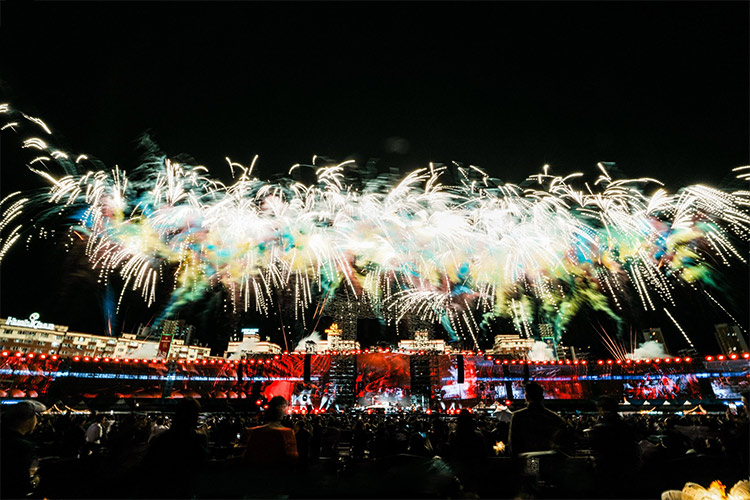
The stage was designed around a multi-screen configuration, combining a central 11 m × 16 m screen with two screens of the same size on either side. Additional screens were installed around the rear and sides of the stage, creating an approximately 300-meter-long circular visual environment. The result was a 360° LED stage covering approximately 2,000 m². For an installation of this scale, environmental protection could not be considered separately from structural and installation requirements. The display had to maintain stable operation while being configured across a large outdoor structure and exposed to changing weather conditions. This is where the characteristics of MT II became particularly relevant.
How Does MT II Handle Outdoor Conditions?
MT II blow-through display is designed as an outdoor transparent LED display for demanding stage and event applications. Its design combines high transparency with structural reinforcement and outdoor protection, allowing it to address several of the challenges associated with large-scale outdoor installations. With more than 50% transparency, MT II allows a significant amount of air to pass through the display structure. This open configuration can help reduce the wind-blocking effect of a conventional solid LED wall, which is particularly valuable when a large transparent display is installed outdoors.
At the same time, MT II is designed with structural reinforcement rather than relying on transparency alone. Its magnesium-alloy dual-frame structure and integrated reinforcing ribs improve the rigidity of the cabinet and help support large-scale screen configurations. This distinction is important: the objective is not simply to make the screen transparent, but to combine openness with structural reliability.
MT II also provides IP65 protection for outdoor applications. As discussed earlier, IP65 represents protection against dust ingress and water jets under standardized test conditions. It is an important part of an outdoor LED display's environmental protection strategy, particularly for temporary events where exposure to rain and dust cannot be fully controlled. For the Kharkhorum Festival installation, intermittent rain occurred during the preparation period and event days. Despite the challenging outdoor conditions, the MT II display system maintained stable operation throughout the event.
From Weather Protection to Large-Scale Performance
Weather protection is only meaningful when it supports reliable performance in a real application. At Kharkhorum Festival, MT II was not used as a small outdoor display. It formed the visual core of an approximately 2,000 m² LED stage extending around 300 meters and creating a 360° immersive environment. The system combined flat and curved configurations to create a continuous visual experience around the stage. This type of large-scale configuration demonstrates why transparent LED technology requires a balance between visual design and engineering performance.
The installation was completed within five days, supported by MT II's fast connection and handling design. For a large festival production, installation efficiency is closely connected to reliability: the faster and more accurately a screen can be assembled, the more time the production team has for testing, calibration, content preparation, and final safety checks. The result was a large outdoor LED environment capable of delivering immersive visuals while maintaining stable operation under changing weather conditions.
What Makes an Outdoor Transparent LED Display Truly Reliable?
A reliable outdoor transparent LED display should not be judged by transparency, brightness, or IP rating alone. The more meaningful evaluation is whether the display can maintain stable performance within the complete conditions of the intended application. That means considering environmental protection against rain and dust, structural design for mechanical loads, airflow management for outdoor wind conditions, component protection, thermal performance, installation accuracy, and the supporting structure as a complete system. This becomes even more important for large-scale rental applications. A screen covering thousands of square meters is not simply a collection of individual LED cabinets. It is a temporary engineered structure that must perform as one integrated system.
The successful deployment of approximately 2,000 m² of MT II at Kharkhorum Festival 2026 provides a practical example of this principle. By combining more than 50% transparency, IP65 outdoor protection, reinforced cabinet construction, and a design suited to large-scale stage configurations, MT II demonstrates how transparent LED technology can balance visual openness with the reliability required for demanding outdoor events.
Ultimately, the best outdoor transparent LED display is not simply the one with the highest transparency or the highest IP rating. It is the one engineered to handle the complete environment in which it will operate. For concerts, festivals, touring productions, and large outdoor stages, that means looking beyond the specification sheet and evaluating the entire system—from cabinet structure and environmental protection to wind management, installation, and real-world performance. That is what turns an outdoor transparent LED display from a visual product into a reliable professional stage solution.


+86-(0)731-84539619


Hunan Yestech Optoelectronic Co., Ltd. Terms of Service Privacy Policy Powered by szweb


