



ADDRESS
Blog/2026.08.25
For a long time, the LED cabinet was one of the least visible parts of stage design. Audiences saw the LED display, but rarely thought about the structure behind it. In a conventional stage setup, the requirement was relatively simple: assemble a number of cabinets into a flat, stable screen, connect the power and signal, and make sure the display performs reliably throughout the event. Cabinet dimensions, weight, locking mechanisms and maintenance access mattered, but they were largely considered engineering details rather than creative considerations.That is changing as stage design becomes more spatial and less rectangular.
Concerts, festivals, touring productions, corporate events and large-scale entertainment shows increasingly use LED displays as part of the physical architecture of the stage. Screens are no longer limited to a single flat backdrop. They can wrap around performers, follow curved stage structures, form corners, extend vertically, create cubes or other three-dimensional structures, and combine several display surfaces into one visual environment. The LED screen is becoming part of the architecture rather than simply a surface attached to it. This change is also changing the role of the LED cabinet.
A modern rental LED cabinet has to do more than carry LED modules. It has to provide a mechanical system that allows the display to be assembled quickly, aligned accurately, transported repeatedly and configured into different shapes. For rental companies and touring productions in particular, cabinet design has become closely connected to production efficiency. The question is no longer simply whether a cabinet can produce a high-quality image. It is whether the cabinet can support the way professional stage productions are actually built.
Why the Traditional Flat LED Cabinet Is No Longer Enough
The standard rectangular LED wall remains one of the most common configurations in the industry, and there is nothing inherently wrong with a flat cabinet system. Large flat screens are efficient to manufacture, transport and install, and they remain the right solution for many applications. The limitation appears when the creative brief moves beyond a flat plane.
Consider a stage where the LED wall needs to curve around the audience sightline. A conventional fixed-angle cabinet can only approximate that curve through a limited number of predefined configurations. If the stage requires a different radius, the available cabinet geometry may become a constraint. The same issue appears when a designer wants to create a 90-degree corner, a recessed section, a wraparound screen or a three-dimensional LED structure. This is why the mechanical architecture of a rental LED display has become increasingly important.
The connection between cabinets determines how freely a screen can move from one plane to another. The cabinet dimensions influence how efficiently different areas of the structure can be filled. The locking mechanism affects both installation speed and alignment. Cabinet weight influences manual handling, transportation and rigging loads. Service access determines how easily technicians can maintain a screen after it has been installed. In other words, the cabinet is no longer just the container around the electronics. It is part of the system that determines what the display can physically become.
The Shift From Screen Size to Screen Geometry
One of the clearest changes in stage LED design is the growing importance of geometry. A large LED wall can create visual impact simply through its scale. More sophisticated productions, however, often use geometry to create visual depth. A curved screen can follow the shape of a stage. A corner can turn a conventional backdrop into a three-dimensional structure. Multiple planes can create depth between foreground and background. Cylindrical or polygonal structures can become independent scenic elements.
This is why flexible and curved LED cabinets have become increasingly common in rental LED systems. A curved cabinet does not simply make the screen look different. It changes the relationship between the display and the audience. A concave configuration can visually enclose a performance area, while a convex configuration can project the screen toward the audience. The radius of the curve, cabinet angle and number of cabinets determine the final geometry, so the mechanical accuracy of the cabinet connection system becomes critical.
The principle is straightforward: the more complex the desired geometry, the more important the cabinet's mechanical design becomes. Modern rental LED cabinets therefore increasingly incorporate adjustable locking systems, positioning structures and cabinet formats designed specifically for curved or angled installations. Industry products now commonly offer combinations of flat, curved and 90-degree configurations rather than treating each as an entirely separate application.
This development is significant for rental companies because the same inventory can potentially support more types of productions. Instead of purchasing one screen system for flat walls and another for every creative configuration, a flexible cabinet platform can provide a broader range of usable layouts.
Cabinet Dimensions Are Becoming a Design Consideration
Cabinet size is another factor that is often underestimated. A 500 × 1000 mm cabinet and a 500 × 500 mm cabinet may appear to perform the same basic function, but they create different possibilities during installation. Larger cabinets can reduce the number of individual units required for a large surface, while smaller formats can provide more flexibility around corners, transitions and irregular structures.
This is why some professional rental LED platforms use multiple cabinet sizes within the same system. The objective is not simply to have more options. It is to balance installation efficiency with design flexibility. For a large flat LED wall, larger cabinets can help crews cover the structure efficiently. For a stage with multiple dimensions or transitions, smaller cabinets can make it easier to complete sections without creating unnecessary gaps or requiring custom fabrication. In practice, cabinet size becomes part of the cabinet map and stage engineering process. This is also where the distinction between a display specification and a system specification becomes important.
Pixel pitch, brightness, refresh rate and contrast describe how the display performs visually. Cabinet dimensions, connection methods, weight, installation orientation and maintenance access describe how the display behaves as a physical system. For professional rental applications, both sets of specifications have to work together.
Installation Speed Is an Engineering Issue
A complex stage may take only a few minutes to look simple once the show begins. Behind that result can be hundreds or thousands of individual cabinet connections. For rental and touring productions, installation time is therefore directly connected to operating cost.
A cabinet that requires several manual adjustments for every connection may add only seconds to a single cabinet installation. Multiply that by hundreds of cabinets, however, and the accumulated labor can become substantial. This is why professional rental cabinets increasingly focus on fast-locking mechanisms, precise positioning and tool-free or reduced-tool installation. The objective is not simply to make installation faster. It is to make installation repeatable.
This is particularly important for curved LED screens. If the angle between cabinets is inconsistent, small errors can accumulate across the entire display. The result may be visible as uneven curvature, misalignment or mechanical stress. Precision in the locking system therefore has both aesthetic and structural implications. For this reason, the development of rental LED cabinets increasingly treats installation mechanics as a core engineering feature rather than an accessory.
Weight Reduction Has a Direct Impact on Touring
The growth of touring and large-scale rental productions has also increased the importance of cabinet weight. A touring LED screen may be transported dozens of times during its service life. Every additional kilogram affects handling, packing density, vehicle loading and, in suspended applications, the overall rigging load. At the venue, lighter cabinets can also reduce physical strain on technicians during installation and dismantling.But lightweight construction has to be approached carefully.
Reducing weight by itself does not make an LED cabinet better. The cabinet still needs sufficient structural rigidity, reliable locking points, accurate alignment and protection for the LED modules and internal electronics. A rental cabinet is subjected to repeated mechanical handling that a permanent indoor display may never experience. The engineering challenge is therefore to reduce unnecessary material while preserving the mechanical properties required for professional use.
This is one reason die-cast aluminum and other lightweight structural approaches have become common in rental LED cabinets. Across the industry, manufacturers increasingly combine lightweight frames with reinforced corners, integrated handles, positioning pins and dedicated locking systems to balance handling efficiency with durability. For touring productions, the benefit is cumulative. A cabinet that is easier to lift, connect, remove and pack may save only a small amount of effort at each step, but that difference becomes significant over an entire production schedule.
Maintenance Has to Be Considered Before the Screen Goes Up
Another important change in LED cabinet design is the increasing attention given to maintenance access. In a simple ground-stacked LED wall, technicians can often access the rear of the cabinet. In a flown screen, a high stage structure or a tightly integrated scenic installation, rear access may be restricted. A cabinet that is easy to service from the front can therefore reduce the need to dismantle part of the structure when a module, receiving card or power component needs to be replaced.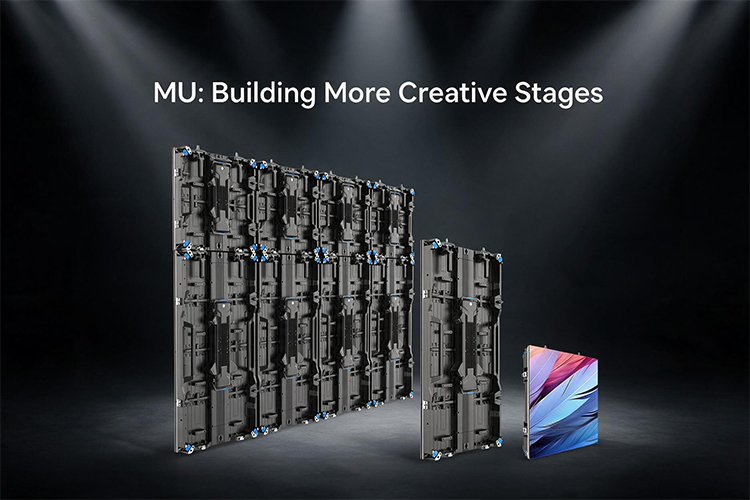
This is particularly relevant to rental fleets because equipment is expected to return to service quickly. A professional rental LED display should therefore be evaluated not only by how quickly it can be installed, but also by how quickly it can be repaired. Front and rear maintenance, removable power boxes, modular components and accessible connection points can all reduce downtime when service is required.
The same principle applies to transportation and protection. Cabinets that repeatedly move between trucks, warehouses and venues need protection around corners and other vulnerable areas. A good rental cabinet is designed around the entire operational cycle: transport, installation, operation, dismantling, maintenance and storage. That lifecycle perspective is increasingly important as LED rental companies look beyond the initial purchase price and evaluate total cost of ownership.
The More Interesting Development: Modular Cabinet Ecosystems
Perhaps the most important evolution is that manufacturers are moving from individual cabinet products toward more flexible cabinet ecosystems. A stage designer does not necessarily need one cabinet that can do everything. What is more useful is a system in which different cabinet formats can work together.
A standard cabinet can handle the main flat surface. A curved cabinet can create an arc. A dedicated corner cabinet can create a clean transition between planes. A flexible cabinet can handle a more irregular shape. When these formats share compatible mechanical and electrical principles, the rental company can build more configurations from a manageable inventory.
This approach is already visible in professional rental LED products across the market, where manufacturers are combining standard cabinets with curved, flexible and corner formats to support more complex stage structures. The advantage is not only creative.
For a rental company, inventory efficiency matters. Equipment that can be used across concerts, festivals, corporate events, exhibitions and touring productions has greater utilization potential. A modular cabinet ecosystem can therefore expand creative possibilities without requiring an entirely separate fleet for every type of stage design.
How the MU Series Fits Into This Evolution
The YES TECH MU Series is a useful example of how these requirements are being addressed in a professional rental LED cabinet. Rather than treating the cabinet as a fixed rectangular unit, the MU platform is designed around the practical requirements of rental and staging: different cabinet formats, flexible installation, fast handling and compatibility with creative configurations.
The MU Series includes 500 × 500 mm and 500 × 1000 mm cabinet formats, giving production teams different options when balancing installation efficiency and layout flexibility. Its cabinet architecture is also designed for curved configurations, allowing the display to move beyond a purely flat installation.
This matters because a stage is rarely a perfect rectangle. A large central LED wall may use the larger cabinet format for efficient coverage, while smaller sections can use the 500 × 500 mm format where greater flexibility is needed. The ability to combine different cabinet dimensions can be particularly useful when a stage design includes multiple screen surfaces or transitions.
The MU Series is also designed around single-person handling, helping crews work more efficiently during installation and dismantling. Its mechanical design supports the repeated setup cycles expected from rental equipment, while front and rear maintenance options give technicians greater flexibility depending on how the screen is installed. These features are not independent selling points. They address the same underlying requirement: an LED cabinet needs to adapt to the production workflow as well as the visual design. That is ultimately what distinguishes a modern rental LED cabinet from a conventional display panel.
What Should Professional Buyers Look for in an LED Cabinet?
As stage designs become more complex, buyers should evaluate LED cabinets at the system level rather than comparing only pixel pitch and brightness. The first consideration is mechanical flexibility. Can the cabinet support the configurations your productions actually require? If curved screens are important, what range of curvature is available, and how accurately can that angle be controlled? If your projects use corners or three-dimensional structures, does the system offer dedicated solutions rather than relying on improvised connections?
The second is installation efficiency. How many steps are required to connect two cabinets? Can one technician handle the cabinet? Are positioning and locking mechanisms designed to reduce alignment work? The third is structural performance. Rental cabinets are repeatedly transported and assembled, so impact protection, connection strength, structural rigidity and rigging compatibility deserve as much attention as visual specifications.
The fourth is serviceability. A display that performs well but takes hours to access when a component fails can become expensive to operate over time. Front or rear maintenance, modular power and signal components, and easy access to critical parts can make a significant difference in real-world production. Finally, consider system scalability. A cabinet that can work with other formats and configurations may provide more long-term value than a cabinet designed around one specific screen shape.
The LED Cabinet Is Becoming Part of the Stage Design
The evolution of the LED cabinet reflects a broader change in the live-event industry. LED displays are no longer used only as large electronic backdrops. They are increasingly being integrated into the physical language of the stage. Curves, corners, multiple planes, suspended structures and unconventional geometries are becoming part of the visual vocabulary of concerts and live productions.
That puts new demands on the cabinet. The modern LED cabinet has to be light enough to handle, strong enough to travel, precise enough to align, flexible enough to create different shapes, accessible enough to maintain and efficient enough to install under real production schedules.
This is why cabinet engineering has become an increasingly important part of LED display development. Image quality will always matter, but professional stage production requires more than a good picture. The mechanical platform behind that picture determines how quickly a screen can be built, how many configurations it can support and how reliably it can return to service after the show. The direction of the industry is therefore clear: LED cabinets are evolving from standardized display boxes into modular building blocks for stage architecture.
For designers, that means more freedom to turn a visual concept into a physical structure. For rental companies, it means greater fleet flexibility and better equipment utilization. For touring crews, it means faster installation, easier handling and more practical maintenance. And for the LED display itself, it means one important thing: the cabinet is no longer simply what holds the screen together. Increasingly, it is what makes the design possible.


+86-(0)731-84539619


Hunan Yestech Optoelectronic Co., Ltd. Terms of Service Privacy Policy Powered by szweb


