



ADDRESS
Blog/2026.07.16
The live entertainment industry is experiencing rapid transformation. Concert tours, music festivals, and large-scale events are becoming more frequent, while stage productions continue to become more complex. Modern performances are no longer defined only by artists and lighting effects; they are immersive environments where LED displays, stage structures, lighting systems, automation technologies, and creative content work together to deliver a complete visual experience.
As production expectations continue to rise, the pressure on technical teams has also increased. A successful event requires not only outstanding visual performance but also efficient installation, reliable operation, and fast turnaround between venues. This is particularly important for touring productions, where the same LED display system may need to be transported, installed, operated, and dismantled repeatedly across different locations within a limited timeframe.
In the past, LED display selection was often focused primarily on image quality, brightness, pixel pitch, and viewing experience. While these factors remain essential, production teams today are paying increasing attention to another critical factor: operational efficiency.
For touring and rental applications, the real cost of an LED display system is not determined only by the equipment itself. Installation time, technician requirements, maintenance procedures, transportation efficiency, and potential downtime all directly influence the overall project cost.
A display system that requires complicated assembly procedures or extensive troubleshooting can create additional pressure on production schedules. Even small delays during installation can affect rehearsals, lighting programming, and final show preparation. As a result, stage professionals are increasingly looking for transparent LED display solutions that can simplify deployment without compromising visual performance.
This shift has accelerated the development of more integrated LED display architectures. Instead of focusing only on improving individual hardware components, manufacturers are now exploring how the entire system can be optimized to support faster installation, easier maintenance, and more efficient touring operations.
Why Traditional Transparent LED Display Systems Create Installation Challenges
Transparent LED displays have become increasingly popular in stage applications because they provide unique creative possibilities. Unlike traditional LED walls, transparent LED screens allow designers to combine digital visuals with physical stage elements, lighting effects, and performer visibility. This makes them particularly valuable for concerts, festivals, and immersive stage environments. However, as transparent LED displays become more widely used in touring productions, the requirements for system efficiency have also become more demanding.
Traditional LED display systems are often built around multiple independent components. A complete installation may involve separate power systems, signal processing components, receiving cards, connection structures, and external control devices. While this modular approach provides flexibility, it can also increase installation complexity when systems need to be deployed frequently.
For fixed installations, this complexity is usually manageable because the equipment remains in one location for an extended period. Touring productions, however, operate under very different conditions. The same equipment may experience repeated transportation, installation, removal, and reconfiguration. Each additional connection and external component adds another step that technicians must manage during every deployment cycle.
Over time, these small operational requirements can become significant. More connections mean more inspection points. More external components mean more preparation work. More complex cable structures mean longer installation and troubleshooting processes.
Cable management is one example of a challenge that is often overlooked. In large-scale stage productions, hundreds of power and signal connections may need to be organized within a limited backstage environment. Technicians must ensure that every connection is properly installed, labeled, and tested before the show begins. The process requires both time and experience. For touring productions, efficiency is not simply about installing a display once. It is about creating a repeatable workflow that can be executed reliably at every venue. This has driven the LED display industry toward a new design philosophy: reducing unnecessary complexity through greater system integration.
What Does Integrated Transparent LED Display Design Mean?
The concept of integration has become an important trend in the development of modern LED display systems. An integrated transparent LED display system is designed to combine multiple functional elements into a more unified architecture, reducing dependence on external components and simplifying the overall workflow.
The purpose of integration is not only to make a display system smaller or more compact. More importantly, it improves how the system is installed, operated, and maintained throughout its entire lifecycle. By integrating key electronic components, modern LED display systems can reduce the number of independent connections required during installation. Functions that previously depended on multiple external devices can be managed through a more streamlined structure, allowing technicians to complete setup procedures more efficiently.
This approach is particularly valuable for touring and rental LED display applications, where speed and consistency are essential. A simplified system architecture reduces installation steps, minimizes potential connection issues, and makes troubleshooting more straightforward.
Beyond hardware integration, modern transparent LED display systems are also moving toward smarter operation. Improved control methods, simplified configuration processes, and more efficient monitoring capabilities are helping production teams manage complex stage environments with greater confidence. As live events continue to demand faster deployment and more flexible stage designs, integrated LED display technology is becoming an important direction for the future of professional display solutions. The evolution of transparent LED displays is no longer only about achieving higher brightness or finer pixel pitches. It is increasingly about creating systems that fit better into the real-world workflow of concerts, festivals, and touring productions.
How MAir Improves Touring Efficiency Through Integrated and Wireless Design
As touring productions continue to demand faster setup, easier operation, and more reliable performance, transparent LED display systems are evolving beyond traditional modular designs. For production teams, installation efficiency is no longer only about reducing assembly time. It also involves simplifying every stage of the workflow, from transportation and setup to maintenance and replacement.
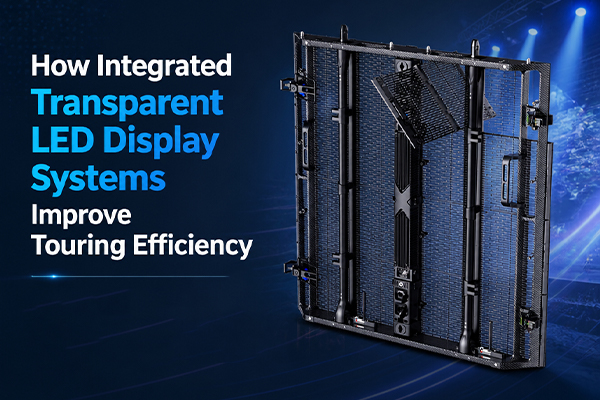
Designed for professional touring applications, MAir adopts an integrated and streamlined system architecture that helps reduce unnecessary complexity during installation and operation. By combining integrated design concepts with optimized connection solutions, MAir provides a more efficient approach for transparent LED display applications where speed and reliability are critical.
For a transparent LED display for touring, every installation step matters. Large-scale concerts, festivals, and live events often require equipment to be assembled and dismantled within limited timeframes. A system that reduces manual procedures can significantly improve overall production efficiency while helping teams better manage labor requirements.
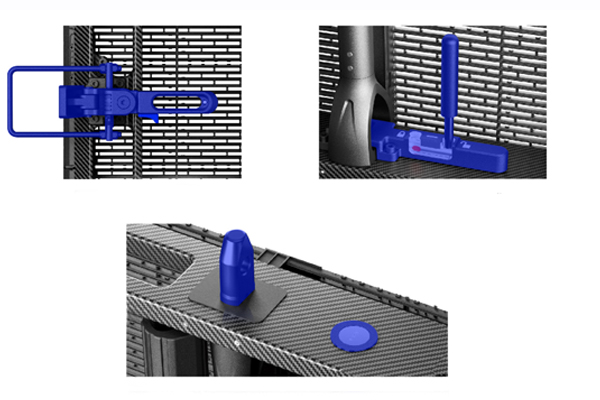
One of the key elements behind MAir’s installation efficiency is its simplified connection design. The self-developed curved blade lock features a one-touch pop-up mechanism and supports single-handed operation, allowing technicians to complete cabinet connection more quickly during stage setup. Compared with traditional locking structures that require more manual adjustment, this design helps create a smoother and more efficient installation process.
The large latch lock structure further improves usability during both installation and dismantling. When the cabinets are separated, the latch automatically rebounds, making removal easier and reducing unnecessary handling steps. For touring productions where equipment is frequently assembled, transported, and rebuilt at different venues, these small improvements can create meaningful time savings throughout the entire touring cycle.
Precision is another important factor in professional stage LED display installation. MAir integrates large positioning pins with a top magnetic suction design, enabling faster and more accurate cabinet alignment. This helps technicians achieve efficient positioning while reducing adjustment time during large-scale screen assembly.
Beyond installation, maintenance efficiency is equally important for rental and touring applications. A touring transparent LED display system needs to support quick service procedures because any unexpected issue during an event can affect the entire production schedule. MAir’s modular design supports fast rear maintenance, allowing technicians to access components efficiently when servicing is required. The power box is equipped with safety holes designed to improve operational safety during work at height, providing additional protection for technicians working in complex stage environments.
The interchangeable left-right module design further simplifies maintenance management by reducing the need to identify different module positions during replacement. Combined with captive screws that remain attached during maintenance, the design helps create a faster and safer servicing process while minimizing the risk of lost components.
For concert tours, festivals, and rental applications, efficiency is not created by a single feature. It comes from the combination of structural design, connection systems, maintenance accessibility, and operational reliability. By focusing on integrated architecture, simplified installation, and convenient maintenance, MAir represents a new approach to transparent LED display system design. It helps production teams reduce installation complexity, improve workflow efficiency, and better meet the demanding requirements of modern touring productions.


+86-(0)731-84539619


Hunan Yestech Optoelectronic Co., Ltd. Terms of Service Privacy Policy Powered by szweb


