



ADDRESS
Blog/2026.08.12
Waterfront events create a unique setting for live entertainment. A concert along a river, a fireworks festival by the sea, or a large-scale cultural event beside a lake can use the surrounding landscape to make the production more immersive. At the same time, however, these locations introduce environmental and structural conditions that cannot be ignored when choosing an LED display.
For event production teams, installing a rental LED screen near water is not simply a matter of choosing an outdoor-rated product. The display may be exposed to rain, high humidity, water spray, dust, wind, and changing temperatures. If the screen is suspended above the audience or integrated into a temporary stage structure, its mechanical performance becomes equally important. Unlike a fixed LED display, a rental screen must also be transported, assembled, dismantled, and reused at different venues.
This makes the selection process more demanding. Brightness and pixel pitch still matter, but they are only part of the equation. For a waterfront application, a professional evaluation should also consider environmental protection, corrosion resistance, cabinet construction, structural strength, wind exposure, installation method, and the practical requirements of repeated rental deployment.
Why Waterfront Conditions Matter for Rental LED Screens
Water itself is not necessarily the greatest challenge for an outdoor LED display. The more important issue is the combination of environmental factors that can occur around a waterfront venue. Humidity and rainfall can expose the display to moisture over long periods, while sudden changes in temperature may create condensation. During an outdoor event, rain or water spray can reach the cabinet, connectors, cables, and other components that form part of the complete display system. Dust and airborne contaminants can create additional challenges when combined with moisture.
This is why the term “waterproof LED screen” is often too simplistic when evaluating professional equipment. A rental LED display is not just an LED module. It is an integrated system consisting of modules, cabinet structures, power supplies, receiving cards, connectors, control components, and supporting hardware. Environmental protection needs to be considered across the system rather than judged only by the appearance of the front surface.
The IP rating is an important reference point. Under IEC 60529, the Ingress Protection Code classifies the degree of protection provided by an enclosure against the intrusion of solid objects and water. An IP65-rated enclosure, for example, is dust-tight and protected against water jets under the relevant test conditions. It should not be interpreted as meaning that the equipment is designed for immersion or unrestricted exposure to water.
For a waterfront LED screen, this distinction is important. An appropriate IP rating provides a defined level of protection, but it does not eliminate the need to consider installation conditions, drainage, cable connections, supporting structures, weather conditions, and operating procedures.
Corrosion is another consideration. Not every waterfront location has the same corrosion risk. A riverside festival and a coastal installation can have very different atmospheric conditions. Coastal environments, in particular, can expose equipment to salt spray, which may accelerate corrosion of metal components and electrical connections. Even where salt exposure is not a major factor, persistent humidity and outdoor contaminants can influence long-term reliability.
Structural Stability Is Just as Important as Environmental Protection
Environmental protection is only one side of outdoor reliability. The other is structural performance. A large LED screen presents a significant surface area to wind. As the display becomes larger or is installed higher above the ground, wind exposure becomes increasingly relevant to the engineering of the complete installation. The cabinet frame, connection system, hanging hardware, supporting truss, and installation method all contribute to the final structural performance.
This is particularly important for rental LED screens because temporary event installations often use configurations that would not be found in a permanent digital signage project. A display may be flown above a stage, attached to a temporary structure, positioned beside a river, or incorporated into a creative scenic installation. The screen therefore needs to work within a broader structural system.
For this reason, a specification such as maximum hanging height should not be viewed as an isolated product number. It needs to be understood in relation to the cabinet design, load distribution, supporting structure, wind conditions, and the engineering requirements of the installation site.
Repeated deployment adds another layer to the problem. Rental cabinets are handled far more frequently than permanently installed displays. They are transported between venues, connected and disconnected, loaded into trucks, assembled on site, dismantled after events, and stored before their next deployment. Structural components must therefore withstand repeated handling while maintaining the rigidity required for installation. The challenge for rental LED display manufacturers is to achieve this without simply making the cabinet heavier.
The Balance Between Weight and Strength
Weight has a direct impact on rental operations. A lighter LED cabinet can reduce transportation requirements and make manual handling and installation easier. But reducing weight without considering structural rigidity can compromise reliability. The more effective approach is to optimize the relationship between material selection and structural geometry.
Instead of relying solely on additional material to increase strength, engineers can use the cabinet frame itself to manage loads more efficiently. Material properties, frame configuration, connection points, reinforcement, and load distribution all influence how a cabinet behaves when subjected to mechanical stress.
This is particularly relevant to transparent LED displays. A transparent display is expected to preserve a degree of visual openness, so the structural design cannot simply be based on creating a solid enclosure. The frame needs to provide adequate support while maintaining the open visual character that makes transparent LED technology useful for creative stages and architectural applications.
For rental applications, the ideal cabinet is therefore not simply the lightest one. It is the one that provides an appropriate balance of weight, rigidity, handling efficiency, and load-bearing capability. This is also why product specifications should be considered together rather than individually. A lightweight cabinet with limited structural capability may not be suitable for a large suspended installation, while an extremely heavy cabinet can create unnecessary challenges in transportation, installation, and supporting structure requirements.
What Should You Look for When Choosing a Waterfront Rental LED Screen?
The selection process becomes much clearer when the screen is evaluated according to the actual conditions of the event. Start with the environment. Determine whether the installation will be exposed primarily to rain and humidity, or whether coastal salt spray and corrosion are also concerns. Check the product's IP rating and understand what the rating actually represents. Consider how the cabinet protects not only the LED modules but also the internal electrical components and connection points. Next, evaluate the structure. If the screen will be suspended, determine the supported hanging configuration and the requirements for the complete supporting system. If it will be ground-stacked, consider the stability of the cabinet connection and the conditions of the installation surface. For a large outdoor screen, wind exposure should always be assessed as part of the engineering process.
Then consider the realities of rental operation. How easy is the cabinet to handle? Does its construction provide sufficient durability for repeated installation and dismantling? Can the screen be transported efficiently? Does the cabinet design allow the production team to work quickly without sacrificing structural reliability?
Only after these factors have been considered should visual specifications be evaluated in isolation. Brightness needs to match ambient lighting conditions, pixel pitch should correspond to the expected viewing distance, and refresh rate is important for live production and camera capture. A high-quality outdoor LED screen needs to perform visually while remaining reliable under the conditions in which it is actually deployed.
How MT II Addresses the Requirements of Outdoor Rental Applications
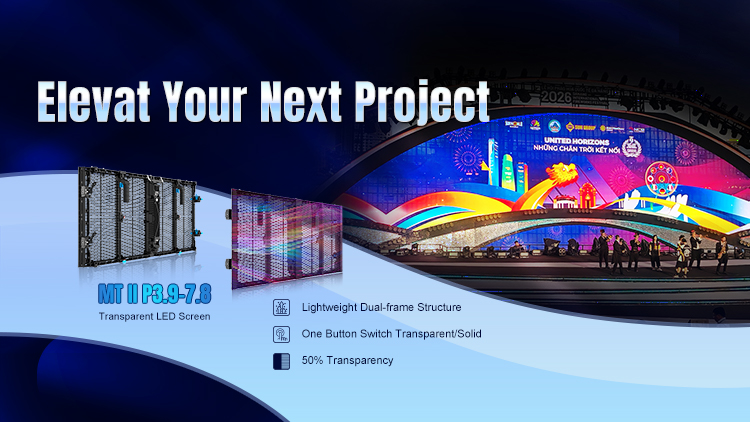
These considerations are reflected in the design of MT II, a transparent rental LED display developed for demanding event environments. One of its key design decisions is the use of magnesium alloy for both the cabinet frame and control box. Magnesium alloy provides a useful combination of low weight and high strength, allowing MT II to address one of the fundamental requirements of rental equipment: the need to remain practical to handle while providing sufficient structural performance for professional installations.
For a rental LED screen, this balance has practical consequences. Every cabinet may be moved many times throughout its service life. Lower weight can make transportation and on-site handling more manageable, but the cabinet still needs to maintain its structural integrity when assembled into a large display.
MT II also uses an open dual-frame architecture. The structure is designed to retain the visual openness associated with transparent LED displays while providing stronger load-bearing performance. This is particularly relevant for installations where the screen needs to become part of a large creative structure rather than simply function as a conventional flat wall.
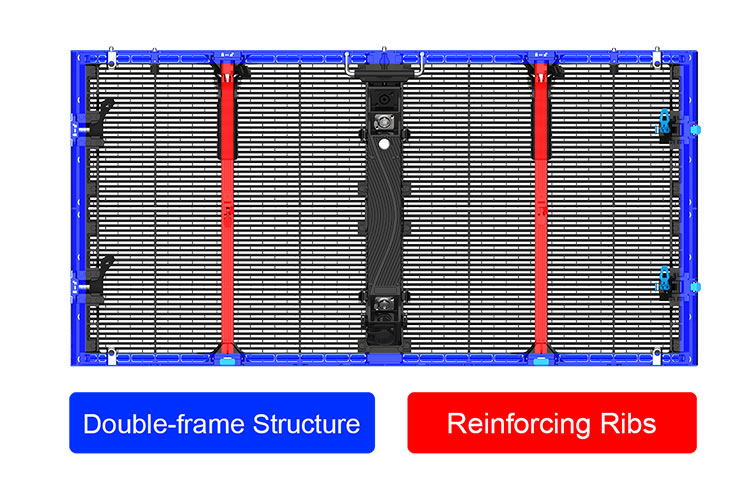
The structural design supports hanging installations of up to 20 meters, creating greater flexibility for elevated and large-scale event configurations. For high-level installations, however, the screen's hanging capability should always be considered together with the supporting structure, connection system, wind conditions, load calculations, and the requirements of the specific venue.
Environmental protection is another part of the design. MT II features an IP65-rated structure, providing protection against dust and water exposure under the conditions defined by the applicable IP classification. For outdoor events, this provides an important layer of protection against rain, water spray, and dust.
MT II is also designed for salt-spray resistance, which is particularly relevant when an outdoor LED display is deployed in environments where corrosion can become a concern. This does not mean that every waterfront installation presents the same salt-spray conditions; rather, it provides an additional level of environmental consideration for demanding outdoor applications.
Taken together, these features reflect a broader approach to outdoor rental LED display design. Environmental protection, structural strength, material selection, and rental practicality cannot be treated as completely independent specifications. Their value comes from how they work together in an actual installation.
MT II in a Real Waterfront Environment: Da Nang International Fireworks Festival
The practical value of this approach can be seen in MT II's application at the Da Nang International Fireworks Festival (DIFF) in Vietnam. Held in a riverside environment along the Han River, DIFF is a large-scale outdoor event where the surrounding waterfront is an integral part of the production. The LED display is therefore not operating in a controlled indoor environment. It becomes part of a temporary outdoor installation exposed to the conditions of the venue.
For this type of application, environmental protection and structural reliability are closely connected. The display needs to remain protected against outdoor exposure while maintaining the structural performance required by its installation configuration. At the same time, as a rental product, it needs to remain practical for transportation, installation, and dismantling.
MT II's magnesium alloy construction contributes to the balance between strength and handling efficiency. Its open dual-frame architecture provides structural support while maintaining the visual characteristics required for transparent LED applications. Its IP65-rated structure addresses dust and water exposure, while its salt-spray resistance adds another layer of consideration for demanding outdoor environments.
The DIFF application demonstrates an important principle for waterfront LED screen selection: reliability should be evaluated according to the complete operating environment rather than a single specification. A product may have a high brightness level, a fine pixel pitch, or a high refresh rate, but those specifications alone do not determine whether it is suitable for a riverside installation. The cabinet structure, environmental protection, installation method, supporting system, and rental workflow all influence the final result.
Making the Right Choice for a Waterfront Event
There is no single specification that defines a reliable outdoor rental LED screen. The right solution is the one that matches the environmental and structural requirements of the actual event. For a waterfront application, start by understanding the environment. Consider humidity, rain, water spray, dust, wind, and, where relevant, salt exposure. Then look at the display's IP protection and corrosion resistance.
Next, examine the mechanical design. Consider cabinet material, structural architecture, hanging capability, load distribution, and the requirements of the supporting structure. For rental applications, also consider how the cabinet will be transported, handled, assembled, dismantled, and reused. Finally, make sure the display can deliver the required visual performance for the audience and production environment.
The most reliable outdoor LED display is not necessarily the one with the most specifications. It is the one in which environmental protection, structural engineering, visual performance, and rental practicality have been designed to work together.
For demanding riverside festivals and other outdoor waterfront events, MT II takes this approach through its magnesium alloy construction, open dual-frame architecture, up to 20-meter hanging capability, IP65-rated structure, and salt-spray resistance. Its deployment at the Da Nang International Fireworks Festival provides a real-world example of how these design considerations can come together in a demanding waterfront event environment.
When choosing a rental LED screen for an outdoor waterfront event, the key question is therefore not simply whether the display can be used outdoors. The more useful question is whether its engineering is designed for the environmental, structural, and operational demands of the specific event.


+86-(0)731-84539619


Hunan Yestech Optoelectronic Co., Ltd. Terms of Service Privacy Policy Powered by szweb


