



ADDRESS
Blog/2026.08.17
A transparent LED display is designed to do something a conventional LED wall cannot: show digital content without completely blocking the physical environment behind it. For stage productions, that can change the way an LED screen interacts with lighting, performers, scenery, architecture, and the audience. Instead of functioning as an opaque video wall, a see-through LED display can become another visual layer within the stage.
But transparency is not always the objective. There are moments when a production benefits from seeing through the display, and there are moments when the LED screen needs to create a stronger visual boundary between the content and everything behind it. A concert may need an open, layered stage during one sequence and a dense full-screen visual background during another. A corporate event may want the stage structure and lighting to remain visible during a product reveal, then require a controlled visual surface for brand content. In these situations, the question is no longer simply whether to use a transparent LED screen or a conventional LED display.
The more relevant question is: when should a transparent LED screen become a solid LED screen? That question points to a broader development in professional LED display design: transparency is becoming less of a fixed characteristic and more of a configurable visual function.
Transparency Is a Design Choice, Not a Permanent Requirement
The value of a transparent LED display lies in what it allows the production to preserve. When the LED screen does not completely obstruct the space behind it, designers can build visual depth by combining digital content with physical elements. Lighting fixtures can remain visible. Performers can move behind the display. Scenic structures can become part of the composition. Architectural features can remain integrated with the screen rather than being hidden by it.
This is one reason see-through LED displays have become particularly interesting for stage design. A conventional LED wall establishes a clear visual boundary: the audience sees the LED content instead of what is behind the cabinet. A transparent LED screen creates a different relationship. The display can occupy the same visual space as the stage environment without completely replacing it.
That distinction is important in concerts and live events where lighting and video are often designed as a single system. A transparent LED display can allow lighting effects to interact with video content rather than simply sitting behind an opaque wall. The result can be a layered stage in which the LED image, physical scenery, lighting, and performers occupy different visual planes. The same principle applies to architectural and outdoor applications. A transparent LED display can be used where maintaining openness or sightlines is important, including temporary structures, event venues, glass architecture, and open-air stages. However, transparency only adds value when the elements behind the display contribute to the intended visual experience. If the production does not want those elements to be seen, transparency can become a limitation rather than an advantage.
When Does a Transparent LED Screen Need to Become Solid?
The simplest way to understand the difference is to consider what the LED screen is expected to do at a particular moment. When the display is being used as a visual layer, transparency is highly effective. When it needs to become the dominant visual surface, a more solid appearance may be preferable.
Consider a concert stage. During an opening sequence, the creative team may want the audience to see lighting, performers, and scenic structures through the LED screen. The transparency adds depth and prevents the display from visually flattening the stage. Once the performance moves into a large-scale video sequence, however, the visual objective may change. The production may want the audience to focus entirely on the graphics displayed on the LED screen rather than on the equipment or scenery behind it.
The same display has now taken on a different role. This is especially relevant when the content contains large graphic areas, cinematic sequences, text, branding, or dark backgrounds. The visual quality of an LED display is influenced not only by the panel itself but also by the environment surrounding it. Objects, lighting, and movement behind a transparent LED screen can become part of the perceived image. When that background is intentionally designed, it creates depth. When it is not, it can compete with the content.
A solid visual surface provides greater separation. This does not mean that solid LED is inherently better than transparent LED. It means that the two configurations serve different creative purposes. A transparent LED screen is effective when the production wants to maintain a relationship between the screen and its surroundings. A solid display surface is useful when the production wants the screen content to establish stronger visual control. The challenge is that a modern event rarely stays in one visual condition for its entire duration.
Why One Production May Need Both Transparent and Solid LED
Stage design is increasingly dynamic. Video content, lighting, scenery, and physical movement are programmed together, and the role of an LED display can change from one part of the show to another. A transparent LED screen may be ideal for an opening because it allows the stage to remain visible while graphics appear to float within the space. During the main performance, the same screen may need to deliver a dense visual background. Later, the production may return to a transparent configuration so that performers or lighting effects behind the display become visible again.
In other words, the requirement is not necessarily for two different LED screens. It is for one LED display that can perform two different visual roles. This distinction is becoming increasingly important in the rental LED market. Rental equipment has to work across different venues, productions, and creative concepts. A screen used for a concert may later be deployed at a corporate event, festival, product launch, or architectural installation. Each application can place different demands on the relationship between the display and its surroundings.
For production companies, this creates a practical reason to look beyond conventional specifications. Pixel pitch, brightness, refresh rate, cabinet dimensions, and transparency remain important, but they do not fully describe how adaptable a display is in real-world production.
What Makes Transparent-to-Solid Switching Practical?
A display that technically supports different visual states is not necessarily flexible in a production environment. If changing from transparent to solid requires extensive disassembly, cabinet replacement, or reconstruction, the flexibility may have limited value on a live event site.
Professional stage and rental environments operate under tight schedules. Installation, signal testing, content checks, rehearsals, and show operation all compete for limited time. The display therefore needs to fit into an established production workflow.
The switching mechanism also needs to be practical for technicians. It should be straightforward enough to use during preparation and, where the production requires it, during a configuration change on site. At the same time, the mechanism cannot be treated separately from the cabinet's structural design. A professional rental LED display still has to meet the mechanical requirements associated with handling, installation, transportation, and repeated deployment.
This creates a more demanding engineering problem than simply making an LED cabinet transparent. The manufacturer has to balance visual openness with structural performance, while also providing a mechanism that allows the display to change its visual behavior. That is the approach behind the YES TECH MT II transparent LED display.
How MT II Turns Transparency Into a Configurable Display Function
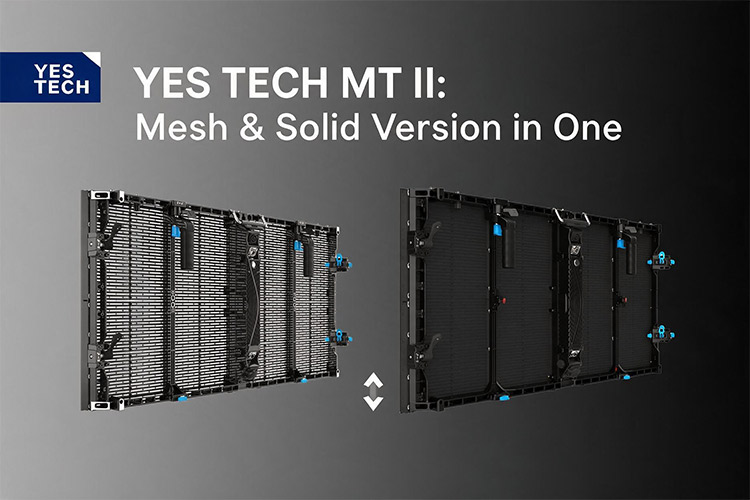
The MT II addresses this requirement with a one-button Transparent/Solid switching system. Rather than treating the see-through characteristic as a permanent condition of the LED screen, the system allows the display to switch between transparent and solid states according to the needs of the production.
In transparent mode, the display can maintain the open visual relationship that makes a see-through LED display useful for stage design. Lighting, performers, scenery, and the space behind the screen can remain part of the composition. When a production requires stronger visual separation, the display can be switched to solid mode. The LED surface then provides a more concentrated visual background, reducing the visual influence of the environment behind it.
The important point is not simply that the MT II has two modes. It is that the transition between them is integrated into the display itself. This changes the design decision. Instead of deciding before installation that a screen must always behave as a transparent display, the production team can treat transparency as one available visual state and solidity as another. That gives designers more freedom to determine how the screen should behave in different parts of a production.
For a rental LED display, the advantage extends beyond a single event. The same MT II system can be used for productions that have very different visual requirements, increasing the range of applications that can be covered by the same equipment.
Flexibility Also Has to Exist in the Physical Configuration
Visual adaptability is only one part of a professional stage LED display. The physical screen also has to accommodate the geometry and installation requirements of modern productions. MT II is designed around a magnesium-alloy frame and a hollow double-frame structure intended to combine transparency with structural performance. The system supports hanging installations up to 20 meters and is available in 1000 × 500 mm and 500 × 500 mm cabinet sizes.
Its mechanical design also supports configurations beyond a conventional flat wall. MT II can be curved up to ±15 degrees and supports 90-degree splicing, allowing production teams to create different screen geometries rather than being restricted to a single planar configuration. The system can also be deployed in both hanging and stacking applications. These capabilities are relevant because stage flexibility is rarely determined by one feature.
A transparent LED screen may need to become a curved visual surface for one stage design, a flat backdrop for another, or a corner configuration for an immersive installation. The ability to change its visual state adds another layer of flexibility on top of these physical configurations. The result is a display that can adapt in two dimensions: how it is physically arranged and how it visually behaves.
When Should You Use Transparent Mode and When Should You Use Solid Mode?
The decision ultimately depends on the role of the LED display within the production. Transparent mode is most effective when the space behind the display is an intentional part of the design. If performers, lighting, scenery, or architecture need to remain visible, the see-through effect can create a stronger sense of depth and integration. It is also useful when the designer wants the LED display to feel like a layer within the stage rather than a physical wall.
Solid mode becomes more useful when the display needs to establish a stronger visual boundary. If the screen content is the primary focus, if the background contains unwanted visual information, or if a production needs a dense and controlled visual surface, reducing the visibility of the environment behind the display can improve the overall composition.
The most flexible scenario is when both are required. That is particularly relevant for concerts, festivals, corporate events, and other productions where the visual language changes throughout the program. Instead of selecting one permanent condition, the production team can decide how the screen should behave according to the scene.
This is a subtle but important change in how transparent LED display technology can be used. The question is no longer simply “How transparent is the screen?” It becomes “How much control do we have over when the screen should be transparent?”
The Next Step for Transparent LED Display Technology Is Adaptability
Transparency has long been one of the defining characteristics of transparent LED displays. Manufacturers have focused on improving transparency, image quality, brightness, cabinet construction, and reliability. Those areas remain critical for professional applications. But greater transparency alone does not necessarily make a display more useful. For stage and rental applications, adaptability can be just as important.
A highly transparent LED screen that can only operate as a transparent screen gives the production team one visual option. A display that can move between transparent and solid states provides more control over how digital content interacts with the physical environment.
This suggests a broader direction for the development of see-through LED display technology. The next stage is not simply making the screen disappear more effectively. It is giving designers greater control over when the screen should disappear and when it should become visually dominant.
That is particularly relevant as LED displays move beyond the traditional concept of a fixed rectangular video wall. Modern stage designs increasingly use curved surfaces, corner configurations, layered structures, suspended displays, and unconventional geometries. The display is becoming part of the stage architecture rather than simply sitting behind the performers. In that environment, a fixed visual characteristic can become restrictive. A configurable display is more closely aligned with the way productions are actually designed.
A Transparent LED Screen Does Not Always Have to Stay Transparent
The strongest argument for transparent LED technology is not that transparency is always better. It is that transparency creates a visual possibility that conventional solid LED cannot provide. But there are equally valid moments when the production needs the LED screen to become a stronger, more controlled visual surface.
The YES TECH MT II transparent LED display takes this concept further with its one-button Transparent/Solid switching system. Instead of requiring designers to commit to a single visual behavior before the production begins, MT II allows the same LED display to respond to different creative requirements while retaining the characteristics expected from a professional rental and stage LED display. For a see-through LED display, the real question may therefore not be how transparent it can be. It may be how easily it can stop being transparent when the production needs something else.


+86-(0)731-84539619


Hunan Yestech Optoelectronic Co., Ltd. Terms of Service Privacy Policy Powered by szweb


