



ADDRESS
Blog/2026.09.21
Transparent LED displays have changed how LED technology can be used in live events. Instead of creating a completely solid visual wall, a transparent LED display allows the content on the screen to coexist with lighting, stage structures, performers, and the environment behind it. This makes transparent LED particularly useful for concerts, festivals, touring productions, and creative stage designs.
But not all transparent LED displays are designed in the same way. For a rental company or production team, the key question is not simply how transparent a screen is. A more useful comparison is how the display handles the practical requirements of a large event: structural strength, hanging, installation, transportation, stage configurations, outdoor operation, and the ability to adapt to different productions.
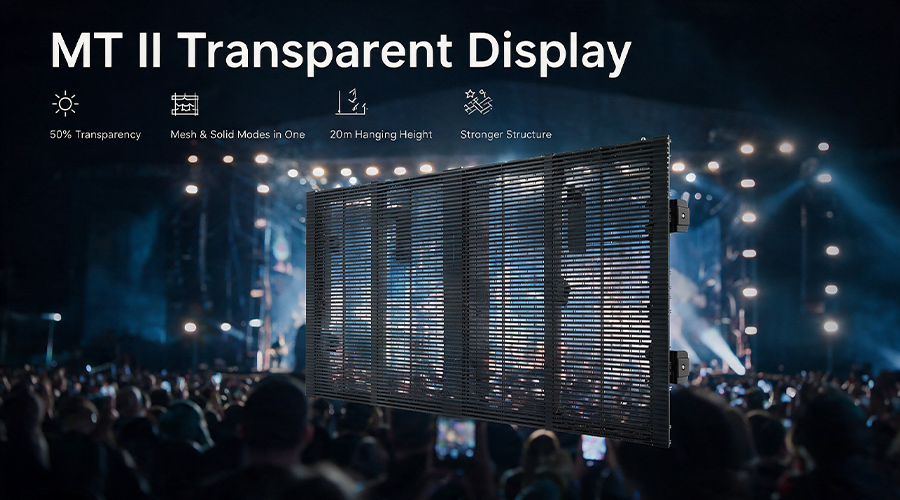
This is where the design philosophy behind the YES TECH MT II becomes important. Rather than treating transparency as the only defining feature, MT II combines a high-transparency LED structure with a magnesium-alloy hollow double-frame, quick-lock installation, transparent and solid modes, flexible cabinet configurations, and both hanging and stacking installation. The result is a transparent LED platform designed specifically around rental, staging, and live-event applications.
Structural Design: Transparency Is Only the Starting Point
The fundamental challenge of transparent LED is the relationship between openness and structural strength. A transparent display needs open space within its structure to allow light and sightlines to pass through. At the same time, the display still needs a sufficiently rigid frame to withstand handling, assembly, transportation, and installation.
A conventional transparent LED display can use different structural approaches depending on its intended application. Some are optimized primarily for architectural, commercial, or fixed installations, while others are designed for temporary events. Therefore, there is no single structure that can accurately represent every conventional transparent LED product.
MT II takes a distinctly rental-oriented approach. Its frame uses magnesium alloy and a hollow double-frame structure designed to combine high transparency with structural load capacity. YES TECH specifies the platform for H3.9–V7.8 pixel pitches and offers 1000 × 500 × 83 mm and 500 × 500 × 83 mm cabinet sizes.
The significance of the double-frame structure is not simply that it makes the cabinet look different. It addresses the engineering balance between keeping the structure open and providing a supporting framework for large-scale LED configurations. For a display that may be suspended above a stage or assembled into a large temporary structure, cabinet architecture becomes just as important as the LED modules themselves.
Hanging Height: A Transparent LED Screen Has to Work as Part of a Larger System
Large event screens are often installed well above the stage. When a transparent LED display is used as a main backdrop, secondary screen, or large suspended visual structure, the hanging system becomes an important part of the overall solution. MT II is specified for stable hanging up to 20 meters. YES TECH attributes this capability to its hollow double-frame structure, which is designed to maintain high transparency while providing structural load capacity for large-scale stage installations.
However, a 20-meter specification should not be interpreted as a universal instruction that every MT II installation can simply be suspended at that height. Actual rigging always depends on the complete installation system, including the supporting structure, hanging beams, rigging equipment, screen configuration, venue requirements, environmental conditions, and applicable safety procedures.
That distinction is important when comparing professional LED products. A hanging-height figure is meaningful only when considered together with the structure supporting the display. The screen itself is one part of the system. The way its weight is transferred, how cabinets are connected, and how the complete structure is installed are equally important. For rental and staging applications, this makes structural design a practical consideration rather than just a specification on a product sheet.
Transparent Mode vs. Solid Mode: One Screen Can Serve Different Visual Requirements
One of the more distinctive characteristics of MT II is its optional shutter system, which allows the screen to switch between transparent and solid modes with one button. This is different from simply choosing a transparent LED display or a conventional solid LED display for a project. In transparent mode, the open visual structure allows the LED content to coexist with elements behind the screen. Lighting fixtures, performers, scenic structures, and other stage elements can remain part of the overall composition.
In solid mode, the screen can provide a more continuous visual surface when the production calls for stronger visual coverage. This flexibility can be useful in live events because the visual requirements of a production are not always the same throughout the show. A stage designer may want the screen to visually integrate with the lighting system during one section of a performance and provide a more complete background during another. For rental companies, the value is equally practical. Instead of treating transparent and solid visual configurations as completely separate concepts, MT II provides both options within one screen platform through its optional shutter system. The important point is therefore not simply that MT II has a “dual mode.” The more meaningful advantage is that the same LED inventory can be configured for different visual requirements.
Installation: The Difference Between a Screen That Works and a Screen That Works Efficiently
In a permanent installation, installation efficiency may be important once during the initial build. In rental and touring applications, it matters repeatedly. A rental LED screen may be assembled, dismantled, transported, and installed again and again. Every connection, lock, cabinet handle, and structural component therefore becomes part of the operational workflow.
MT II uses an integrated quick-lock system with large handles designed to make installation and disassembly easier and support one-person operation at the cabinet-handling level. This should not be interpreted as meaning that an entire large LED structure can be safely installed by one person; large-scale installations still require appropriate crews and qualified procedures. Rather, the design is intended to make individual cabinet handling and locking more straightforward.
This distinction matters. The real benefit of a rental-oriented cabinet is not simply that it is lightweight. It is that the cabinet can move through the installation workflow efficiently: transport → positioning → locking → configuration → dismantling → packing. When a product is repeatedly used across different projects, small improvements in these steps can have practical value for production teams. MT II's published cabinet weight is 7.9 kg for the mesh configuration and 8.7 kg for the solid configuration of the 1000 × 500 mm cabinet. The 500 × 500 mm cabinet is listed at 5.8 kg. That makes weight relevant not only to transportation but also to physical handling during setup and dismantling.
Flat Screens vs. Creative Stage Structures
Another important difference appears when transparent LED is used as part of the stage architecture rather than simply as a flat backdrop. A conventional transparent LED product may be perfectly suitable for a flat installation. But modern stage designs increasingly use curved surfaces, corners, layers, and irregular visual structures.
MT II's integrated quick-lock system supports curved configurations with ±15° adjustment, 90° corner LED displays, and staggered cabinet splicing. These capabilities change how the display can be used. Instead of thinking of the LED screen as a rectangular plane positioned behind the performers, designers can use it as part of a three-dimensional stage composition. A curved screen can follow the geometry of a stage. A 90° configuration can wrap around a structure. Staggered splicing can create a less conventional visual arrangement.
This is particularly relevant to concert and festival production, where LED, lighting, scenic elements, and stage structures often need to work together as one visual environment. The advantage is therefore not simply “more shapes.” It is the ability to use the same LED platform in different spatial configurations.
1000 × 500 mm and 500 × 500 mm Cabinets: Why Cabinet Size Matters
MT II is available in two cabinet formats: 1000 × 500 × 83 mm and 500 × 500 × 83 mm. Both use a 500 × 250 mm module size, while the cabinet resolutions differ according to cabinet size. The 1000 × 500 mm format provides a larger standard cabinet for building larger screen areas efficiently. The 500 × 500 mm half-size format provides another option when the screen needs to accommodate more detailed structural layouts.
This becomes particularly useful when a stage design includes corners, transitions, smaller sections, or irregular screen boundaries. Cabinet size is sometimes treated as a simple specification, but for rental applications it can directly affect how easily a screen adapts to different layouts. A system that offers more than one cabinet format gives production teams another tool when designing around the physical structure of a stage. Combined with curved configurations, corner connections, and staggered splicing, the two cabinet sizes give MT II a broader configuration range than a transparent LED system designed only around a fixed flat format.
Hanging and Stacking: More Than One Way to Deploy the Same Inventory
Another practical distinction is installation flexibility. MT II supports both hanging and stacking installation and uses the same beam for these two installation methods. YES TECH positions this design as a way to simplify setup and reduce the need for separate structural solutions. This matters because rental projects do not all have the same venue conditions A large concert may require a suspended transparent LED backdrop. A smaller event may use a ground-supported screen. A festival may combine different screen positions across one stage. A production company may also need to change the configuration from one event to another. For a rental company, flexibility therefore has an inventory value. The question is not only: “How good is this screen?”
It is also: “How many different jobs can this screen realistically do?”
A platform that supports both hanging and stacking can potentially be deployed across a wider range of temporary event configurations without requiring the rental company to maintain completely different display platforms for each installation method.
Outdoor Use: Transparency Does Not Eliminate Engineering Requirements
MT II blow-through LED Display is designed for indoor and outdoor operation and has an IP65 rating. The product page also lists an optional high-brightness solution up to 4500 nits and a 7680 Hz refresh rate. These specifications make the platform suitable for outdoor event scenarios, but it is important to understand what they do and do not mean. IP65 indicates protection against dust ingress and water jets under the relevant test conditions. It does not mean that an LED display can be installed outdoors without considering the actual weather, supporting structure, drainage, power, cabling, wind conditions, and venue requirements.
Likewise, transparency does not automatically mean that wind is no longer a concern. An open structure can allow airflow through the display, but the actual wind behavior of a large screen depends on its configuration, surrounding structures, installation method, environmental conditions, and other engineering factors. For professional outdoor production, the correct approach is therefore to consider transparency, weather protection, structural design, brightness, and installation requirements together rather than relying on any single specification.
MT II vs. Conventional Transparent LED: What Is the Real Difference?
The comparison becomes clearer when the major factors are considered together.
|
Feature |
Conventional Transparent LED |
YES TECH MT II |
|
Design focus |
Varies by product and application |
Rental, staging, and live-event use |
|
Transparency |
Varies by product |
≥50% |
|
Structural design |
Varies by product |
Magnesium-alloy hollow double-frame |
|
Standard hanging capability |
Varies by product |
Up to 20 m |
|
Visual modes |
Usually depends on product design |
Transparent and solid modes with optional shutter system |
|
Installation |
Varies by product |
Quick-lock system with large handles |
|
Curved configuration |
Product-dependent |
±15° adjustable |
|
Corner configuration |
Product-dependent |
90° corner |
|
Staggered splicing |
Product-dependent |
Supported |
|
Installation methods |
Product-dependent |
Hanging and stacking |
|
Cabinet sizes |
Product-dependent |
1000 × 500 × 83 mm and 500 × 500 × 83 mm |
|
Outdoor use |
Product-dependent |
Indoor and outdoor; IP65 |
|
Brightness |
Product-dependent |
Up to 4500 nits optional solution |
|
Refresh rate |
Product-dependent |
7680 Hz |
The important qualification is that “conventional transparent LED” is not a specific standardized product category. Different manufacturers use different structures, materials, cabinet dimensions, transparency levels, installation systems, and environmental ratings. Therefore, this comparison should be understood as a comparison of design approaches, not a universal statement about every other transparent LED product.
Which Approach Makes More Sense for Rental and Live Events?
A transparent LED display does not automatically need every feature offered by MT II. For a fixed indoor installation or a relatively simple transparent display application, the decision may depend primarily on pixel pitch, transparency, cabinet size, brightness, viewing distance, and installation conditions. The requirements change when the screen becomes part of a touring or rental workflow.
For a large concert or festival, the display may need to be suspended high above the stage. The stage designer may want curved or corner configurations. The production team may need to install and dismantle the screen within a limited schedule. The rental company may need to use the same inventory across different venues and different types of productions. In that environment, a transparent LED display needs to be considered as more than a visual surface.
It becomes a stage system. This is where MT II's combination of structural design, transparent and solid modes, quick-lock installation, multiple cabinet sizes, curved and corner configurations, and hanging and stacking options becomes relevant. These features are not isolated specifications. They are connected to the way a rental LED system is actually deployed in the field.
Transparent LED Is About More Than Transparency
The biggest difference between MT II and a conventional transparent LED approach is not one single number. It is the way the product combines transparency with the practical requirements of live-event production. A transparent LED display needs to provide the visual openness that allows LED content to coexist with the physical stage. But for large-scale rental applications, it also needs to address structure, installation, configuration, transportation, and repeated deployment.
MT II brings these requirements together through a magnesium-alloy hollow double-frame, ≥50% transparency, up to 20 m hanging capability, an optional transparent/solid shutter system, quick-lock installation, ±15° curved configurations, 90° corners, staggered splicing, two cabinet sizes, IP65 protection, and both hanging and stacking installation. That makes the more useful comparison less about whether MT II is simply “more transparent” than another screen.
The real question is what you need the transparent LED to do. If the goal is simply to create a see-through visual surface, many types of transparent LED may be suitable. But when the screen needs to become part of a large-scale stage structure, adapt to different configurations, work in both transparent and solid modes, and move repeatedly through a rental workflow, the design of the entire LED platform becomes much more important. That is where MT II moves beyond the idea of a transparent LED screen and toward a more flexible LED solution for modern rental and staging applications.


+86-(0)731-84539619


Hunan Yestech Optoelectronic Co., Ltd. Terms of Service Privacy Policy Powered by szweb


