



ADDRESS
Blog/2026.09.16
In the rental LED display industry, flexibility is becoming just as important as image quality. A rental company may provide LED screens for a concert today, a corporate event tomorrow, and an outdoor festival or sports event a few days later. These projects can have very different requirements for pixel pitch, screen size, brightness, installation method, and stage configuration.
This raises a practical question: can one LED display platform support different event applications without requiring a completely different system for every project? The idea behind a “one-for-all” LED display solution is not that one cabinet or one configuration can meet every possible requirement. Different environments still require different technical specifications. Instead, a more useful definition is a flexible LED display platform that can accommodate different pixel pitches, screen sizes, installation methods, and event configurations while maintaining a common platform and workflow.
For rental and staging companies, this approach can make LED display inventory more adaptable. It can also help production teams respond more efficiently when a project changes from a standard flat LED wall to a larger screen, a curved configuration, or a different stage layout.
What Does One-for-All Really Mean for an LED Display?
A professional rental LED display needs to do more than produce a good image. It becomes part of the entire event production process, from transportation and installation to operation, maintenance, dismantling, and storage. For this reason, a one-for-all approach should be considered from a system perspective rather than a single specification. Pixel pitch is a good example. A fine-pitch LED display may be suitable when the audience is relatively close to the screen, while a larger pixel pitch can be more practical for a large event where the audience is farther away. Indoor and outdoor applications can also require different brightness and environmental protection requirements. A screen used for a corporate conference is not necessarily configured in the same way as an outdoor concert screen.
The objective of a flexible LED display platform is therefore not to remove these differences. It is to make the platform adaptable enough to handle them. A platform-based design can allow different pixel pitch modules to use a common cabinet frame. It can also provide different cabinet dimensions, installation methods, and compatible products for creative configurations. This means a rental company can adapt its LED display inventory to different projects without treating every application as a completely separate equipment system.
This concept is already used by several major LED display manufacturers. For example, Absen describes its PL Series as a platform design in which different pixel pitch modules can be used on one frame, while its PL V2 Series combines 500 × 500 mm and 500 × 1000 mm panels with multiple pixel pitch options for indoor and outdoor rental applications. Unilumin's URM III also combines multiple pixel pitch options with 500 × 500 mm and 500 × 1000 mm cabinets and supports different installation configurations. The value of this approach becomes clearer when we look at the actual environments in which rental LED displays are used.
One LED Platform for Different Event Scenarios
A concert is one of the most demanding applications for a rental LED display. A stage may include a large main screen, side screens, hanging screens, or curved elements, while the production schedule can leave a limited amount of time for installation and testing. The LED screen may also need to be dismantled and transported to another venue after the show. In this environment, installation efficiency matters alongside image quality. Cabinet dimensions, connection systems, hanging and stacking options, maintenance access, and the ability to create different screen shapes can all affect the production workflow.
Sports events create a different viewing environment. A stadium LED display may need to cover a large physical area and remain visible to audiences positioned at very different distances from the screen. Large-format LED screens can be used for live video, replays, graphics, sponsor content, or scoreboard-related information. Here, screen size, pixel pitch, brightness, viewing distance, and installation structure need to be considered together.
Corporate events and product launches can have another set of requirements. The audience may be closer to the LED video wall, while presentations, product visuals, text, logos, and detailed graphics place greater importance on image detail. A clean and precise LED wall may be more important than simply maximizing screen size. At the same time, the stage may require different screen dimensions or creative configurations to match the event design.
Outdoor festivals add environmental considerations. The LED display may need to operate in daylight, withstand outdoor conditions, and be installed within a fixed production schedule. A large festival can also require several LED screens in different positions, making transportation, setup, and inventory flexibility important considerations for the rental company. Touring productions combine many of these requirements. The same rental LED display may be used repeatedly at different venues, with different stage dimensions and different installation conditions. Equipment that works well for one fixed installation may not be equally practical when it has to be transported, assembled, adjusted, dismantled, and assembled again. These scenarios show why “one-for-all” should not mean “one configuration for everything.” It means having an LED display platform flexible enough to adapt to different requirements.
Why Pixel Pitch Matters in a Flexible LED Display Platform
Pixel pitch is one of the first specifications considered when choosing an LED display, but it should always be evaluated together with viewing distance and application. Pixel pitch describes the distance between the centers of adjacent LED pixels. A smaller pixel pitch provides a higher pixel density and can reproduce finer image detail at closer viewing distances. A larger pixel pitch can be appropriate when the screen is viewed from farther away or when the physical size and application make a larger pitch more practical.
There is no universal pixel pitch that is automatically correct for every event. For a corporate presentation where viewers may sit close to the LED screen, a fine-pitch LED display can be important for text, graphics, and detailed visual content. For a large outdoor festival, where the audience is spread over a much larger area, the selection may be different. Concert productions can fall anywhere between these scenarios depending on the stage design, audience position, screen size, and camera requirements.
This is where platform design can provide a practical advantage for rental companies. The YES TECH MU Series is available in P1.9, P2.6, P2.9, P3.9, and P4.8 configurations. The MU platform uses the same frame architecture across its pixel pitch range, allowing rental companies to select different pixel pitches according to the project rather than building a completely separate cabinet platform for each requirement.
This does not mean that every MU pixel pitch is intended for every environment. The current MU specifications distinguish between indoor configurations and P2.9 and P3.9 configurations designed for both indoor and outdoor use. The appropriate version still needs to be selected according to the venue, viewing distance, ambient light, and other project requirements. The benefit of the platform is that these choices can exist within a more consistent rental ecosystem.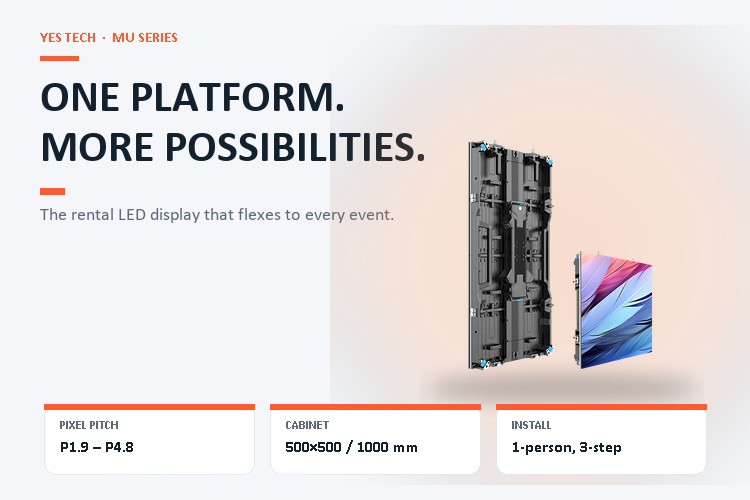
Cabinet Size Can Change the Way a Large LED Screen Is Built
Pixel pitch is only one part of LED display design. Cabinet size also affects how efficiently a large LED screen can be assembled. The YES TECH MU Series offers two cabinet dimensions: 500 × 500 mm and 500 × 1000 mm, both with a cabinet depth of 73 mm. The 500 × 1000 mm cabinet covers 0.5 square meters, while the 500 × 500 mm cabinet covers 0.25 square meters. For a large rectangular LED wall, using larger-format cabinets can reduce the number of cabinet connections required compared with building the same area entirely from smaller cabinets. This does not mean that a larger cabinet is always the better choice. Screen dimensions, transportation, handling, stage structure, and creative requirements still need to be considered.
The advantage comes from having both options available on the same platform. For example, a large main screen can benefit from the 500 × 1000 mm format when the design allows it, while a 500 × 500 mm cabinet can provide more flexibility for certain dimensions, layouts, or creative structures. This kind of modularity becomes particularly useful in rental applications because event designs are rarely identical. A production company may need a large rectangular backdrop for one project and a more segmented configuration for another.
From Flat LED Walls to Creative Stage Structures
A flexible rental LED display should also be considered as part of the stage structure. Traditional LED video walls are often built as flat rectangles, but modern event production can require curved, angled, or multi-faceted configurations. The screen may become a central visual element of the stage rather than simply a background. The MU Series supports curved splicing of ±7.5°, with ±15° available as an option. Its 500 × 500 mm and 500 × 1000 mm cabinets can also be vertically spliced. For more complex structures, MU can be combined with YES TECH Rubik, which uses 45° edge-cutting cabinets to create configurations such as 90° corners and multi-faceted structures.
This creates a distinction between a conventional LED wall and a more flexible modular LED display system. The LED cabinet is still the basic building block, but the production team has more freedom in deciding how those building blocks are arranged within the stage. This is particularly relevant for concerts, festivals, product launches, award ceremonies, and other productions where stage design is closely connected with the visual content.
Installation and Maintenance Are Part of the Solution
A rental LED display is used in a working environment where time matters. The screen has to arrive at the venue, be assembled, connected, tested, operated, maintained when necessary, and removed after the event. This makes installation and maintenance part of the product selection rather than secondary considerations. The MU Series is designed for single-person installation and uses a three-step hanging process. It supports both hanging and ground-stacking installation, allowing production teams to select a configuration according to the stage and venue.
The series also uses a modular design that supports both front and rear maintenance. This can be useful because the most practical maintenance direction depends on the actual installation. A screen positioned directly against a stage structure may require front access, while a hanging or freestanding structure may allow technicians to work from the rear. The power box is also designed for quick replacement, with YES TECH specifying a five-second power box replacement process for MU.
These features should not be viewed simply as a collection of product functions. Their importance comes from how they fit into the workflow of a rental LED display. A faster installation process can help when venue access time is limited. Flexible maintenance access can help technicians respond to issues without completely dismantling the screen. Multiple installation methods can make it easier to adapt the same LED display platform to different stage structures.
One Platform Does Not Mean One Configuration
The term “one-for-all” can sometimes be misleading in the LED display industry. An LED display used outdoors in direct sunlight should not automatically be treated as equivalent to an indoor LED display. A screen viewed from a short distance should not automatically use the same pixel pitch as a stadium display. A touring production may have different transportation and installation requirements from a fixed event installation. Professional LED display selection still requires technical judgment.
The real value of a one-for-all platform is that it gives rental companies a common foundation from which different configurations can be developed.
For YES TECH MU, that foundation includes multiple pixel pitches, two cabinet sizes, indoor and outdoor configurations within the series, hanging and stacking installation, front and rear maintenance, curved splicing, and compatibility with other YES TECH rental LED display series. The MU Series can also work with the MG9, MG10, and Xtra Series to create additional stage configurations. The Xtra Series, for example, is designed for curved LED walls and can be spliced with MU, MG, and Rubik, while Rubik can be combined with MU and MG for cube and multi-faceted structures.
This broader compatibility makes the concept more relevant to rental companies that manage several types of LED display equipment. Instead of thinking about each product as an isolated system, the equipment can be considered as part of a wider modular LED display ecosystem.
A More Practical Way to Think About One-for-All LED Displays
For rental and staging applications, the question is not whether one LED display can replace every other LED display. The more useful question is whether a platform can support enough different applications to make the rental inventory more flexible, while still providing the technical performance required for each individual project. That means considering pixel pitch according to viewing distance, brightness according to the environment, screen size according to the venue, installation according to the stage structure, and maintenance according to the production workflow.
A platform-based rental LED display can then connect these requirements through a common cabinet architecture and compatible installation system. This is the practical meaning of a one-for-all LED display solution. For event production teams, it means having more options when designing a stage. For rental companies, it can mean greater flexibility when planning inventory. And for large-scale events, it means the LED display can be treated not simply as a video wall, but as a modular part of the overall production system.
YES TECH MU is built around this approach. With multiple pixel pitches, 500 × 500 mm and 500 × 1000 mm cabinets, indoor and outdoor options, single-person installation, multiple installation methods, front and rear maintenance, and creative splicing capabilities, MU provides a flexible platform for different rental LED display applications. One platform cannot eliminate the technical differences between concerts, sports events, festivals, corporate events, and touring productions. But a well-designed platform can make it easier to adapt the LED display to those differences. That is what makes one LED platform capable of creating more event possibilities.


+86-(0)731-84539619


Hunan Yestech Optoelectronic Co., Ltd. Terms of Service Privacy Policy Powered by szweb


