



ADDRESS
Blog/2026.08.31
Large-scale LED displays are becoming an essential part of concerts, festivals, sports events, touring productions, and temporary outdoor stages. As LED screen projects become larger and more complex, installation efficiency has become an increasingly important factor in determining the overall success of an event. For a small LED display, the difference between installing one cabinet in a few seconds or a few minutes may seem insignificant. For a screen covering hundreds or thousands of square meters, however, the cumulative effect can be substantial. Every additional step required to connect, lock, position, adjust, or dismantle a cabinet is repeated across the entire display. When thousands of cabinets are involved, installation efficiency can directly affect labor requirements, project schedules, testing time, and overall operational risk.
This is particularly important for rental LED displays. Unlike permanent fixed installations, rental LED screens are designed to be transported, assembled, dismantled, and reconfigured repeatedly. A touring or festival production may have only a few days—or sometimes only a few hours—to transform a collection of cabinets into a fully operational LED stage. So what makes a large-scale LED display easier and faster to install? The answer goes beyond simply adding a quick lock. An efficient LED display installation system needs to reduce unnecessary operations at every stage, from cabinet handling and alignment to mechanical connection, electrical connection, configuration, and dismantling. The cabinet itself must be designed around the people who install it, because installation efficiency ultimately depends on how easily crews can work with the equipment in real-world conditions.
Why Does Installation Efficiency Matter for Large LED Projects?
Large LED installations are highly repetitive operations. A typical LED display may consist of hundreds or thousands of individual cabinets, each requiring mechanical connection, positioning, electrical connection, and inspection. When the screen is large or configured into a complex shape, the process becomes even more demanding. Consider a 2,000 m² LED display. Even a small amount of additional time spent on each cabinet can accumulate into many hours of additional labor. If workers need to repeatedly reach around the cabinet to operate a lock, manually hold components in position, or make multiple adjustments before achieving proper alignment, the installation process becomes slower and more physically demanding.
The situation becomes more complicated for temporary outdoor events. Installation crews may be working against a fixed production schedule while simultaneously dealing with stage construction, rigging, power distribution, weather conditions, and content preparation. The LED display therefore needs to be installed not only quickly, but also accurately and consistently. This is why installation efficiency should be considered a core engineering characteristic of a professional rental LED display rather than simply a convenience feature. A well-designed LED cabinet can reduce repetitive operations, simplify alignment, make locks easier to access, and allow installers to complete common tasks with fewer tools and fewer movements. Across a large screen, these small improvements can translate into significant time savings.
What Makes an LED Display Easy to Install?
The installation process of a rental LED display generally involves several interconnected tasks: transporting cabinets to the installation position, aligning them, connecting cabinets mechanically, securing the structure, connecting power and data, checking the display, and eventually dismantling everything after the event. An efficient cabinet design should simplify as many of these steps as possible. One of the most important factors is the locking mechanism. Traditional mechanical connection systems may require installers to operate multiple components manually. On a large screen, this can increase installation time and place additional physical demands on the crew.
A quick-lock system can simplify this process by allowing cabinets to be connected and secured with fewer operations. However, the real value of a quick lock depends on its ergonomics and accessibility. A mechanism that is technically fast but difficult to reach or operate may not provide the same practical benefit in the field. This is why professional rental LED displays increasingly focus on human-centered cabinet design. Handles, locks, positioning pins, cabinet weight, connection points, and access to power and data interfaces all contribute to the actual installation experience. The goal is straightforward: reduce the number of actions required to complete each cabinet connection. When this principle is applied across hundreds or thousands of cabinets, the difference becomes measurable.
Why Does Cabinet Handling Matter in Large-Scale Installation?
Installation speed begins before the cabinet is connected to the screen. Large LED cabinets must first be moved, lifted, positioned, and aligned. If a cabinet is difficult to handle, the installation crew may need additional workers or more time to position each unit correctly. For rental applications, cabinet weight and ergonomic design are therefore important considerations. A lighter cabinet can reduce physical workload, but weight reduction cannot come at the expense of structural strength or reliability. The engineering challenge is to achieve an appropriate balance between weight, rigidity, durability, and ease of handling.
Handles also play an important role. Properly positioned handles allow installers to control the cabinet during lifting and positioning, particularly when working on large vertical screens or complex stage structures. For large-scale LED installation, these details may appear minor when viewed individually. In practice, however, they are repeated hundreds or thousands of times. That is why a professional rental LED cabinet should be designed not only around its display performance, but also around the workflow of the installation crew.
Why Is Alignment So Important for Large LED Displays?
Fast installation is not useful if the resulting screen requires extensive correction. Large LED displays must maintain consistent cabinet alignment to produce a visually continuous image. Small gaps, height differences, or cabinet misalignment can become noticeable when multiple cabinets are assembled into a large screen. This is particularly challenging when the display includes curved sections, irregular shapes, or multiple interconnected surfaces.
Accurate positioning structures can help reduce the amount of manual adjustment required during installation. Positioning pins and precisely engineered connection points allow cabinets to locate more consistently relative to one another. When the mechanical structure itself helps establish alignment, installers spend less time correcting individual cabinets after they have been connected. This is an important distinction between simply “fast assembly” and genuinely efficient installation. A professional LED installation system should aim for fast, repeatable, and accurate assembly. The fewer corrections required after the initial connection, the more efficient the overall workflow becomes.
Why Is Installation Speed Particularly Important for Rental LED Displays?
For fixed LED displays, installation may be a one-time process. For rental LED displays, installation is part of the product's entire lifecycle. Rental equipment may be used at one venue today and transported to another location tomorrow. A festival screen may need to be dismantled immediately after the final performance and prepared for another event. Touring productions may repeatedly change screen sizes and configurations depending on the venue.
Every additional minute required for assembly and dismantling therefore affects the efficiency of the rental operation. Faster installation can help rental companies reduce labor requirements and make better use of limited setup windows. It can also create additional time for system testing, calibration, signal checking, content preparation, and safety inspections. This is particularly valuable for outdoor festivals, where the LED display is only one part of a much larger production schedule. Stage construction, lighting, audio, rigging, power distribution, video systems, and rehearsals all compete for the same limited setup period. A display that can be installed efficiently gives production teams more flexibility.
Large-Scale Installation Requires More Than a Fast Lock
It is tempting to associate installation speed with one particular cabinet feature, but large-scale installation efficiency is more comprehensive. A quick-lock mechanism is important, but it works together with cabinet weight, handles, positioning structures, frame design, power and signal interfaces, and the overall configuration system.
For example, if the lock is fast but the cabinet is difficult to position, time may simply be transferred from the locking step to the alignment step. If alignment is accurate but the cabinet is difficult to handle, more workers may still be required. If the screen can be assembled quickly but takes a long time to correct and calibrate afterward, the overall project may not actually be faster. This is why installation efficiency should be evaluated at the system level. A well-engineered rental LED display minimizes unnecessary movements and repeated operations throughout the workflow. The objective is not merely to make one connection faster, but to make the entire installation process more predictable. For large-scale projects, predictability is especially valuable. Production teams need to know how long installation will take, how many workers are required, and how much time remains for testing before the event begins.
MT II: Designed for Faster Large-Scale Installation
These principles are particularly relevant to outdoor transparent LED displays used for large-scale stage applications. YES TECH MT II is designed around the requirements of professional rental and outdoor stage applications, combining a lightweight transparent cabinet structure with a connection system intended to simplify large-scale installation.
Its quick-lock design allows cabinets to be connected efficiently, while the large handles provide installers with easier control during lifting, positioning, and assembly. The cabinet design also incorporates positioning features that help improve alignment between adjacent panels. The result is a workflow designed to reduce repetitive manual operations during large-scale LED screen installation. For transparent LED stages, this becomes even more important because the screen may need to be configured across curved surfaces, multiple planes, or large circular structures. A cabinet that is easy to connect and position gives installation crews greater flexibility when working with complex stage designs. The objective is not simply to make MT II faster to install as an individual cabinet. It is to make large-scale screen assembly more efficient as a complete process.
A Real-World Test: 2,000 m² of MT II at Kharkhorum Festival 2026
The practical value of installation efficiency can be seen in the deployment of MT II at Kharkhorum Festival 2026 in Mongolia. For this large-scale outdoor music and visual arts festival, approximately 2,000 m² of MT II transparent LED displays were used to create a 360° immersive stage environment.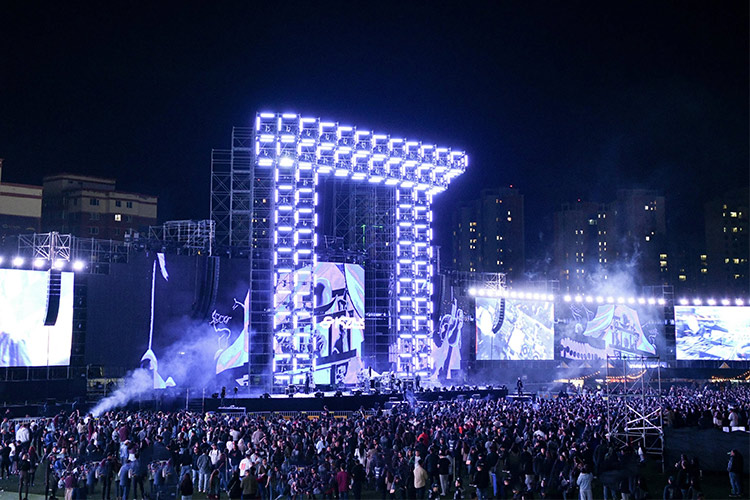
The project was significantly larger than a conventional single LED wall. The display system incorporated multiple screens around the stage, forming an approximately 300-meter-long visual environment. The configuration combined central, side, rear, and curved screen sections to create a continuous 360° stage. Such a configuration places considerable demands on the installation process. Crews need to work across multiple screen sections while maintaining consistent alignment and ensuring that each part of the structure is securely connected. Despite the scale and complexity of the installation, the MT II display system was installed and delivered within five days. The five-day installation period is significant not simply because of the number itself, but because it demonstrates how cabinet-level installation efficiency can contribute to the execution of a large-scale LED project. When hundreds or thousands of repeated installation operations are simplified, the cumulative effect can help shorten the overall setup schedule. For an event production team, this creates additional time for system testing, content preparation, signal verification, and final adjustments before the audience arrives.
Why Does a Five-Day Installation Matter?
The value of a fast installation schedule goes beyond labor savings. Large festival productions operate according to tightly coordinated timelines. The LED display cannot be treated as an isolated component because it interacts with stage construction, lighting, audio, rigging, video control, power systems, and rehearsals. If LED installation takes longer than expected, it can delay subsequent activities. Conversely, completing the screen earlier creates additional time for testing and troubleshooting. For a 2,000 m² display system, even a small amount of additional preparation time can be valuable.
At Kharkhorum Festival, the MT II transparent display was not only installed on a large scale but also integrated into a 300-meter-long, 360° stage environment. The ability to complete the installation within five days helped support the overall production schedule and enabled the display system to be prepared for the event within the required timeframe. This is one of the practical advantages of designing LED cabinets around installation efficiency: time saved during assembly can become time gained for production.
From Cabinet Design to Installation Efficiency
Large-scale LED installation is ultimately a workflow problem. The cabinet must be easy to handle. The locking system must be quick and accessible. Positioning needs to be accurate. Connections need to be straightforward. The structure needs to support repeated assembly and dismantling. And the entire system needs to work consistently across large screen configurations. When these elements are considered together, installation becomes more than simply attaching one LED cabinet to another. It becomes a repeatable process that can be scaled from a small screen to a multi-thousand-square-meter stage.
This approach is particularly valuable for rental LED displays, where installation and dismantling happen repeatedly and where production schedules are often highly compressed. The most efficient LED display is therefore not necessarily the one with the fastest individual locking mechanism. It is the one that reduces the total number of operations required from the installation crew while maintaining structural accuracy and reliability.
What Makes a Large LED Display Easier to Install?
For professional LED rental applications, several principles should be considered when evaluating installation efficiency. First, the cabinet should be manageable for the installation crew, with an appropriate balance between weight, strength, and ergonomics. Second, mechanical connections should require as few operations as practical. Third, positioning and alignment systems should help installers achieve accurate cabinet placement without excessive manual correction. Fourth, the design should support repeated assembly and dismantling without unnecessary complexity.
Most importantly, these features should work together. Large-scale installation is ultimately measured by the performance of the entire workflow—not by a single specification on a product sheet. The deployment of approximately 2,000 m² of MT II at Kharkhorum Festival demonstrates this principle in a real outdoor stage environment. With its quick-lock connection system, ergonomic handling design, and positioning features, MT II helped enable the installation of a large 360° transparent LED stage within five days.
For concerts, festivals, touring productions, and other time-sensitive events, installation efficiency is not simply about finishing faster. It is about reducing repetitive work, improving installation consistency, maximizing the available production window, and giving event teams greater confidence in the final result. When an LED display can make a large installation easier, every cabinet matters—and when thousands of cabinets are involved, those small improvements can make a significant difference.


+86-(0)731-84539619


Hunan Yestech Optoelectronic Co., Ltd. Terms of Service Privacy Policy Powered by szweb


