



ADDRESS
Blog/2026.09.15
Transparent LED screens are becoming an increasingly practical solution for outdoor festivals, concerts, touring productions, and large-scale live events. Unlike conventional LED displays with a solid structure behind the LED modules, transparent LED displays use an open design that allows the stage environment behind the screen to remain visible. For production managers, however, choosing a transparent LED screen is not simply about achieving a visually open stage. The display also needs to meet the practical requirements of outdoor production, including structural stability, installation efficiency, weather protection, transportation, and creative flexibility.
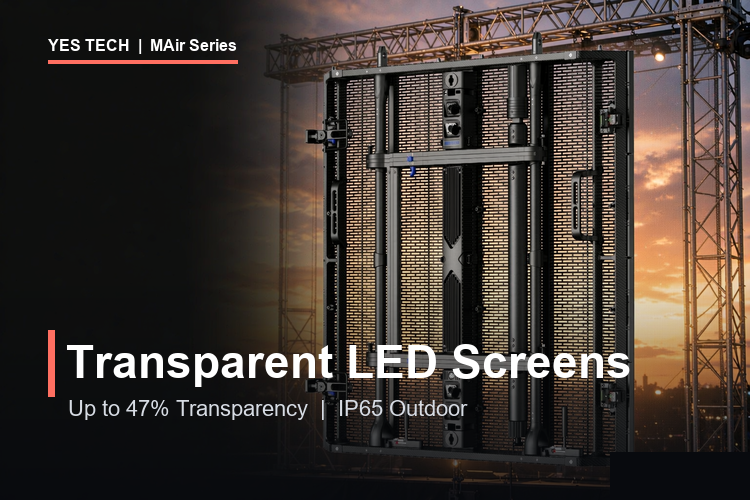
This is particularly important for touring productions, where an LED display may be transported, installed, operated, dismantled, and redeployed repeatedly. A transparent LED display therefore needs to perform as part of a complete production system rather than simply as a visual surface. The YES TECH MAir Series was developed specifically for large-scale outdoor rental and touring applications. Available in P5.9 and P7.8 pixel pitches, MAir uses a 1000 × 1000 × 102 mm cabinet and combines a seamless one-piece carbon fiber frame with an open transparent structure. The design focuses on three practical requirements for professional outdoor production: maintaining visual openness, supporting demanding installation conditions, and simplifying touring workflows.
What Makes Transparent LED Different?
The main difference between a transparent LED display and a conventional LED screen is its open structure. Instead of forming a visually solid surface, transparent LED displays leave open areas within the display structure, allowing parts of the stage, lighting, truss, or other elements behind the screen to remain visible. This changes the way an LED screen interacts with stage design. With a conventional solid LED wall, the screen naturally becomes a visual backdrop. With transparent LED, the screen can become one layer within a larger stage environment. Lighting equipment can remain visible behind the display, while video content is presented in front of it. Designers can also use the space behind the screen as part of the visual composition.
For outdoor events, this open structure can also contribute to airflow through the display. However, visual transparency and wind permeability are not exactly the same thing. A transparent LED display still contains LED modules, frames, structural components, and other elements that influence how air moves through the system. Therefore, a production manager should evaluate the complete structural and wind-performance design rather than judging outdoor suitability by transparency percentage alone.
MAir P7.8 provides up to 47% transparency, giving designers a more open visual surface while maintaining the performance required for outdoor applications. At Rock in Rio Lisboa 2026, approximately 427 m² of YES TECH LED displays were used, including MAir P7.8 transparent LED displays. The stage incorporated large LED surfaces together with cube-shaped structures, creating a layered stage environment while keeping the overall design visually open.
Transparency and Outdoor Visual Performance
For outdoor production, transparency needs to be considered together with image performance. The purpose of a transparent LED screen is not simply to allow viewers to see through it. The display still needs to deliver clear and effective visuals under the conditions of the event. This makes the balance between transparency and brightness particularly important. YES TECH MAir P7.8 provides up to 47% transparency while delivering 3,500–5,000 nits at white balance. This combination is designed for outdoor event applications where visual openness is important but the LED display must still maintain sufficient image brightness.
The appropriate configuration should always be selected according to the actual event environment, stage position, viewing conditions, content, and production requirements. There is no single transparent LED configuration that is ideal for every event. For example, a festival stage may use transparent LED as a visual layer around performers, lighting fixtures, or architectural structures. A touring production may prioritize lightweight construction and fast installation. A large outdoor celebration may require transparent LED to form a three-dimensional structure rather than a conventional flat wall. This is why production managers should look beyond transparency alone and consider the entire system, including cabinet structure, outdoor protection, installation method, wind performance, and transportation.
Wind Performance and Outdoor Reliability
Outdoor LED displays have to operate in environments where wind and weather can directly affect the installation. This is especially important for large suspended LED structures. A transparent structure can allow air to pass through its open areas, but that does not automatically make the display suitable for high-wind applications. The cabinet structure, frame, connection system, and hanging configuration all contribute to overall performance.
MAir is designed with a specialized Air Frame for outdoor touring applications. According to YES TECH's published product information, the system supports wind speeds of up to 20 m/s and hanging installations up to 25 meters. YES TECH also states that the MAir wind-performance design has been evaluated by Indurium Engineering in Belgium. The MAir structure combines a seamless one-piece carbon fiber frame with reinforced structural elements. This approach allows the display to maintain a lightweight form while providing the structural performance required for large outdoor installations.
For production managers, this means that wind performance should be considered as part of the complete installation system. The display itself is only one component. Rigging method, support structure, installation height, site conditions, and the applicable safety requirements must also be considered for each project. MAir also incorporates outdoor protection features. The display uses IP65 protection, supporting applications where the LED system needs to operate in demanding outdoor environments.
Lightweight Construction for Touring Productions
Weight becomes particularly important when transparent LED is used for touring. A touring LED system does not remain in one location. Cabinets need to be transported between venues, moved into position during load-in, installed at height or on structures, removed after the show, and prepared for the next production. Every stage of this workflow involves physical handling. MAir addresses this challenge with a seamless one-piece carbon fiber frame. Each cabinet weighs 19 kg, and YES TECH states that MAir is 23.2% lighter per square meter than conventional transparent LED cabinets.
The benefit of lightweight construction is not limited to transportation. It also affects how crews handle the cabinets during installation and dismantling. A lighter cabinet can be easier to lift, position, align, and remove, which is particularly relevant when crews need to complete large installations within a limited production window. This becomes even more important when transparent LED is used across large stage structures. Instead of treating the screen as a standalone product, touring companies need to consider how the display fits into the entire workflow from transportation to installation and redeployment. YES TECH's MAir design follows this touring-oriented approach by combining lightweight construction with an integrated transport system and installation features designed for repeated deployment.
Faster Installation for Outdoor Events
Installation time is another important consideration for festival and touring production. Outdoor events often operate within fixed production schedules. The LED system may need to be installed alongside stage structures, lighting, audio, rigging, and other production equipment. Any unnecessary complexity can increase the workload for the crew and affect the overall setup schedule. MAir uses a patented fast-lock system with self-developed blade locks designed to simplify cabinet connection. The system also supports flexible installation configurations, allowing production teams to adapt the display to different stage structures. YES TECH has also documented a real-world installation comparison at Kingsport Fun Fest 2026. For a 200 m² display, the production team completed the installation with MAir in approximately 6 hours, compared with approximately 10 hours using a conventional solution. YES TECH reports this as a 40% reduction in installation time.
This project provides a practical example of why installation efficiency matters. Rather than relying only on theoretical specifications, production managers can evaluate an LED system by looking at how it performs during an actual event setup. The integrated 6-in-1 transport system is another part of MAir's touring-oriented design. YES TECH states that the system can accommodate up to 288 m² of display in a single truck, helping simplify transportation and redeployment for large touring productions.
Flexible Configurations for Creative Stage Design
One of the most useful advantages of transparent LED for live events is its ability to become part of the stage structure. Traditional LED walls are commonly used as large rectangular surfaces. Transparent LED can support more open and architectural configurations, allowing the display to work together with other stage elements. MAir supports ±15° curved installations, 90-degree corner configurations, cube-style structures, and vertical half-panel splicing. These options allow production teams to create more complex visual structures without treating the LED display as a simple flat backdrop.
At Rock in Rio Lisboa 2026, MAir P7.8 was integrated into a stage design that included cube-shaped structures at the center. The approximately 427 m² LED setup combined large-format LED surfaces with transparent MAir elements, creating a more layered stage environment. The production team specifically highlighted the clean structure and the ability to create 90-degree corner designs.
MAir was also used at Albufeira Carpe Nox 2026 in Portugal, where the system was configured into a rectangular portal structure. This demonstrates another practical application of transparent LED: instead of functioning only as a screen, the display can become part of the physical architecture of the stage.
Transportation and Deployment
For touring productions, transportation is closely connected to installation efficiency. A professional LED rental system needs to be practical not only during the show but also when moving between venues. This is why MAir integrates its display structure with a dedicated touring transport solution. The 6-in-1 integrated transport system is designed to simplify transportation, dismantling, and redeployment. YES TECH states that up to 288 m² of MAir display can be transported in a single truck.
The significance of this approach is that transportation is considered as part of the LED system rather than as a separate process. For touring companies handling repeated installations, this can help create a more consistent workflow from one venue to the next. The lightweight 19 kg cabinet also contributes to easier handling during these stages. Combined with the carbon fiber frame, fast-lock system, and integrated transport solution, MAir is designed around the practical requirements of touring productions rather than only the visual requirements of the final show.
How to Choose a Transparent LED Display for an Outdoor Event
When evaluating a transparent LED display, production managers should start with the requirements of the actual event rather than selecting a product based on one specification. First, consider the visual concept. If the stage design relies on visible structures, lighting, depth, or layered visual elements, transparency can provide a clear creative advantage.
Second, consider the outdoor environment. Wind resistance, weather protection, installation height, and the overall support structure are critical factors for large outdoor deployments. A transparent LED display should be evaluated as a complete system rather than by transparency percentage alone.
Third, consider the touring workflow. For productions that move between venues, cabinet weight, installation method, transportation, dismantling, and redeployment can have a significant effect on the efficiency of the crew.
Fourth, consider the required configuration. A flat video wall may not need the same structural flexibility as a stage that includes curves, corners, cubes, portals, or other architectural elements. MAir's ±15° curved installation, 90-degree corner configurations, cube-style structures, and half-panel splicing provide options for these applications.
Finally, consider real project experience. Outdoor event requirements can vary significantly, so project references provide useful evidence of how a transparent LED system performs in practical production environments. MAir has been used in projects including Rock in Rio Lisboa 2026, Kingsport Fun Fest 2026, and Albufeira Carpe Nox 2026, covering different stage structures and production requirements.
Transparent LED as a Touring Production Tool
Transparent LED screens are not intended to replace conventional LED displays in every application. Instead, they provide a different set of capabilities for productions where visual openness, structural flexibility, and integration with the stage environment are important.
For outdoor events, the most effective transparent LED solutions need to balance several requirements at the same time. High transparency supports visual depth. Outdoor protection supports reliable operation. Wind-resistant structural design supports demanding installations. Lightweight construction makes handling easier. Flexible configurations give designers more freedom, while efficient installation and transportation help production teams manage the practical demands of touring.
The YES TECH MAir Series brings these elements together in a display platform designed for large-scale outdoor rental and touring applications. With a 1000 × 1000 × 102 mm cabinet, P5.9 and P7.8 options, up to 47% transparency on P7.8, a 19 kg cabinet, IP65 protection, wind resistance up to 20 m/s, hanging applications up to 25 meters, and a touring-focused transport and installation system, MAir is designed to address both the creative and operational requirements of professional outdoor events.
For production managers, that is ultimately the key point. A transparent LED display should not be selected only because it looks different from a conventional LED wall. It should be selected because its structure, performance, installation workflow, and creative flexibility match the actual requirements of the production.
When those requirements align, transparent LED can do more than display content. It can become part of the stage itself—creating visual layers, maintaining an open environment, and giving production teams more flexibility in how the screen is installed and used.


+86-(0)731-84539619


Hunan Yestech Optoelectronic Co., Ltd. Terms of Service Privacy Policy Powered by szweb


