



ADDRESS
Blog/2026.08.24
Transparent LED displays have changed how LED technology can be integrated into stages, buildings, exhibitions, and large-scale events. Unlike conventional LED screens, transparent LED displays are designed to maintain visual openness, allowing light, scenery, or architectural elements to remain visible behind the screen. This makes them particularly useful when a production needs digital content without completely blocking the physical environment.
However, transparency introduces a structural challenge that is often overlooked. The more open a transparent LED cabinet becomes, the more carefully its mechanical structure must be engineered. For professional applications, especially rental and staging, a transparent LED display needs to balance transparency, structural rigidity, weight, installation efficiency, and long-term reliability. This is why the cabinet frame is not simply a supporting component. It is a critical part of the overall engineering design.
The Structural Challenge Behind Transparent LED Displays
A conventional LED display cabinet generally relies on a relatively continuous frame to support the LED modules, electronic components, power systems, and mechanical connections. Because the cabinet is comparatively enclosed, structural elements can be distributed across a larger continuous surface. A transparent LED display has a different design requirement. To create a high level of transparency, the cabinet needs to reduce visual obstruction and leave open areas between LED components. This open architecture is essential to the product's visual effect, but it also changes how mechanical loads are transferred through the cabinet.
This creates a fundamental engineering balance. Increasing transparency can reduce the amount of structural material available, while increasing structural reinforcement can affect transparency and cabinet weight. A professional transparent LED display therefore cannot optimize transparency in isolation. Its frame must be engineered to maintain sufficient rigidity and dimensional stability without unnecessarily increasing weight or blocking the view behind the display.
Why Does Structural Rigidity Matter?
Structural rigidity refers to a structure's ability to resist deformation when subjected to mechanical loads. For LED display cabinets, this matters because even small changes in cabinet geometry can affect the alignment of a larger LED wall. Consider a large transparent LED screen assembled from dozens or hundreds of cabinets. If individual cabinets experience bending, twisting, or uneven mechanical stress, the resulting deviations can accumulate across the entire wall. The issue may not be obvious at the cabinet level, but it can become visible when multiple cabinets are connected together.
This becomes even more important for rental and touring applications. A professional LED cabinet may be transported between venues, installed at different heights, dismantled after an event, and reused repeatedly. The frame therefore needs to maintain its designed geometry through repeated handling and installation cycles. For this reason, structural performance should be evaluated at both the cabinet level and system level. A strong individual cabinet is useful, but the real objective is to maintain stability and alignment when multiple cabinets become one large display structure.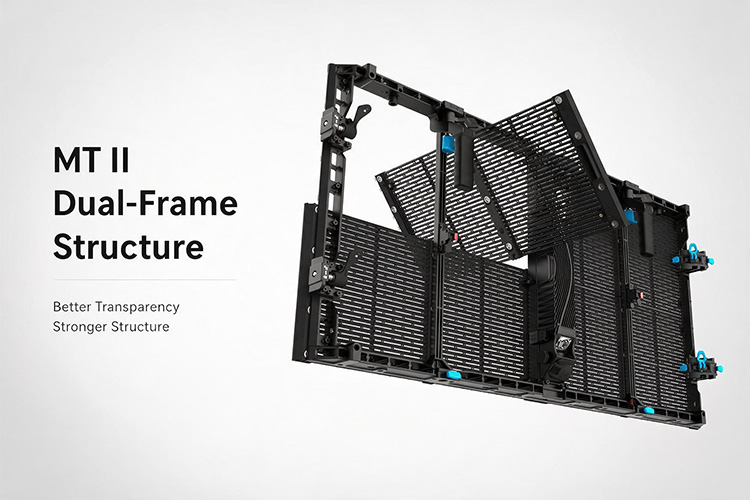
Why Are Large and Hanging Applications More Demanding?
The structural requirements increase significantly when a transparent LED display is used for large-scale or elevated installations. In a ground-stacked application, the supporting structure and installation environment can help manage part of the system load. A hanging display introduces different mechanical requirements because the cabinets and their connections must work with the rigging system to support the overall suspended structure.
As the number of cabinets increases, the cumulative load also increases. The cabinet structure must therefore work together with the connection and supporting system to distribute mechanical forces effectively. Maintaining cabinet alignment becomes particularly important because deformation in a large suspended display can affect both appearance and mechanical stability.
For professional stage and event applications, the frame also needs to accommodate practical production requirements. LED equipment may be assembled under time pressure, handled by different crews, transported repeatedly, and configured for different venues. Structural design must therefore consider not only static strength but also repeatability, handling, connection reliability, and installation efficiency. This is why the structural architecture of a transparent LED display becomes increasingly important as the application moves from a small decorative screen to a large-scale professional production.
How Does a Dual-Frame Structure Work?
A dual-frame structure is designed around two complementary structural elements rather than relying on a single primary frame. The purpose is not simply to add more material. Instead, the two frames are engineered to work together to provide structural support while maintaining the open architecture required for transparency. From an engineering perspective, the effectiveness of a dual-frame structure depends on the geometry, material properties, connection points, and load paths within the cabinet. When properly designed, the structure can distribute mechanical loads more efficiently and help maintain cabinet rigidity without turning the transparent cabinet into a conventional solid structure.
This is particularly valuable for transparent LED displays because the frame has to perform two seemingly conflicting functions. It must provide sufficient mechanical support while remaining visually unobtrusive. A well-designed dual-frame structure therefore focuses on structural efficiency rather than simply adding reinforcement. The principle can be summarized simply: transparency requires openness, openness creates structural challenges, and intelligent frame architecture helps restore the rigidity required for professional applications.
Why Does Material Selection Matter?
The frame structure cannot be separated from the material used to manufacture it. For rental LED displays, cabinet weight is an important consideration because it affects transportation, handling, installation, rigging, and overall production logistics. However, lighter does not automatically mean better. A cabinet that achieves a lower weight by sacrificing rigidity may create other problems during installation or operation. What matters is the relationship between cabinet weight and structural performance.
This is where magnesium alloy becomes relevant. Magnesium alloys are known for their low density, making them attractive for applications where weight reduction is important. In a transparent LED display, this can help engineers pursue a lightweight cabinet structure while maintaining the mechanical characteristics required for professional use. The objective is therefore not simply to make the LED cabinet as light as possible. It is to achieve an appropriate strength-to-weight ratio. For rental and staging companies, this balance can affect how efficiently equipment can be transported, installed, dismantled, and reused.
How Can Structural Design Improve Transparency Without Sacrificing Performance?
It is tempting to evaluate transparent LED displays primarily by their transparency percentage. While transparency is an important specification, it does not tell the whole story. A transparent LED display also needs to deliver sufficient brightness, image quality, structural stability, mechanical reliability, and installation flexibility. Maximizing transparency at the expense of these characteristics may limit the display's usefulness in professional environments.
The better approach is to consider transparency as part of a larger engineering system. The frame, LED modules, mechanical connections, electronic components, and installation structure must work together. For large-scale applications, the goal is not necessarily to achieve the highest possible transparency. The goal is to achieve an effective balance between transparency and performance. A display that remains visually open while providing adequate structural support, brightness, reliability, and installation flexibility can be more valuable than one that simply maximizes a single specification. This balance is especially important for stage and rental applications, where the LED display has to perform as both a visual surface and a professional production system.
How Does MT II Apply This Structural Philosophy?
The structural challenges discussed above are particularly relevant to the development of YES TECH MT II, the second-generation transparent LED display designed for professional rental and staging applications. Rather than treating transparency as an isolated feature, MT II is designed around a combination of structural architecture, material selection, installation flexibility, and operational requirements. Its magnesium-alloy dual-frame structure addresses the need for a lightweight yet structurally capable cabinet while preserving the open configuration required for transparent LED applications.
This approach is important because the second generation of a transparent LED product should not simply focus on making the display more transparent. It should address the practical problems that arise when transparent LED technology is used at a larger scale. For professional rental companies, that means considering how the cabinet performs during transportation, installation, hanging, operation, dismantling, and repeated deployment—not just how it looks when the audience sees it.
A Magnesium-Alloy Dual Frame for Professional Applications
The magnesium-alloy dual-frame structure is one of the key structural features of MT II. By combining a lightweight material with a dual-frame architecture, the design aims to establish a more efficient relationship between cabinet weight and structural performance. This becomes particularly valuable for touring and staging applications. LED equipment is often transported over long distances and installed under tight production schedules. Reducing unnecessary cabinet weight can make handling and logistics more efficient, while structural rigidity remains essential for maintaining cabinet alignment and stability.
The dual-frame design also reflects a broader principle in LED cabinet engineering: structural strength should be achieved through intelligent architecture, not simply through additional material. For MT II, the frame is therefore part of the product's performance strategy. It supports the demands of professional transparent LED applications while maintaining the visual openness that makes the technology attractive for creative productions.
Designed for Large-Scale Hanging and Creative Structures
MT II extends the application range of transparent LED technology with a hanging capability of up to 20 meters, making it suitable for larger stage and event environments where transparent LED screens need to be suspended above the performance area. Its structural flexibility also goes beyond a conventional flat LED wall. MT II supports ±15° curved splicing, allowing production teams to create concave and convex configurations. It also supports 90° corner configurations and staggered splicing, giving designers greater freedom when developing spatial LED structures.
These capabilities demonstrate an important relationship between structural engineering and creative flexibility. The cabinet frame does not simply determine whether the LED modules can be installed. It also influences how the entire display can be shaped and integrated into a stage or event environment. For concerts, festivals, corporate events, exhibitions, and immersive productions, this can allow transparent LED to function as a three-dimensional visual element rather than simply a flat video surface.
Built Around the Realities of Rental and Staging
Professional rental LED displays face demands that permanent installations do not. Equipment needs to be moved between venues, installed by different production teams, configured for different applications, and repeatedly dismantled after events. MT II is designed with these operating conditions in mind. Its installation-oriented mechanical design supports efficient handling, while its structural system is intended to maintain stability across large-scale configurations.
The display also supports both hanging and stacking applications using the same beam system, giving rental companies greater flexibility when adapting equipment to different production requirements. Instead of requiring completely different structural approaches for different deployment methods, one structural solution can support multiple installation scenarios. This matters from an operational perspective. For rental companies, product efficiency is not determined solely by specifications such as pixel pitch or brightness. Installation time, transportation, handling, configuration flexibility, and maintenance all contribute to the total value of an LED display system.
What Should Professionals Look for in a Transparent LED Display?
When evaluating a transparent LED display, buyers should look beyond transparency percentage and consider the complete structural system. Important questions include how the cabinet maintains rigidity, how multiple cabinets remain aligned, how the frame handles repeated installation, and whether the display can support the required hanging or stacking configurations.
Material selection should also be evaluated together with structural architecture. A lightweight cabinet is valuable only when it maintains the mechanical performance required for its intended application. Likewise, a heavily reinforced cabinet may not be an efficient solution if the additional material compromises transparency or creates unnecessary transportation and installation demands. A more comprehensive evaluation should therefore consider transparency, structural strength, weight, installation flexibility, connection design, and serviceability as a complete system.
This is the engineering perspective behind MT II. Its magnesium-alloy dual-frame structure is not simply a material upgrade or a visual design choice. It is part of a broader approach to making transparent LED technology more suitable for professional rental and staging environments.
Conclusion: Transparency Needs a Structural Foundation
The evolution of transparent LED displays is moving beyond the simple goal of creating a see-through screen. As the technology enters larger concerts, festivals, touring productions, exhibitions, and creative installations, structural engineering becomes increasingly important. The central challenge is clear: a transparent LED display must remain open enough to preserve its visual advantages while being strong and stable enough for real-world professional applications.
A dual-frame structure provides one approach to solving this challenge. By combining structural architecture with appropriate material selection, engineers can pursue a better balance between transparency, rigidity, weight, and operational efficiency. YES TECH MT II applies this philosophy through its magnesium-alloy dual-frame structure, up to 20 m hanging capability, ±15° curved splicing, 90° corner configurations, and rental-oriented mechanical design.
Ultimately, the best transparent LED display is not simply the one with the highest transparency. It is the one that can maintain the right balance between visual openness, structural performance, installation efficiency, and creative flexibility. For professional LED rental and staging applications, that balance is what allows transparent LED technology to move from a visual effect to a reliable, scalable production solution.


+86-(0)731-84539619


Hunan Yestech Optoelectronic Co., Ltd. Terms of Service Privacy Policy Powered by szweb


