



ADDRESS
Blog/2026.09.01
When people evaluate an LED display, the first specifications they usually look at are pixel pitch, brightness, refresh rate, transparency, and resolution. These parameters directly determine what the audience sees on screen. But for professional rental and touring applications, there is another factor that is often overlooked: the material and structural design of the LED cabinet itself.
An LED cabinet is more than a frame that holds LED modules. It provides the structural foundation for the display, maintains module alignment, transfers loads during stacking or hanging, and protects internal components during transportation, installation, operation, and dismantling. As LED displays become larger, lighter, more transparent, and more frequently deployed for concerts, festivals, sports events, and touring productions, cabinet material has become increasingly important.
This is particularly true for transparent LED displays. Unlike conventional solid LED cabinets, a transparent LED display must balance visual openness with structural stability. A large-format outdoor transparent LED display may also need to withstand repeated handling, wind loads, outdoor exposure, and high-altitude installation while remaining light enough for efficient touring. In other words, cabinet material can influence far more than the physical appearance of a display. It can affect how the entire LED system is transported, installed, supported, and operated.
What Makes Cabinet Material Important for an LED Display?
The fundamental purpose of a cabinet structure is to maintain the required geometry and mechanical integrity of the display under real operating conditions. During a typical rental production, a cabinet may be lifted, transported, stacked, connected, dismantled, and transported again many times. For touring applications, these loading cycles can occur repeatedly across different venues and environments.
This creates a demanding combination of requirements. A professional LED cabinet needs sufficient stiffness to maintain its geometry, adequate strength to carry mechanical loads, appropriate dimensional stability to support accurate alignment, and enough durability to withstand repeated handling. At the same time, reducing cabinet weight can make transportation and installation more efficient.
This is why material selection matters. Steel, aluminum alloys, magnesium alloys, and composite materials each offer different combinations of density, strength, stiffness, manufacturability, corrosion resistance, and cost. There is no single material that is automatically superior in every application. The engineering objective is to select a material and structural architecture that provide the right performance for the intended use.
For large rental displays and especially transparent LED display rental applications, the balance becomes even more important. A cabinet that is lightweight but lacks sufficient rigidity may be difficult to keep aligned. A cabinet that is extremely rigid but unnecessarily heavy can increase handling and transportation requirements. The real engineering challenge is therefore not simply making an LED cabinet lighter. It is achieving the right balance between weight, structural performance, dimensional stability, and operational efficiency.
What Is Carbon Fiber Composite?
Carbon fiber is often described simply as a lightweight, high-strength material, but the engineering reality is more specific. Most structural applications use carbon-fiber-reinforced polymer (CFRP) rather than bare carbon fibers.
CFRP is a composite material made by combining carbon fibers with a polymer matrix, commonly a resin system. The carbon fibers provide much of the structure's tensile strength and stiffness, while the matrix binds the fibers together, transfers loads between them, and forms the finished composite structure. The properties of the final component depend not only on the carbon fiber itself, but also on fiber type, fiber orientation, fiber volume, resin system, laminate configuration, and manufacturing process.
This is one reason carbon fiber is widely used in aerospace and other weight-sensitive engineering applications. NASA technical literature identifies high strength-to-weight and stiffness-to-weight performance, low density, fatigue performance, corrosion resistance, and low thermal expansion among the potential advantages of carbon-fiber composites.
An important distinction should also be made between material properties and component performance. A carbon fiber material does not automatically make every structure stronger or more durable than a metal structure. Composite performance depends heavily on how the fibers are oriented and how the complete structure is designed and manufactured. In a properly engineered component, however, the directional nature of carbon fiber can be used to place reinforcement where the structure needs it most.
Why Does a High Strength-to-Weight Ratio Matter?
One of the most important characteristics of carbon-fiber composites is their high strength-to-weight and stiffness-to-weight ratios. This means that engineers can potentially achieve the required structural performance with less mass than would be required from some conventional materials.
For an LED display cabinet, this distinction is important. The weight of a single cabinet may appear relatively small, but the effect becomes significant when hundreds of cabinets are installed together. A large LED wall can contain hundreds or even thousands of individual cabinets. Every kilogram saved at cabinet level becomes part of the total system-level weight.
For touring productions, this can influence several stages of the workflow. Lighter cabinets can be easier for crews to move and position during installation and dismantling. They can also reduce transportation weight and make large-format displays more manageable in venues where access, lifting equipment, or installation time is limited.
The benefit becomes particularly relevant for large transparent cabinets. A blow-through LED display is designed with an open structure that allows a significant amount of air and background scenery to remain visible through the display. This makes blow-through LED displays attractive for concerts, festivals, architectural stages, and outdoor events where the screen needs to integrate with lighting, truss, scenic elements, or the surrounding environment.
However, transparency alone does not make a display suitable for professional touring. The cabinet still needs to maintain sufficient structural stability while being lightweight enough to handle efficiently. This is where material engineering becomes part of the overall display design.
Why Does Structural Rigidity Matter as Much as Weight?
A common misconception is that the lightest LED cabinet is automatically the best cabinet for touring. In reality, weight reduction has to be achieved without compromising the structural requirements of the application. For an LED display, structural rigidity helps the cabinet maintain its intended geometry under mechanical loads. This matters because accurate cabinet alignment directly influences the visual continuity of a large LED wall. When cabinets are connected across a large surface, small dimensional differences or structural deformation can accumulate and become visible as uneven seams or surface irregularities.
This is especially important for transparent LED displays because large transparent cabinets can have a different structural architecture from conventional closed cabinets. The open design creates opportunities for lower weight and greater airflow, but the structural frame becomes an even more important part of the system.
Carbon-fiber composite construction is attractive in this context because its mechanical properties can be tailored through fiber orientation and laminate design. NASA research on composite structures has demonstrated how fiber arrangement can be engineered to achieve specific stiffness and thermal characteristics.
Therefore, the question is not simply whether carbon fiber is “stronger” than aluminum or steel. The more meaningful engineering question is whether the material, structural architecture, and manufacturing process work together to achieve the required performance at the lowest practical weight.
Why Can Carbon Fiber Be Valuable for Touring LED Displays?
Touring places unusual demands on an LED cabinet. A fixed-installation display may be assembled once and remain in the same location for years. A touring LED display can experience a completely different operating cycle: transport, installation, operation, dismantling, transportation, and reinstallation at another venue.
This repeated cycle makes handling efficiency and structural durability important considerations. Carbon-fiber composites can offer advantages in applications where low mass, high stiffness, fatigue performance, and dimensional stability are important. Their low density can contribute to lightweight structures, while properly engineered composite laminates can provide high stiffness and strength relative to their mass.
Thermal stability can also be relevant. Carbon-fiber composite structures can be engineered with relatively low coefficients of thermal expansion, although the actual value depends on fiber type, orientation, laminate configuration, and resin system. NASA data illustrates how the thermal expansion behavior of carbon-fiber composites can differ significantly by fiber direction and laminate configuration. For a large LED display, dimensional stability matters because the cabinet is part of the physical geometry of the entire screen. Maintaining structural consistency helps support accurate alignment as the display is assembled and operated under changing environmental conditions.
MAir: An Industry-First Seamless One-Piece Carbon Fiber LED Cabinet
The principles of material engineering become particularly relevant when they are translated into an actual LED cabinet structure. YES TECH applies this approach to MAir, an outdoor transparent LED display developed specifically for large-scale touring and live-event applications.
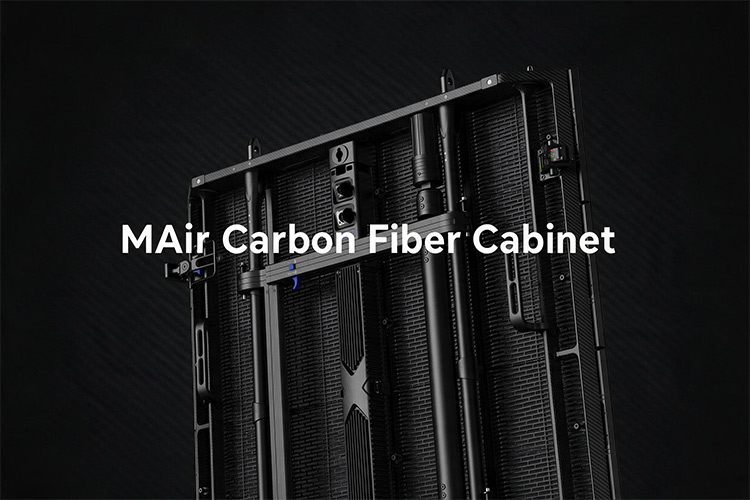
MAir uses what YES TECH describes as the industry's first seamless, one-piece carbon fiber molded frame, integrating the main cabinet frame into a continuous carbon-fiber structure rather than treating carbon fiber simply as a partial reinforcement. The MAir product architecture combines the carbon fiber frame with internal metal support structures, creating a hybrid structural system designed to balance low weight with mechanical stability. This distinction is important. The value of carbon fiber in an LED display is not simply the presence of a carbon-fiber material. It is how the material is integrated into the load-bearing architecture of the cabinet.
With a 1000 × 1000 mm cabinet weighing approximately 19 kg, MAir is designed to reduce the physical burden associated with handling large transparent LED cabinets. YES TECH states that the cabinet is 23.2% lighter per square meter than conventional transparent LED cabinets, while its structural system supports hanging installations up to 25 meters.
For a touring production, the significance of this design extends beyond a single specification. Lower cabinet weight can simplify lifting, positioning, transportation, and dismantling. When multiplied across a large screen, the reduction in individual cabinet weight can translate into a meaningful difference in the overall handling workload.
At the same time, MAir is not designed around lightweight construction alone. Its carbon-fiber frame forms part of a broader structural system that includes internal load-bearing components and optional wind-bracing structures. The result is an approach that treats the cabinet as an engineered load-bearing system rather than simply a lightweight enclosure.
This becomes particularly relevant for an outdoor transparent LED display. MAir is available in transparent configurations with transparency of up to 50% for the P7.8 version, while its open structure is designed to support airflow and visual integration with the stage environment. The product is also engineered for outdoor applications, with IP65 protection and wind performance specified up to 20 m/s. The result is not simply a lighter cabinet. It is a different approach to designing a carbon fiber LED display cabinet around the requirements of touring: lightweight handling, structural stability, outdoor deployment, and repeated installation.
The Future of LED Cabinet Design Is About More Than Weight
As LED displays continue to move toward larger formats, more flexible configurations, and more demanding touring applications, cabinet material is becoming an increasingly important part of display engineering. The best material is not necessarily the lightest or the strongest in isolation. What matters is how material properties, structural design, manufacturing precision, and application requirements work together.
Carbon-fiber composite technology provides engineers with an additional route to achieve high structural performance at relatively low mass. For transparent LED display rental, outdoor transparent LED displays, and blow-through LED displays used in touring environments, this combination can address several practical challenges at the same time. MAir takes this concept further through its industry-first seamless one-piece molded carbon fiber frame. By combining carbon fiber with a purpose-designed structural system, MAir turns a material innovation into an application-focused touring LED display solution.
Ultimately, cabinet material matters because an LED display is not only a visual product. It is also a physical structure that must be transported, installed, supported, operated, dismantled, and reused. As the industry moves toward more mobile and demanding production environments, the future of LED cabinet design will depend increasingly on achieving the right balance between lightweight construction, structural integrity, dimensional stability, and real-world operational efficiency.


+86-(0)731-84539619


Hunan Yestech Optoelectronic Co., Ltd. Terms of Service Privacy Policy Powered by szweb


