



ADDRESS
Blog/2026.09.09
Large-scale concerts, music festivals, sporting events, and live productions are demanding more from LED display systems than ever before. As stages become larger and more visually complex, LED screens are increasingly installed at greater heights, across wider spans, and in more unconventional configurations. In these environments, image quality is only one part of the equation. The weight, structural performance, rigging efficiency, installation speed, and flexibility of the LED cabinet can have an equally significant impact on the success of an event.
This is where lightweight LED cabinet design is becoming increasingly important. Traditional metal cabinets have long been the standard for professional LED displays because of their durability and structural reliability. However, when hundreds or even thousands of cabinets are combined into a large display, every kilogram matters. The accumulated weight can increase transportation requirements, lifting loads, structural demands, and on-site labor.
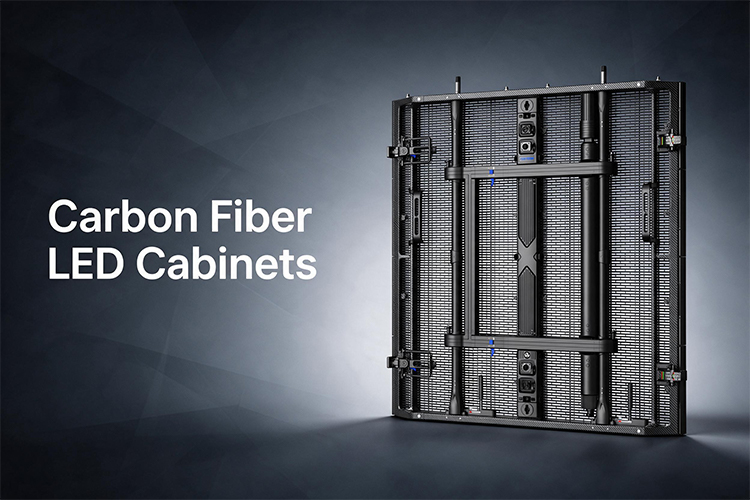
Carbon fiber LED cabinets offer a different approach. By combining high-performance composite materials with optimized structural engineering, carbon fiber can help reduce cabinet weight while maintaining the strength and rigidity required for professional LED display applications. For large-scale events, this can translate into more efficient transportation, easier handling, greater rigging flexibility, and faster deployment.
Why Does Cabinet Weight Matter in Large-Scale LED Display Applications?
For a small LED display, the weight of an individual cabinet may not seem particularly important. The situation changes significantly when the display reaches hundreds or thousands of square meters. A large event may require hundreds of LED cabinets to be transported to a venue, moved into position, assembled, rigged, tested, and eventually dismantled within a very limited time window. Even a small reduction in the weight of each cabinet can create a substantial difference at the system level.
Lower cabinet weight can reduce the overall load placed on the rigging system and supporting structures. It can also make individual cabinets easier for technicians to handle during installation and adjustment. In high-level rigging applications, where LED screens may be suspended several meters above the stage, reducing unnecessary weight can provide additional flexibility when planning the overall structure. This is particularly valuable for touring productions. Unlike permanent installations, touring LED systems are repeatedly loaded, transported, unloaded, installed, adjusted, dismantled, and transported again. A lightweight cabinet therefore does more than make one installation easier. Its benefits can be repeated throughout the entire production cycle.
Why Is Carbon Fiber Suitable for LED Cabinet Construction?
The value of carbon fiber lies not simply in being lightweight, but in its combination of low weight, high strength, and high stiffness relative to its mass. For an LED cabinet, structural performance is critical. The cabinet must support the LED modules and internal components while also withstanding transportation, handling, assembly, rigging, and environmental loads. Outdoor applications introduce additional considerations such as wind exposure, moisture, and temperature changes. A well-engineered carbon fiber LED cabinet uses the material as part of an integrated structural system rather than treating carbon fiber as a simple replacement for metal. The material, frame geometry, load paths, joints, and manufacturing process all need to work together.
This distinction is important because lightweight construction should never mean simply making a cabinet thinner or less robust. The objective is to remove unnecessary mass while maintaining the mechanical performance required for the intended application. For professional LED rental systems, this approach can create a more favorable balance between weight and structural performance.
How Does a Lightweight LED Cabinet Improve Rigging Efficiency?
Rigging a large LED display is a system-level engineering task. The total weight of the screen affects the supporting structure, lifting equipment, suspension points, and overall load calculations. When cabinet weight is reduced, the cumulative effect can become significant. Consider a large display consisting of several hundred cabinets. Reducing the weight of each cabinet by only a few kilograms can potentially reduce the total screen weight by hundreds or even thousands of kilograms.
This can make a difference when designing suspended LED structures for concerts, festivals, and other large-scale productions. A lighter display can reduce the load that the supporting system needs to carry and can provide greater flexibility when integrating LED screens into complex stage structures. However, cabinet weight is only one part of rigging efficiency. The physical dimensions of the cabinet, connection system, alignment mechanism, lifting structure, and installation workflow also influence how quickly and safely a screen can be deployed. That is why modern LED rental cabinets need to be designed around the entire workflow rather than weight alone.
Beyond Weight: What Makes an LED Cabinet Efficient to Deploy?
A professional LED rental cabinet needs to perform efficiently from transportation through dismantling. A typical event workflow may involve loading, transportation, unloading, positioning, assembly, rigging, alignment, power and signal connection, testing, operation, and dismantling. If every stage requires excessive manual effort, a lightweight cabinet alone will not solve the problem. This is why advanced LED cabinet design increasingly combines lightweight construction with integrated handling and installation features. A cabinet should be easy to move, quick to connect, accurate to align, and capable of adapting to different stage configurations.
This becomes even more important when the display is not a simple flat wall. Modern stage design frequently incorporates curved screens, corner structures, suspended surfaces, layered displays, and other three-dimensional configurations. The more complex the structure becomes, the more important cabinet weight and mechanical flexibility become.
MAir: Carbon Fiber Engineering for Large-Scale Event Applications
YES TECH MAir takes a structural approach to lightweight LED display design by integrating carbon fiber into a seamless one-piece molded frame. The MAir cabinet measures 1000 × 1000 × 102 mm and weighs approximately 19 kg. Rather than treating lightweight construction as an isolated feature, MAir combines the carbon fiber frame with structural engineering designed for demanding outdoor and large-scale event applications.
At large screen sizes, the significance of this weight becomes more apparent. When hundreds of cabinets are installed together, reducing the weight of each cabinet can substantially reduce the overall mass of the display system. For production teams, this can help ease transportation and handling while providing greater flexibility when planning suspended LED structures. For touring applications, the benefit is repeated every time the system is moved and redeployed.
Built for Strength as Well as Lightweight Performance
Lightweight construction is only meaningful when it maintains the structural performance required for professional applications. MAir is engineered with a tensile strength of up to 51 kN, providing a structural foundation for demanding rigging and large-scale deployment scenarios. This combination of low weight and high structural performance is particularly relevant to suspended LED displays, where cabinet construction and rigging design need to work together.
MAir supports hanging heights of up to 25 meters, making it suitable for large stages and high-level LED display applications. Of course, actual rigging safety always depends on the complete installation environment. Supporting structures, suspension points, load distribution, local regulations, and site-specific engineering calculations must be evaluated for every project. A lightweight cabinet is not a substitute for professional structural assessment; rather, it is one component of a more efficient overall system.
More Freedom for Curved and 3D Stage Designs
Large-scale event production is moving beyond conventional flat LED walls. Designers increasingly use LED displays as architectural elements within the stage, creating curves, corners, suspended structures, and immersive visual environments. MAir supports ±15° curved configurations, allowing rental companies and production teams to build curved LED surfaces without relying exclusively on flat configurations. It also supports 90° corner applications, enabling the display to extend across different planes and create more three-dimensional structures.
This flexibility can be particularly useful for concerts, festivals, sports events, and brand activations where the LED display needs to become part of the stage architecture rather than simply function as a background screen. A more flexible cabinet design can reduce the need to compromise the creative concept around the limitations of the display system.
Why Integrated Handling Matters for Fast Deployment
Large-scale events operate under strict production schedules. LED systems often need to be installed and tested within a narrow window before rehearsals or live performances begin. Once the event is finished, the same equipment may need to be dismantled immediately. This makes deployment speed a critical consideration for professional rental companies. MAir integrates a 6-in-1 dolly concept to simplify equipment handling and movement. Combined with its lightweight carbon fiber frame, the design is intended to make the cabinet easier to manage throughout transportation and on-site deployment.
The goal is not simply to make one part of installation faster. It is to reduce friction throughout the entire workflow, from moving cabinets around the venue to assembling large display surfaces and preparing them for operation. For touring productions in particular, small efficiency gains can accumulate into meaningful savings in labor, time, and logistics.
Combining Lightweight Structure with Transparent LED Technology
MAir also extends the concept of lightweight structural design into transparent LED applications. The series is available in P5.9 solid configurations as well as P5.9 and P7.8 mesh configurations. The P7.8 mesh version can achieve up to 47% transparency, allowing stage lighting, structural elements, and the surrounding environment to remain visually integrated with the LED content.
This approach is particularly valuable for outdoor concerts, festivals, and large cultural events where designers want the LED display to provide visual impact without completely blocking the stage structure or background. In these applications, the advantage of MAir is not simply that the cabinet is lightweight. Its structural design, transparent display options, curved configurations, and rigging capabilities work together to create a more adaptable platform for large-scale stage design.
Is Lightweight the Future of Professional LED Rental Displays?
As event productions continue to grow in scale and complexity, the definition of a high-performance LED rental cabinet is changing. Traditional cabinet design focused primarily on durability and display performance. Modern rental applications require a broader combination of characteristics: lightweight construction, structural strength, fast deployment, precise alignment, flexible configuration, and efficient transportation. Carbon fiber provides an effective material platform for addressing some of these requirements, but the real advantage comes from integrating the material into a complete cabinet architecture.
For large-scale events, the question is no longer simply whether an LED cabinet can support a display. The more important question is whether the cabinet can help the entire production team work more efficiently. That means reducing unnecessary weight without compromising structural performance, supporting demanding rigging applications without limiting creative design, and simplifying transportation and deployment without sacrificing reliability.
MAir is designed around this philosophy. With a seamless one-piece carbon fiber frame, approximately 19 kg cabinet weight, up to 51 kN tensile strength, support for hanging heights of up to 25 meters, ±15° curved configurations, 90° corners, and an integrated 6-in-1 dolly design, MAir brings lightweight engineering and practical deployment requirements together in one LED display platform. For large concerts, festivals, touring productions, sporting events, and other demanding live applications, this approach can help transform lightweight construction from a material advantage into a practical production advantage.
The evolution of large-scale LED displays is closely connected to the evolution of the cabinet itself. As screens become larger, stages become more complex, and installation windows become shorter, reducing unnecessary weight while maintaining structural performance is becoming increasingly important. Carbon fiber LED cabinets offer a new approach by combining material efficiency with advanced structural engineering. The real value of a lightweight LED cabinet, however, is not simply measured by kilograms.
A lighter cabinet can mean more efficient transportation.
A stronger structure can support more demanding rigging applications.
A more flexible cabinet can unlock more creative stage designs.
And a more integrated system can help production teams deploy large LED displays more efficiently.
For the next generation of large-scale live events, lightweight LED cabinet engineering is not just about making LED displays lighter. It is about making the entire production workflow smarter, more flexible, and more efficient.


+86-(0)731-84539619


Hunan Yestech Optoelectronic Co., Ltd. Terms of Service Privacy Policy Powered by szweb


