



ADDRESS
Blog/2026.08.18
For years, lightweight construction has been one of the defining priorities in rental LED display design. As LED cabinets became thinner and easier to transport, manufacturers increasingly explored different materials and structural approaches to reduce weight while maintaining sufficient strength. However, as rental LED displays move into more demanding applications—from large festivals and touring stages to basketball events and outdoor productions—the definition of a high-performance LED cabinet is becoming more comprehensive.
Weight still matters. But it is no longer the only consideration. A professional rental LED display must withstand repeated installation and dismantling, transportation between venues, hoisting, stacking, physical handling and continuous operation. At the same time, it needs to maintain accurate cabinet alignment and provide a practical installation experience for production crews working under tight schedules. These requirements have brought structural precision, durability and installation efficiency back to the center of LED cabinet design.
This is one reason die-cast aluminum remains an important material choice for professional LED display cabinets. Rather than simply making a cabinet heavier or stronger, a well-engineered die-cast aluminum structure can provide a balance of rigidity, dimensional consistency, durability and thermal performance while remaining suitable for rental applications. For rental companies, the question is therefore no longer simply how light an LED cabinet can be. The more important question is how effectively the cabinet performs throughout its entire working lifecycle.
Why Die-Cast Aluminum Remains Important for LED Display Cabinets
Die-cast aluminum cabinets are manufactured using a high-pressure casting process that forms aluminum alloy into precisely designed structural components. Key areas can then undergo further machining to achieve the dimensional accuracy required for cabinet assembly and connection.
This manufacturing approach is particularly relevant to LED displays because an LED screen is rarely made from a single cabinet. A large display may consist of hundreds of cabinets connected together. Small variations in cabinet dimensions, connection points or structural alignment can accumulate across a large screen and eventually affect its overall flatness and appearance. For this reason, cabinet precision is not simply a manufacturing specification. It directly contributes to the quality of the finished LED display.
A rigid and accurately manufactured cabinet can help maintain consistent connections between cabinets and provide a stable foundation for LED modules. This becomes particularly important in rental applications, where the same cabinets may be installed and dismantled repeatedly in different venues.
Die-cast aluminum also offers useful thermal characteristics. Aluminum has good thermal conductivity, allowing the cabinet structure to participate in heat dissipation. For LED displays operating for extended periods, particularly in high-brightness outdoor applications, effective thermal management is an important part of maintaining reliable operation.
The material itself, however, is only one part of the equation. The actual performance of an LED cabinet depends on the combination of material selection, structural engineering, manufacturing precision, connection design and maintenance accessibility.
What Does a Professional Rental LED Cabinet Need to Deliver?
A rental LED display has a fundamentally different working environment from a permanent fixed-installation screen. A fixed LED display may be installed once and remain in position for years. A rental display can be installed for a festival, dismantled after several days, transported to another city, reconfigured for a new stage and installed again within a short period of time. Some displays are also flown above stages, stacked on the ground or integrated into temporary sports and event structures.
Every one of these operations places different demands on the cabinet. The cabinet needs sufficient structural durability to handle transportation and repeated assembly. Its connection system needs to be intuitive enough for fast installation. Its dimensions need to remain consistent to support accurate screen alignment. And the overall design needs to reduce unnecessary handling steps for crews working under time pressure. This is where a professional rental LED cabinet goes beyond being a box that holds LED modules. It becomes part of the installation system.
A cabinet that saves several minutes during installation may seem like a small improvement when viewed individually. Across a large LED screen involving hundreds of cabinets, however, installation efficiency can have a meaningful effect on labor requirements and production schedules.
MU: Designed Around Precision and Installation Efficiency
YES TECH's MU Series is designed around these practical requirements, combining a die-cast aluminum cabinet structure with an installation-oriented design. The cabinet and power control box are both manufactured from die-cast aluminum alloy, providing a rigid and durable structural platform for rental applications. The purpose is not simply to use aluminum as a material, but to use the material as part of a complete cabinet design focused on precision, protection and repeated operation.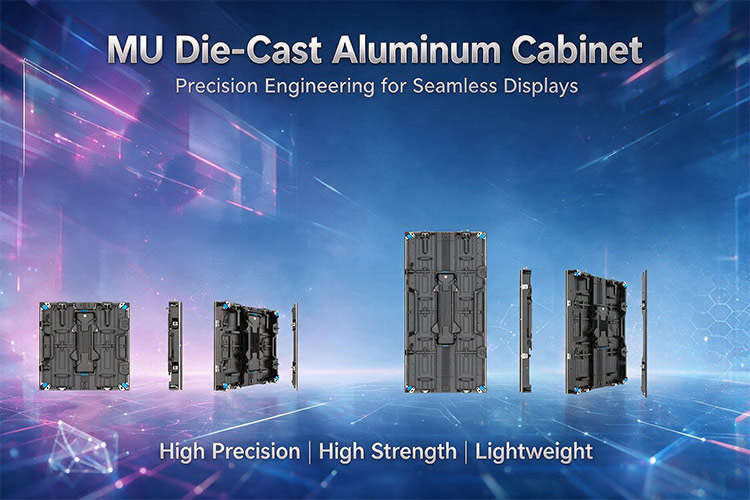
This approach is reflected in one of the key design concepts of the MU Series: Precision Protection. For a rental LED display, protection starts with the cabinet structure itself. During transportation and installation, the cabinet is exposed to handling, connection, stacking and other physical forces. A robust structural design helps protect the internal components while maintaining the geometry needed for accurate screen assembly.
The die-cast aluminum construction of the MU cabinet and power control box provides a durable foundation for this type of repeated use. It also gives the cabinet the structural characteristics required for professional event applications where reliability cannot depend solely on careful handling. But durability is only useful if the cabinet is practical to install.
Single-Person Operation for Faster LED Screen Installation
Installation efficiency is one of the most important considerations for rental LED displays, particularly when crews need to assemble large screens within a limited production window. MU addresses this requirement through a series of details designed around the physical process of handling a cabinet.
The large handle provides a more secure grip when the cabinet is being carried and positioned, while the large holder makes it easier for operators to hold the cabinet during installation. These may appear to be simple mechanical details, but they directly affect how an operator interacts with the cabinet.
The quick-lock design is particularly useful during hoisting installation. By helping secure the cabinet while freeing the operator's hands, the locking mechanism can reduce unnecessary manual movements and make the installation process more efficient. This creates a more practical workflow: Lift. Position. Lock. Instead of designing a rental cabinet only around its finished appearance, MU considers what happens when technicians actually have to install it.
That distinction matters. A professional LED display may look excellent once it is assembled, but the real test begins before the screen is switched on—during loading, transportation, positioning, connection, hoisting and dismantling.
Flexible Cabinet Sizes for Different LED Display Configurations
Different event environments require different screen structures. A compact indoor screen may need a different cabinet configuration from a large festival display or sports application. MU is available in both 500 × 500 mm and 500 × 1000 mm cabinet formats, giving rental companies greater flexibility when planning different screen dimensions and structures.
The 500 × 500 mm format can provide greater flexibility when building smaller or more complex screen configurations, while the 500 × 1000 mm format can help cover larger areas efficiently. This flexibility becomes particularly valuable for rental companies managing multiple types of events. Instead of designing every project around a completely different cabinet platform, a flexible product family can support a broader range of applications.
MU also supports optional 2-in-1 and 4-in-1 schemes, further expanding its configuration possibilities for different project requirements. The goal is straightforward: one cabinet platform should be capable of adapting to more than one type of event.
Multiple Pixel Pitches for Indoor and Outdoor Applications
Material and cabinet structure are only part of an LED display solution. Pixel pitch determines the level of image detail and is closely related to viewing distance and application environment. The MU Series offers a broad range of pixel pitch options for both indoor and outdoor applications. For indoor applications, MU is available in: P1.9, P2.6, P2.9, P3.9 and P4.8. For outdoor applications, the available options include: P2.9, P3.9 and P4.8.
This range allows the same general cabinet platform to address different viewing environments, from relatively close-range indoor audiences to larger outdoor event spaces where viewing distances are greater. As a result, MU can be considered not simply as a single LED cabinet specification, but as a flexible rental display platform that can be configured according to the requirements of different events.
From Festival Stages to Sports Applications
The practical value of a rental LED display becomes most visible when it is deployed in real production environments. Festival applications are a natural fit for rental LED technology because screens often need to be installed quickly, operated throughout the event and dismantled immediately afterward. Large outdoor festivals also place additional demands on equipment because the screen must function within temporary production environments and often under changing weather conditions.
The MU Series has been used in events including Moorea Festival 2026, Cocorico Electro 2026 and Terres du Son 2026, demonstrating its application in festival environments where installation efficiency and dependable cabinet construction are important considerations.
However, the role of rental LED displays is expanding beyond traditional concert stages. Sports events provide another demanding application. LED displays may be used as court-side screens, event backdrops, advertising displays or large-format visual surfaces. These installations can require fast setup, frequent handling and flexible screen configurations while remaining highly visible to audiences.
The Nanterre Basket Show 2026 is an example of this type of application. In a sports environment, the display needs to become part of the overall event production rather than simply function as a conventional video wall. The cabinet therefore needs to support the practical requirements of temporary event installation while delivering the image quality expected from a professional LED display.
This wider range of applications demonstrates why cabinet design has become increasingly important. The same LED display technology may be used on a festival stage one week and in a sports environment the next. What changes is not only the content shown on the screen, but also the way the equipment needs to be installed, transported and configured.
Beyond Lightweight: Designing for the Entire Rental Lifecycle
The development of LED display cabinet materials should not be reduced to a competition between polymer, aluminum, magnesium or other materials. Each material can provide different advantages depending on the structural design and application. For rental LED displays, however, the material needs to work together with the rest of the cabinet system.
A lightweight cabinet that is difficult to install does not necessarily create a more efficient rental operation. Similarly, a highly rigid cabinet without an effective connection system may still require unnecessary labor during setup. The most useful way to evaluate a rental LED cabinet is therefore to consider its entire lifecycle: Transportation → Handling → Installation → Operation → Dismantling → Transportation Again.
Every stage places different requirements on the product. The MU Series approaches this lifecycle through four key design priorities: precision, protection, efficiency and flexibility. Its die-cast aluminum cabinet and power control box provide the structural foundation. Its large handle, large holder and quick-lock design address installation efficiency. Its 500 × 500 mm and 500 × 1000 mm options support different screen configurations, while its range of indoor and outdoor pixel pitches allows the platform to adapt to different viewing environments. That combination is particularly relevant to today's rental market, where an LED display is expected to do much more than produce high-quality visuals. It needs to work efficiently behind the scenes, too.
The evolution of rental LED displays is not simply a race toward lighter materials. As LED screens move into increasingly diverse applications, cabinet design must balance structural durability, dimensional precision, thermal performance, installation efficiency and deployment flexibility.
Die-cast aluminum remains an important solution because it can provide a strong and precise structural foundation while supporting the demands of repeated rental use. But the material alone does not determine the quality of an LED cabinet. The real difference comes from how the material is engineered into the cabinet and how effectively the resulting design works in the field. The MU Series reflects this approach. By combining die-cast aluminum construction, precision protection, single-person-oriented installation features, flexible cabinet sizes and multiple pixel pitch options, MU is designed for the realities of modern event production.
From festival screens at Moorea Festival, Cocorico Electro and Terres du Son to sports applications such as the Nanterre Basket Show, MU demonstrates how a professional rental LED cabinet can be designed around more than the screen itself. Because for rental LED technology, performance does not begin when the content starts playing. It begins with the first cabinet being picked up, positioned and locked into place.


+86-(0)731-84539619


Hunan Yestech Optoelectronic Co., Ltd. Terms of Service Privacy Policy Powered by szweb


