



ADDRESS
Blog/2026.08.27
Transparent LED displays are becoming an important tool for stage designers, rental companies, and production teams looking to create larger visual structures without turning the entire stage into an opaque LED wall. They can be suspended above performers, integrated into scenic structures, wrapped around stage elements, or used as visual layers that combine digital content with lighting and physical scenery.
But choosing a transparent LED display for touring is fundamentally different from choosing one for a permanent installation. Touring equipment has to survive repeated transportation, fast installation, dismantling, changing venues, and demanding outdoor conditions while still delivering the visual performance expected from a professional LED display. For rental companies and production teams, the right question is therefore not simply “Which transparent LED display has the highest transparency?” A better approach is to evaluate how the display performs as part of the entire touring workflow—from the first truck load-in to the final dismantling.
Start With the Application, Not the Specification Sheet
The same transparent LED display may be used very differently depending on the production. A festival may require a large suspended screen exposed to wind and changing weather. A concert tour may prioritize fast installation and transportation between venues. A brand activation may focus more heavily on visual integration and unconventional shapes.
These applications create different technical priorities. For example, a large outdoor suspended display needs appropriate structural and environmental performance, while a touring production moving between venues may place greater emphasis on cabinet weight, mechanical connections, transportation efficiency, and installation time. A designer working with transparent LED as part of a stage structure may instead prioritize curvature, corner configurations, and the ability to combine the screen with lighting and scenic elements. This is why comparing transparent LED displays by a single specification can be misleading. The best transparent LED display is the one whose engineering matches the production workflow. A useful evaluation should therefore consider five interconnected areas: visual performance, structural design, deployment efficiency, environmental capability, and long-term rental usability.
Transparency Is Only One Part of Visual Performance
Transparency is the defining characteristic of a transparent LED display, but it should not be treated as an isolated number. The purpose of transparency is to allow elements behind the LED display to remain visible while digital content is displayed on the screen. Depending on the production, those elements may include stage lighting, performers, scenic structures, architectural backgrounds, or special effects.
The required transparency level depends on how the display will be used. A screen positioned directly in front of a lighting system may require a different visual balance from one installed against a scenic backdrop. Viewing distance, content design, ambient lighting, and the density of the LED layout can also influence the final visual effect. Professional buyers should therefore ask manufacturers for transparency specifications for the exact configuration being considered, rather than assuming that a transparency figure applies equally to every pixel pitch or configuration.
It is also worth considering how transparency is achieved. An open LED structure can reduce the amount of material occupying the visual field, but the cabinet still needs sufficient mechanical rigidity to maintain alignment and stability. The engineering challenge is to create an open visual structure without compromising the requirements of a professional rental system.
Cabinet Architecture Determines More Than Appearance
For touring applications, the cabinet is not simply the frame around the LED modules. It is the basic mechanical platform that determines how the display is transported, assembled, connected, maintained, and integrated into a larger structure. Cabinet dimensions therefore matter.
A larger cabinet can cover more screen area with fewer individual units. In a large installation, fewer cabinets can mean fewer mechanical connections and fewer repeated positioning and locking operations. At the same time, cabinet size must remain practical for transportation and manual handling. This creates an important engineering balance between coverage, weight, rigidity, and handling.
Cabinet weight should similarly be evaluated together with cabinet area. A lightweight cabinet is useful, but the more meaningful metric for large rental projects is often weight per square meter. This helps production teams understand how much equipment must ultimately be transported and supported by the installation structure. For this reason, a transparent LED display should be evaluated as a complete cabinet architecture rather than as a collection of individual specifications.
Mechanical Design Matters When the Screen Travels
A touring LED display may be assembled and dismantled dozens of times during its service life. Every installation introduces repeated mechanical operations: positioning cabinets, aligning connections, locking units together, attaching rigging components, connecting power and signal, and eventually reversing the process after the show.
Mechanical design can therefore have a direct effect on operational efficiency. A well-designed locking system should allow cabinets to be connected consistently while minimizing unnecessary adjustment. Positioning mechanisms can help technicians align adjacent cabinets, while integrated handles and ergonomic features can make repeated handling more manageable. The important consideration is not whether a manufacturer can demonstrate one fast installation. The more useful question is whether the cabinet design can make hundreds of repetitive operations more predictable across an entire production.
This becomes particularly important for rental companies because the equipment may be handled by different crews at different venues. A straightforward mechanical workflow can make the equipment easier to deploy consistently without eliminating the need for qualified technicians and appropriate structural engineering.
Transportation Should Be Part of the LED System
Transportation is one of the areas where the difference between a display designed for touring and one designed primarily for fixed installation becomes particularly visible. Rental equipment has to move. Cabinets must be loaded, transported, unloaded, moved through venues, installed, dismantled, and packed again. A display that performs well once installed can still create operational difficulties if its transportation system is inefficient. This is why rental companies should evaluate the cabinet and its transportation solution together.
Questions should include:
How are cabinets stacked and protected?
How many cabinets can the transportation system accommodate?
Can the same dolly be used for different operational stages?
How easily can equipment move from transportation to installation?
How much manual handling is required?
The objective is to reduce unnecessary handling throughout the workflow. For touring productions, logistics can become especially important because equipment may travel directly from one venue to another under tight production schedules. Transportation efficiency is therefore part of display performance in a rental environment.
Outdoor Transparent LED Requires More Than an IP Rating
Outdoor transparent LED displays face a different set of engineering requirements from indoor systems. Rain, humidity, dust, temperature changes, and wind can all affect temporary outdoor installations. A professional outdoor LED display therefore needs appropriate environmental protection, but an IP rating alone does not determine whether a system is suitable for a particular installation.
Wind performance is especially important for large transparent LED structures. The actual forces acting on a screen depend on its size, orientation, installation height, supporting structure, local wind conditions, and installation configuration. This means manufacturers should provide documented product specifications, while project teams must still carry out the appropriate structural and rigging assessment for the actual installation. For rental companies, the more useful approach is to evaluate environmental protection and structural capability together rather than treating them as separate marketing features.
Installation Height Changes the Engineering Requirements
Transparent LED is increasingly used in suspended stage structures, where screen height can become a significant engineering consideration. As the installation becomes higher or larger, the supporting system and rigging design become increasingly important. The LED cabinet itself is only one part of the load path. Trusses, motors, suspension points, supporting structures, and site conditions all need to be considered as part of the installation.
This is why a manufacturer's stated maximum hanging height should never be interpreted as a universal installation recommendation. Instead, production teams should ask: Under what configuration and conditions was the stated capability determined? This distinction is essential for professional applications. Product specifications describe the capability of the equipment, while the final installation requires project-specific engineering and compliance with applicable safety requirements.
Flexibility Can Increase the Value of Rental Inventory
One of the advantages of rental equipment is its ability to serve multiple projects. A transparent LED display may be used as a flat screen for one event and as a curved or unconventional structure for another. If the cabinet supports multiple configurations, the same inventory can potentially serve a broader range of stage designs.
Curved configurations can help designers create concave or convex surfaces. Corner connections can allow LED to wrap around structures rather than remaining on a single plane. Hanging and stacking options can further expand possible deployment scenarios. For rental companies, this flexibility has a commercial implication: equipment versatility can influence asset utilization. A display that can only serve one type of project may spend more time in storage. A platform capable of adapting to different production requirements has more opportunities to be deployed. However, flexibility should always be evaluated against real customer demand. More configurations do not automatically create more revenue. The relevant question is whether those configurations correspond to the types of projects a rental company actually serves.
Serviceability Becomes Critical After the Show
Reliability is often discussed in terms of whether a display works during the event. For rental companies, there is another equally important question: how quickly can the equipment be inspected, serviced, and returned to the fleet? Rental equipment is exposed to repeated handling. Modules, power components, connectors, and mechanical interfaces can eventually require maintenance or replacement.
A professional transparent LED display should therefore provide practical access to serviceable components and a maintenance process that technicians can understand and execute efficiently. This is especially important between consecutive events. A small issue that can be diagnosed and resolved quickly between shows has a very different operational impact from a problem that requires extensive cabinet disassembly or specialized procedures. Serviceability should therefore be evaluated as part of the equipment's lifecycle—not only after something goes wrong.
Look at the Display as a Complete Rental Asset
At this point, the most important distinction becomes clear: a touring LED display is not simply a screen. It is an asset that moves through a recurring operational cycle: transport → handling → installation → operation → dismantling → inspection → storage → redeployment. Every stage creates potential cost and operational risk. Cabinet weight affects handling. Cabinet size affects coverage and transportation. Mechanical design affects installation. Structural performance affects deployment possibilities. Environmental protection affects outdoor use. Serviceability affects fleet availability. Configuration flexibility affects the number of projects the equipment can serve.
This is why rental companies should avoid making purchasing decisions based only on purchase price or a small group of headline specifications. A more useful evaluation considers the relationship between performance, deployment efficiency, asset utilization, and lifecycle cost.
MAir: Designed Around the Touring Workflow
YES TECH's MAir Series takes this system-level approach to outdoor transparent LED rental applications. The series uses a 1000 × 1000 × 102 mm cabinet with a one-piece carbon fiber molded frame and a cabinet weight of 19 kg. It is available in P5.9 and P7.8 configurations, with solid and mesh options designed for different visual requirements.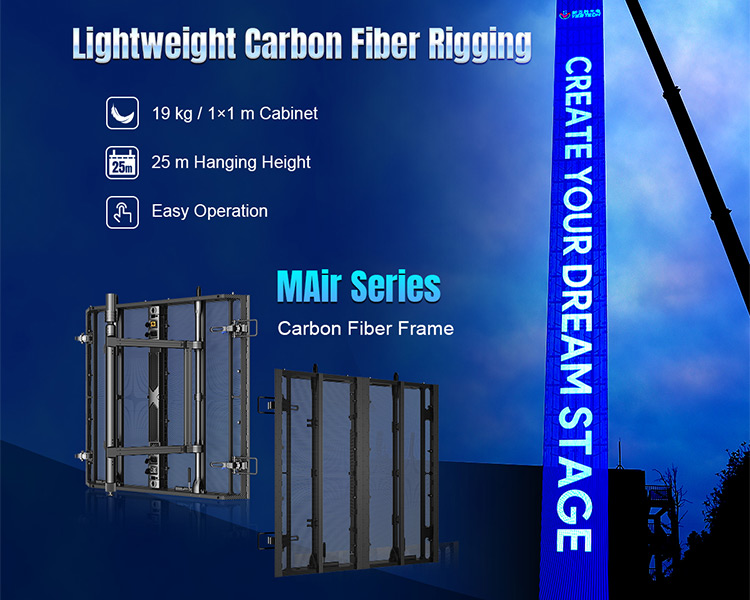
For deployment, MAir incorporates a curved blade lock, positioning pins, magnetic positioning, and an automatic latch system. The cabinet supports concave and convex configurations of up to ±15°, allowing production teams to move beyond a conventional flat LED surface. A 6-in-1 dolly is also designed to support transportation, stacking, and storage workflows.
For outdoor applications, MAir is rated IP65. Its Air Frame configuration is specified for wind speeds of up to 20 m/s, while the system supports hanging heights of up to 25 meters under the manufacturer's specified conditions. These specifications are product capabilities, not substitutes for project-specific structural calculations, rigging design, or local safety requirements.
The P7.8 mesh configuration provides up to 50% transparency according to YES TECH's current product specification, allowing the display to remain visually integrated with lighting and scenic elements behind it. The combination of an open visual structure, lightweight cabinet architecture, flexible configurations, and transportation-focused design is intended to address the practical requirements of large outdoor events and touring productions.
For rental companies, this is ultimately the more useful way to assess a transparent LED display. The value of the equipment is not determined by transparency alone. It comes from how effectively the entire system can move from warehouse to venue, from installation to live production, and from one project to the next. The right transparent LED display for touring is therefore not simply the one with the most impressive specification. It is the one engineered to perform consistently across the entire rental lifecycle.


+86-(0)731-84539619


Hunan Yestech Optoelectronic Co., Ltd. Terms of Service Privacy Policy Powered by szweb


