



ADDRESS
Blog/2026.09.09
Large-scale events are getting bigger, more immersive, and more structurally demanding. From concerts and music festivals to major sporting events and outdoor performances, LED displays are no longer limited to conventional flat screens. Massive main screens, suspended displays, curved surfaces, creative structures, and high-altitude LED installations are becoming increasingly common on modern stages.
As screen size and structural complexity increase, however, one challenge becomes harder to ignore: weight. A large LED display may consist of hundreds or even thousands of cabinets. Every additional kilogram affects transportation, handling, rigging, installation, and the overall structural load. At the same time, reducing weight cannot come at the expense of structural strength, dimensional stability, or durability. For large-scale event production, the real engineering challenge is not simply to make an LED display lighter. It is to make it lighter without compromising strength and reliability.
This is where carbon fiber is attracting increasing attention. Known for its exceptional strength-to-weight ratio, carbon fiber has long been used in aerospace, automotive, marine, and other performance-critical applications. Research and engineering data consistently show that carbon fiber and carbon fiber-reinforced composites can combine low density with high tensile strength, stiffness, fatigue resistance, and corrosion resistance. For large LED displays, this material advantage opens up a new way to think about structural design: lighter, stronger, more stable, and better suited to the demands of large-scale events.
Why Large-Scale Events Need Lighter and Stronger LED Structures
The evolution of live events has changed what LED display structures need to deliver. A conventional LED screen may simply be installed on a ground-supported frame, but today's large-scale productions often require much more. Large concert stages can feature oversized LED backdrops, side screens, curved displays, suspended structures, and creative stage elements that need to be transported and assembled within tight production schedules. Outdoor festivals add another layer of complexity, with wind, rain, temperature changes, repeated handling, and demanding operating environments.
Weight becomes particularly important when LED displays are suspended or installed at height. The heavier the display structure, the greater the load that must be managed by the rigging system and supporting structure. During touring productions, the issue is repeated even more frequently. LED cabinets need to be loaded, transported, unloaded, installed, dismantled, and transported again, sometimes across multiple cities in a short period. This makes the material used in an LED cabinet more than a manufacturing decision. It becomes part of the overall engineering strategy. A material that provides a high strength-to-weight ratio can help address this challenge. Instead of simply adding more material to increase strength, engineers can use a more structurally efficient material to achieve the required performance with less mass. That is one of the fundamental reasons carbon fiber has become so important in weight-sensitive engineering applications.
Carbon Fiber: Lightweight by Nature, Strong by Design
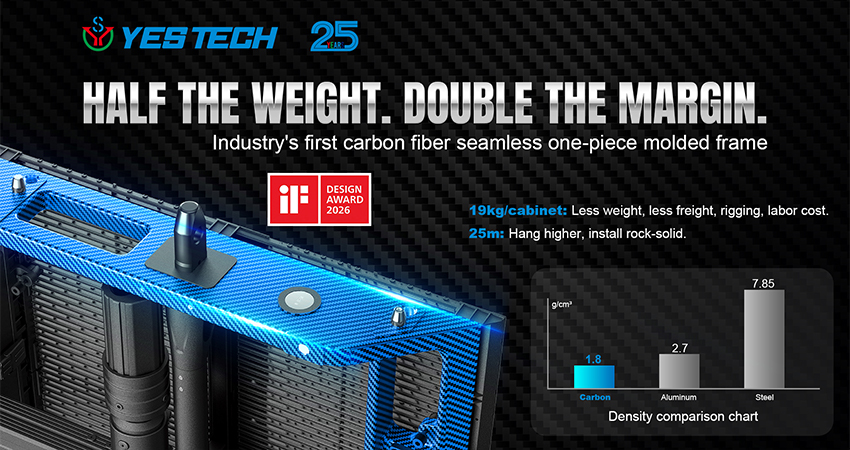
The defining advantage of carbon fiber is not simply that it is light. It is the combination of low density, high tensile strength, and high stiffness that makes it valuable for structural applications. Carbon fibers typically have a density of around 1.75–1.95 g/cm³, while steel is commonly around 7.8 g/cm³. Depending on the carbon fiber grade and the steel grade used for comparison, carbon fiber can therefore have roughly one-quarter the density of steel. Published engineering comparisons also show carbon fiber tensile strengths in the multi-gigapascal range, substantially exceeding those of many structural steels on a material basis.
This is where the idea of “lighter yet stronger” becomes more meaningful. It is not necessarily about comparing two materials by strength alone. The more useful engineering metric is how much structural performance a material can provide for its weight. In other words, the key is the strength-to-weight ratio. A commonly cited comparison places standard carbon fiber at a density of approximately 1.76 g/cm³ and a tensile strength of about 3.53 GPa, while S355 structural steel has a density of approximately 7.85 g/cm³ and a tensile strength of about 0.50 GPa in the referenced comparison. Other engineering data show similar trends: carbon fibers can combine densities below 2 g/cm³ with tensile strengths ranging from roughly 3 to 7 GPa depending on fiber type and processing. This explains why carbon fiber is often associated with three structural characteristics:
Lighter. Stronger. More structurally efficient.
For the LED display industry, these characteristics can have practical consequences. A lighter cabinet can be easier to handle and transport. A structurally efficient cabinet can be better suited to suspended applications. A stiffer structure can help maintain dimensional stability across a large display surface. The advantage is therefore not one isolated material property. It is the way multiple properties work together.
From “Light and Strong” to Real-World Performance
For a large LED display, material performance ultimately needs to translate into practical performance. Eight characteristics are particularly relevant: lightweight, toughness, durability, impact resistance, dimensional stability, precision, weather resistance, and wear and corrosion resistance.
Lightweight: Less Weight, More Possibilities
Weight reduction is one of the most direct advantages of a carbon fiber structure. In large-format LED applications, the impact becomes more significant as the number of cabinets increases. Reducing the weight of each cabinet can make a difference throughout the entire workflow, from transportation and handling to installation and rigging. For touring productions, where equipment is repeatedly moved between venues, lower cabinet weight can also contribute to more efficient logistics. For suspended LED displays, the benefit becomes even more relevant because every component contributes to the overall suspended load.
Toughness: Strength for Demanding Structures
Strength is only one part of structural performance. Large event LED displays are exposed to dynamic loads, repeated handling, vibration, and installation forces. The structure therefore needs to maintain its integrity throughout its operating life. Carbon fiber composites are widely used in demanding engineering applications because of their high specific strength and stiffness. Their performance, however, depends strongly on fiber orientation, resin system, laminate design, manufacturing quality, and the way loads are introduced into the structure. For an LED cabinet, this means the advantage of carbon fiber comes not simply from the raw material, but from how the material is engineered into the complete structure.
Durability and Impact Resistance: Designed for Repeated Use
Rental LED displays experience a very different usage pattern from permanent architectural structures. Cabinets can be moved dozens or hundreds of times throughout their service life. They may encounter impacts during loading, transportation, installation, and dismantling. A durable cabinet structure therefore needs to withstand repeated handling while maintaining its structural and dimensional performance.
Carbon fiber composites can provide excellent fatigue performance and high specific mechanical performance, but impact behavior is highly dependent on composite construction and damage condition. For this reason, proper structural design, protective treatments, and manufacturing quality remain essential. The objective is not simply to create a lightweight material. It is to create a lightweight structure that can perform reliably in real production environments.
Dimensional Stability: When Precision Matters
Large LED displays are made up of many individual cabinets. The final visual effect depends on how accurately these cabinets align with one another. Even small structural deviations can become noticeable when hundreds of cabinets form one large canvas. This makes dimensional stability and precision increasingly important for large-format LED displays, especially when building curved, seamless, or creative structures.
Carbon fiber is valued in precision engineering partly because of its high stiffness and low thermal expansion characteristics. Depending on the fiber architecture and composite design, carbon fiber structures can maintain stable geometry under demanding conditions. For LED display structures, this can support accurate cabinet alignment and consistent large-scale assembly.
High Precision: Turning Material Science into Structure
The material itself is only the starting point. Manufacturing technology determines how effectively its properties can be translated into a finished product. Advanced composite manufacturing allows carbon fiber to be formed into complex structural components while integrating multiple functions into a single structure. Research on carbon fiber-reinforced polymers highlights their design flexibility and suitability for the integrated molding of large components. For large LED displays, this creates an opportunity to rethink the cabinet itself—not simply as a metal box holding LED modules, but as an engineered structural component.
Weather Resistance: Ready for Outdoor Events
Outdoor festivals and large-scale performances expose LED displays to rain, humidity, temperature changes, and other environmental conditions. Carbon fiber composites are inherently resistant to corrosion mechanisms that affect many conventional metals, although the complete environmental performance of a composite structure depends on its resin matrix, surface protection, joints, fasteners, and overall system design. For outdoor LED displays, therefore, material selection should be considered together with cabinet sealing and protection. Structural material and environmental protection need to work as one system.
Wear and Corrosion Resistance: Built for Touring
A touring LED cabinet has to survive more than the performance itself. It has to survive everything that happens before and after the show. Repeated loading, transportation, handling, storage, and installation can place considerable stress on cabinet structures. Corrosion can also become a concern when equipment is used repeatedly in humid or outdoor environments. Carbon fiber composites offer excellent chemical and corrosion resistance compared with conventional metals, making them attractive for applications where long-term environmental durability matters. Combined with appropriate structural protection, this can make carbon fiber a compelling choice for demanding rental and outdoor LED applications.
What Carbon Fiber Means for Large-Scale Event Production
The value of carbon fiber becomes most obvious when its material properties are translated into production efficiency. For large-scale concerts, music festivals, and outdoor performances, a lighter LED cabinet can simplify physical handling. When hundreds of cabinets are involved, reducing the weight of each unit can have a cumulative effect on transportation and installation.
The same principle applies to rigging. Suspended LED screens and high-altitude installations require careful consideration of structural loads. A lighter display structure can help reduce the weight that needs to be supported, creating more flexibility for stage and rigging design. This is particularly relevant as creative stage design continues to move beyond flat rectangular screens. Curved LED displays, multi-sided structures, suspended screens, and other creative configurations demand not only visual flexibility but also structural precision.
For touring productions, the benefits extend throughout the entire workflow. Faster handling can contribute to more efficient installation and dismantling. Lower weight can simplify transportation. Structural stability can help maintain accurate alignment. Durability can support repeated use. In this sense, carbon fiber is not simply a substitute for another cabinet material. It represents a different approach to LED display engineering—one that treats weight, strength, precision, and deployment efficiency as interconnected design objectives.
How MAir Applies Carbon Fiber to Large-Scale LED Displays
The next step is to turn the advantages of carbon fiber into a purpose-built LED display structure. MAir takes this approach with what YES TECH describes as the industry's first integrated carbon fiber seamless one-piece molded frame. Instead of treating carbon fiber as an isolated component, MAir integrates the material into the cabinet's structural architecture. This approach is designed around the specific demands of large-scale outdoor LED applications, where weight, structural strength, deployment efficiency, and environmental protection all matter at the same time.
MAir's cabinet weighs just 19 kg in a 1000 × 1000 mm format, providing a lightweight platform for large-scale LED installations. Its carbon fiber structural design is engineered to deliver a 51 kN tensile strength, supporting demanding structural applications while keeping the cabinet lightweight. For large-scale productions, the significance is not simply the number on the specification sheet. It is how the numbers translate into real-world deployment.
A lighter cabinet can be easier to handle. A high-strength structure can support demanding configurations. Dimensional stability can contribute to accurate large-format assembly. And a structurally efficient cabinet can create new possibilities for suspended and high-altitude LED applications. MAir supports hanging heights of up to 25 meters, making it suited to large-scale stage structures where suspended LED displays are an important part of the design. Its structure also supports up to 20 m/s wind resistance, while front and rear IP65 protection helps address the environmental demands of outdoor events.
The design flexibility extends beyond conventional flat screens. With support for ±15° curves and 90° corners, MAir can adapt to more creative stage configurations, allowing LED displays to become an integrated part of the stage architecture rather than simply a rectangular visual surface. This is where carbon fiber becomes more than a material story. It becomes a structural design story.
The Future of Large LED Displays Is Lighter, Stronger and More Efficient
The development of large-scale LED displays is no longer driven only by pixel pitch, brightness, or screen size. As event productions become more ambitious, the physical structure behind the image becomes equally important. A large LED display must be able to move efficiently, install accurately, withstand demanding environments, support complex structures, and perform reliably throughout repeated productions. Carbon fiber offers a compelling answer because of its exceptional strength-to-weight ratio, low density, high stiffness, fatigue performance, and corrosion resistance. Engineering research across aerospace and other structural applications has demonstrated why carbon fiber composites are increasingly used where weight and structural performance must be optimized together.
For the LED industry, the opportunity is clear: instead of choosing between lightweight and strength, advanced composite structures can be engineered to pursue both. That is the thinking behind MAir. By combining carbon fiber with an integrated seamless one-piece molded cabinet structure, MAir brings material innovation directly into large-scale LED display engineering. With its lightweight 19 kg cabinet, 51 kN tensile strength, up to 25 m hanging capability, 20 m/s wind resistance, IP65 protection, and flexible structural configurations, MAir is designed to help large-scale productions achieve more with less structural weight. The future of large LED displays may not simply be about making screens bigger. It is about making the structure behind those screens lighter, stronger, more precise, more durable, and more efficient to deploy. And carbon fiber is helping make that future possible.


+86-(0)731-84539619


Hunan Yestech Optoelectronic Co., Ltd. Terms of Service Privacy Policy Powered by szweb


