



ADDRESS
Blog/2026.08.18
When companies evaluate a touring LED display, the purchase price is usually one of the first numbers they compare. That is understandable, but it does not tell the whole story. For rental companies, event production teams, and touring professionals, an LED display generates costs every time it is transported, installed, operated, dismantled, maintained, and moved to the next venue. Over dozens or hundreds of deployments, these operating costs can become more significant than the initial difference in cabinet price.
This is where Total Cost of Ownership (TCO) provides a more useful way to evaluate a professional LED display. TCO looks beyond the initial investment and considers the costs associated with using equipment throughout its service life. For a touring or rental LED display, this can include labor, maintenance, transportation, equipment availability, and deployment time. The right question is therefore not simply, “How much does this LED display cost?” but “How much does it cost every time we use it?”
Why Purchase Price Does Not Represent the Full Cost
A touring LED display operates differently from a fixed-installation display. Once a fixed screen has been installed, it may remain in the same location for years, with maintenance performed periodically. Touring equipment faces a much more repetitive operating cycle. Cabinets are transported to a venue, unloaded, installed, operated, dismantled, loaded again, and transported to the next location. The same equipment may go through this process many times in a single season.
Every stage creates a potential cost. Installation requires crew hours, transportation requires truck capacity and handling, and repeated dismantling and assembly place mechanical demands on the cabinets and connection systems. Maintenance can involve replacement parts as well as technician time, while equipment downtime can affect production schedules and rental availability.
A practical TCO model for a touring LED display can therefore include initial investment, labor, maintenance, transportation, and downtime-related costs. These categories are interconnected rather than completely independent. A cabinet that is easier to handle may reduce installation labor. A more efficient transportation system can reduce both handling time and truck-loading complexity. A robust structural design can help manage the mechanical demands associated with repeated touring cycles. For this reason, comparing transparent LED displays only by purchase price can produce an incomplete picture of their long-term economics.
Labor Cost: Installation Efficiency Continues to Matter
Labor is one of the most visible operating costs of a rental LED display, but it is often evaluated too narrowly. Companies may compare the number of installers required without considering the total number of hours those workers spend handling and installing the display. The basic relationship is straightforward: Labor Cost = Number of Workers × Working Hours × Labor Rate. Installation efficiency is therefore directly connected to operating cost. Cabinet weight, mechanical locking, alignment, rigging, and dismantling procedures all influence the amount of time a crew needs to complete a project.
This is particularly important for transparent LED displays used in concerts, festivals, and touring productions. Large transparent screens may be installed on trusses, stage structures, façades, or other temporary structures where access is limited. A cabinet that requires less physical effort to handle and fewer manual adjustments to connect can help reduce repetitive work.
MAir, for example, uses a seamless one-piece carbon-fiber frame to reduce cabinet weight while maintaining structural performance. According to application data provided for the series, conventional transparent LED display cabinets can be 23.2% heavier per square meter than MAir. The significance of this difference goes beyond transportation. Lower cabinet weight can make manual handling easier and reduce the physical burden on crews during installation and dismantling.
The mechanical connection system also influences labor. MAir incorporates a self-developed curved blade lock designed for one-handed operation, together with large positioning pins and top magnetic attraction to assist cabinet alignment. These features are designed to reduce repetitive positioning and locking operations rather than simply add another specification to the cabinet.
According to customer application feedback, a 200-square-meter installation that previously required approximately 10 labor hours could be completed in about 6 hours with the same number of installers, representing a 40% reduction in installation time. Actual results will vary depending on crew experience, site conditions, screen configuration, and installation method, but the example demonstrates why installation time should be considered when calculating the operating cost of a touring LED display.
The same principle applies to dismantling. For touring productions, finishing an event is only the beginning of the next logistics cycle. A faster dismantling process allows equipment to be loaded earlier, transported sooner, and prepared for the next venue with less schedule pressure.
Maintenance Cost: Why Structural Design Matters
Maintenance is another important part of TCO, and it is more complicated than simply calculating the cost of replacing an LED module or power supply. For a touring LED display, mechanical durability deserves equal attention. The equipment may repeatedly experience loading, unloading, transportation vibration, manual handling, assembly, dismantling, and storage. Unlike a fixed installation, where the cabinet structure remains relatively undisturbed, touring equipment is constantly exposed to mechanical movement.
This makes the cabinet frame an important component of long-term equipment performance. A common mistake is to assume that a lighter cabinet must necessarily be less durable. Weight alone does not determine structural reliability. A more useful engineering concept is strength-to-weight ratio, which evaluates how much structural performance a material or structure provides relative to its mass.
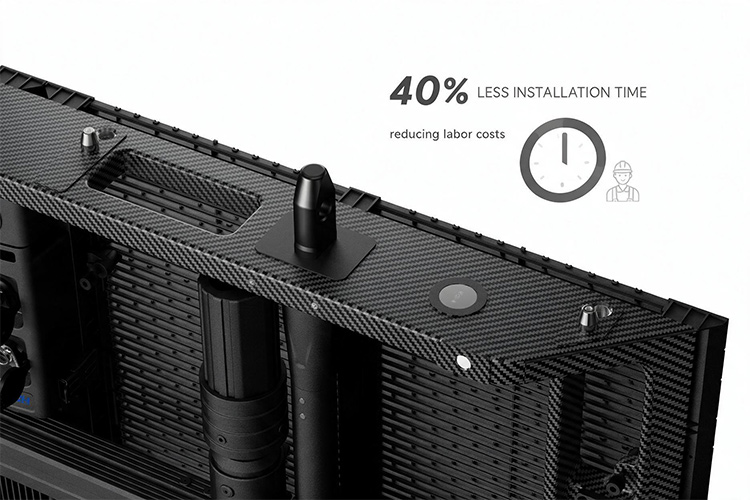
MAir uses a seamless one-piece carbon-fiber frame based on this principle. Carbon fiber can provide a high strength-to-weight ratio, allowing structural weight to be reduced without simply removing material from a conventional metal structure. The design also eliminates multiple frame joints that would otherwise form part of a conventional assembled structure.
For touring equipment, structural strength is relevant not only because of a single static load. More importantly, the cabinet needs to remain reliable through repeated mechanical cycles. MAir's frame is specified with a 51 kN tensile strength, providing a reference for its structural capability.
The broader consideration for rental companies is how cabinet construction performs over repeated use. A robust structure can help reduce the risks associated with repeated handling and transportation, potentially reducing the mechanical maintenance burden over the equipment's service life. Actual maintenance frequency, however, depends on transportation practices, installation conditions, operating environment, crew handling, and other factors. Maintenance cost should therefore be evaluated as part of the entire equipment lifecycle rather than as an isolated technical specification.
Why Lightweight Does Not Mean Fragile
The relationship between weight and durability is especially relevant for transparent LED displays. Rental equipment needs to balance portability with structural performance. Reducing mass can make transportation and handling easier, but the cabinet still needs to withstand the mechanical demands of professional use.
This is why the material and frame architecture matter as much as the weight itself. A professional evaluation should consider weight, material, structural design, connection systems, and performance under repeated touring cycles rather than relying on a single specification.
A cabinet that is lightweight because its structure has simply been weakened is not necessarily a better touring product. The objective is to remove unnecessary mass while retaining the strength and stability required for repeated installation and transportation. This is one reason carbon-fiber construction has attracted attention in professional touring equipment. The material allows designers to approach structural engineering differently from conventional metal construction, focusing on strength-to-weight performance rather than mass alone.
For rental companies, this distinction matters because the economic value of a cabinet is closely related to how efficiently it can be used throughout its service life. Equipment that is easier to handle and structurally suited to repeated touring cycles can potentially reduce the operational burden placed on crews and logistics teams.
Transportation Cost Is More Than Cabinet Weight
Transportation is another major component of TCO. However, calculating transportation cost based only on cabinet weight is too simplistic. For touring LED displays, transportation efficiency is influenced by several factors, including weight, volume, truck utilization, and handling efficiency. A lightweight cabinet may reduce the physical burden during loading, but if the transportation system uses truck space inefficiently, the overall logistics cost can still be high. Similarly, if every cabinet must be unloaded and moved individually, additional labor is required even when the cabinets themselves are relatively light.
This is why transportation design should be considered together with cabinet design. The objective is not simply to move the equipment from one location to another. It is to move it efficiently from the truck to the staging area and then into the installation position. For touring productions operating across multiple venues, even small improvements in this process can accumulate over an entire season. Fewer individual handling operations mean less manual labor, shorter staging time, and a more organized transition between transportation and installation.
How a Touring Cart Changes the Logistics Workflow
MAir integrates a 6-in-1 transport cart system designed around the requirements of touring applications. Instead of moving LED cabinets individually between the truck, staging area, and installation position, multiple cabinets can be transported and handled as a group. The system can carry six cabinets together, reducing the number of individual handling operations required during unloading and on-site staging. For large transparent LED displays, where hundreds of cabinets may need to be moved during a single production, reducing these repeated movements can help improve logistics efficiency while lowering the amount of manual handling required from the crew.
The benefit of a touring cart therefore goes beyond transportation itself. It connects loading, on-site handling, and installation into a more efficient workflow. For rental companies and touring productions, this can help reduce unnecessary handling time and make better use of both labor and transportation resources.
MAir also uses a common structural approach for hanging and ground-supported applications, reducing the need to change major structural components when installation conditions vary between venues. This can simplify equipment preparation and make the system more adaptable to different touring environments.
Downtime Is an Often-Overlooked TCO Factor
There is another cost that is harder to see on an invoice: downtime. If a touring LED display requires unexpected repair, the direct cost may include replacement components and technician labor. The indirect cost can be more significant if the issue delays installation, testing, or production preparation.
For a rental company, equipment downtime also means the asset may not be available for another project. For a touring production, a technical delay can compress an already limited schedule. This is why TCO should include equipment availability as part of the broader evaluation. Structural durability, maintenance accessibility, transportation protection, and mechanical reliability all contribute to how consistently a display can be deployed.
The objective is not to claim that one cabinet design eliminates maintenance or downtime. No professional LED display is immune to component failure, environmental conditions, transportation incidents, or incorrect handling. Instead, the goal is to evaluate whether the overall design is appropriate for the mechanical and operational demands of repeated touring.
How to Evaluate the Real Cost of a Touring LED Display
A professional evaluation should therefore go beyond the initial purchase quotation. Rental companies and production teams can ask several practical questions before choosing a touring LED display. How many labor hours are required for installation and dismantling? This provides a more useful measure than simply counting the number of installers. How easy is the cabinet to handle? Weight affects manual handling, rigging requirements, and crew workload. How is the cabinet designed for repeated touring? Frame construction, connection mechanisms, and mechanical durability all matter when equipment is assembled and dismantled repeatedly. How efficiently can the equipment be transported? Truck utilization, grouped transport, and on-site handling can all influence logistics costs. How much maintenance access does the system provide? Faster servicing can reduce technician time and equipment downtime. How does the system perform over repeated deployments? A touring LED display should be evaluated as a long-term production asset rather than a single-use installation. These questions shift the purchasing decision from initial price toward operational value.
Evaluate LED Displays by Their Lifetime Operating Cost
For touring and rental applications, the real cost of an LED display is created throughout its service life. The initial purchase price is only one component. Labor, maintenance, transportation, and downtime can all influence the economic performance of the equipment over repeated deployments.
This is particularly important for transparent LED displays used in touring environments, where equipment may be transported, assembled, dismantled, and transported again many times. A lightweight but structurally robust cabinet can simplify handling. An efficient mechanical system can reduce repetitive installation work. A well-designed transport solution can reduce individual handling operations. Together, these factors can influence the long-term operating cost of the display.
MAir approaches these challenges through its seamless one-piece carbon-fiber frame, structural design, integrated mechanical connection system, and 6-in-1 touring cart. The value of these features is not limited to individual specifications. Their broader purpose is to improve how the display is handled, transported, installed, and repeatedly deployed.
For professional rental companies and touring production teams, the most useful question is therefore not simply “How much does this LED display cost?” It is “How much does this LED display cost every time we use it?” Looking at the answer through a Total Cost of Ownership framework provides a more complete basis for comparing transparent LED displays and identifying the equipment that can deliver greater operational value over its service life.


+86-(0)731-84539619


Hunan Yestech Optoelectronic Co., Ltd. Terms of Service Privacy Policy Powered by szweb


