



ADDRESS
Blog/2026.08.13
A touring LED display has to do much more than produce high-quality visuals. In a concert, festival, live event, or large-scale stage production, an LED screen may be installed, dismantled, transported, reconfigured, and installed again within a short period of time. It may also need to be flown high above a stage, operate outdoors in changing weather, and be handled by different production crews from one venue to the next. Under these conditions, the question is not simply whether an LED display can be moved. The more important question is whether the LED display cabinet is engineered for repeated touring use.
This distinction matters. A cabinet can be relatively easy to transport and still be inconvenient to install. It can be fast to assemble but difficult to dismantle. It can perform well indoors but lack the environmental protection or structural capability required for an outdoor touring LED display. For professional rental companies and production teams, a touring LED display needs to perform consistently across the entire workflow: transportation, installation, rigging, operation, maintenance, dismantling, and reinstallation.
That is why the suitability of an LED display cabinet for touring should be evaluated as a complete engineering system rather than by looking at a single specification such as pixel pitch, brightness, cabinet size, or weight. The connection system, positioning mechanism, transport solution, rigging capability, environmental protection, and ease of operation all influence how effectively a rental LED display can perform from one event to the next. This broader approach is also where MAir has been designed differently, with its cabinet structure and supporting systems developed around the practical requirements of touring applications.
What Does “Touring-Ready” Really Mean for an LED Display Cabinet?
A touring LED display is fundamentally a repeated-use product. Unlike a fixed LED display that may remain installed in the same location for years, a rental LED screen can go through dozens or even hundreds of installation cycles during its service life. It needs to be practical when it is packed for transportation, efficient when it reaches the venue, reliable during operation, and straightforward to dismantle when the event is over.
For this reason, being “touring-ready” does not simply mean that an LED cabinet is portable. A professional touring LED display cabinet needs to support a complete production workflow. Installation time is important because stage crews often work within strict load-in schedules. Mechanical connections matter because cabinets must be repeatedly assembled without making the installation process unnecessarily complicated. Transportation efficiency matters because large LED walls can occupy significant truck space. Rigging capability matters because many concert and festival screens are flown rather than placed directly on the ground. Environmental protection becomes critical when the same equipment is used for outdoor festivals, stadium events, or waterfront productions.
There is also another factor that is easy to overlook: repeatability. A rental LED display may be configured differently at every venue, but the installation process should remain predictable. The crew should not need to relearn how to connect every cabinet at every show. The physical interfaces should provide clear positioning references, intuitive locking, and efficient release during dismantling. In other words, a touring LED cabinet should be designed not only to work once, but to work reliably through repeated deployment.
This is particularly important for large touring productions, where a small inefficiency at the cabinet level can become a significant operational issue when multiplied across hundreds of cabinets. Saving a few seconds on one connection, for example, can become a meaningful amount of time when an entire LED wall needs to be assembled. The same principle applies to transportation and dismantling. Touring efficiency is created through many small engineering decisions that work together across the entire workflow.
Why Cabinet Connection Design Matters for Touring LED Displays
Installation is often the first major test of a touring LED display cabinet. Production crews may have only a limited window to build the screen before rehearsals begin, so the cabinet needs to make the correct installation process intuitive rather than relying heavily on manual adjustment.
Positioning is the starting point. Before two cabinets can be locked together, they have to be brought into the correct relative position. A well-designed positioning mechanism provides a physical reference between adjacent cabinets, reducing the amount of visual estimation required from the installer. This becomes increasingly valuable as the display grows, because alignment errors can otherwise accumulate across multiple cabinets.
MAir addresses this through a large positioning pin with a top magnetic suction design. The positioning pin establishes a clear mechanical reference between cabinets, while the magnetic design assists the positioning process. This allows cabinets to be brought together more quickly and precisely, helping installers achieve a consistent connection without repeatedly adjusting the cabinet by hand.
Once the cabinet is correctly positioned, the locking mechanism becomes the next part of the workflow. MAir uses a self-developed curved blade lock featuring one-touch pop-up and single-handed operation. The significance of this design is not simply that it makes the installation faster. For touring crews, the ability to operate a locking mechanism intuitively and with one hand can reduce unnecessary movement and make the installation process more manageable when hundreds of cabinets need to be connected under time pressure.
The same principle applies during dismantling. Touring equipment has to come apart as efficiently as it goes together. MAir uses a large latch lock structure with automatic rebound during disassembly, making the cabinet easier to release and remove. This means that the connection system is designed around both sides of the rental workflow rather than focusing only on installation.
Together, the positioning pin, magnetic positioning assistance, curved blade lock, and large automatic-rebound latch create a more controlled cabinet interface. The process becomes less dependent on individual operator habits and more dependent on the mechanical design of the cabinet itself. For a professional LED display for touring, this repeatability is a meaningful advantage.
Why Transportation Efficiency Becomes Critical for Large Touring LED Walls
The scale of touring LED productions changes the transportation problem completely. A small display may be relatively easy to move, but a large concert or festival LED wall can contain hundreds of cabinets. At that scale, transportation is not simply about whether the individual cabinet can be carried. The way cabinets are stacked, stored, loaded, unloaded, and moved around the venue can directly affect logistics efficiency.
This is why a touring LED display should be evaluated together with its transport system. A cabinet that performs well on stage but occupies excessive space during transportation can increase logistics requirements and complicate the production workflow. Rental companies need to consider how efficiently their equipment can be moved between venues, how quickly it can be unloaded, and how easily the cabinets can be organized before installation.
MAir addresses this through an integrated 6-in-1 dolly system designed for direct stacking. Instead of treating transportation as a completely separate process, the system integrates cabinet handling, storage, and transportation into the overall product design. Direct stacking simplifies the movement of cabinets and helps production teams make better use of available space.
This is particularly relevant to touring applications because space efficiency is a recurring operational consideration. Truck capacity is limited, storage areas at venues can be constrained, and equipment often needs to move through loading docks, backstage areas, or narrow access routes before reaching the stage. A practical LED display transport system can therefore contribute to efficiency well before the screen is switched on.
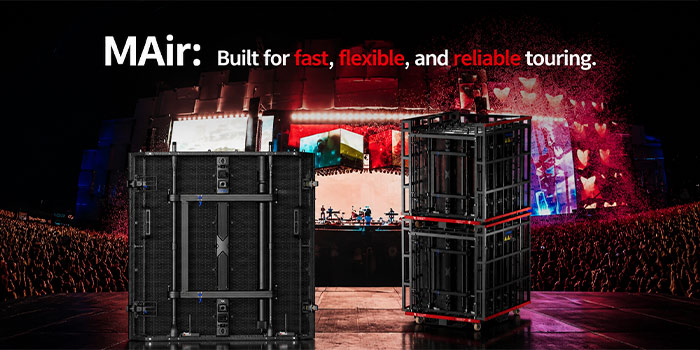
The important point is that transportation should be considered as part of the cabinet's lifecycle. A touring LED display is not only a screen on a stage; it is equipment that constantly moves between stages. The more effectively the cabinet and transport system work together, the easier it becomes to manage repeated deployments.
Rigging Capability Is Essential for Large Touring Productions
Large touring LED screens are frequently suspended above stages rather than installed entirely on the ground. Concerts, festivals, television productions, and large-scale live events can require flown LED walls positioned at considerable heights. This places additional requirements on the cabinet and its supporting structure.
For a flown LED display, the mechanical system has to account for the loads generated by the display assembly and the way those loads are transferred through the connected cabinets and rigging points. The larger the display and the higher it is suspended, the more important the mechanical design becomes. Rigging capability is therefore not just another specification on a product sheet; it determines what types of stage configurations a production team can realistically build.
MAir supports hanging applications up to 25 meters, providing greater flexibility for large suspended LED screens. This capability is particularly relevant to touring productions where stage designs can vary significantly from venue to venue. A cabinet designed for large-scale rigging gives production teams more options when integrating an LED display into a stage structure.
For rental companies, this flexibility can also expand the range of applications for the same LED display system. Instead of being limited to a single type of installation, the equipment can support different event formats and stage configurations, making it more practical as a touring asset.
Why Outdoor Touring LED Displays Need More Than Waterproofing
Outdoor touring creates another layer of complexity. An LED display used at an outdoor concert or festival may be exposed to rain, dust, sunlight, temperature changes, and wind. It therefore needs more than strong visual performance. The cabinet and module structure must also be engineered to protect sensitive electronic components from environmental exposure.
MAir uses proprietary Black Seal Potting Technology for its cabinet modules. The technology provides full encapsulation, creating a protective barrier around the module. The cabinet achieves IP65 protection from both the front and rear, helping protect the display against dust and water exposure during outdoor applications.
The significance of this approach is that environmental protection is integrated into the module structure rather than being treated as an afterthought. For an outdoor touring LED display, the equipment may need to remain operational through changing weather conditions while also being repeatedly transported and installed. Protection therefore needs to work together with the cabinet's mechanical design. At the same time, outdoor touring introduces another challenge that cannot be solved by IP protection alone: wind.
Why Wind Resistance Matters for Transparent LED Displays
Wind becomes particularly important when a large LED display is installed outdoors or flown at height. A transparent LED display can provide an open visual structure and allow greater airflow through the display area, but transparency alone should not be treated as a substitute for structural engineering.
For a large outdoor LED screen, overall wind performance depends on the relationship between the cabinet structure, connection system, supporting frame, installation configuration, and the environmental conditions of the application. The cabinet must provide sufficient structural stability while maintaining the characteristics that make a transparent display useful for stage and outdoor applications.
MAir approaches this through a combination of transparent display architecture, robust structural materials, Air Frame design, and wind resistance of up to 20 m/s. The Air Frame contributes to the structural system while maintaining the open characteristics of the transparent display. This is particularly relevant for touring applications where a screen may be installed in different outdoor environments and exposed to varying wind conditions.
The engineering principle here is important: transparency and structural stability should not be treated as mutually exclusive goals. An outdoor transparent LED display needs to balance visual openness with mechanical reliability. For touring applications, that balance becomes even more important because the same equipment may need to adapt to different stage environments and installation conditions.
A Touring LED Display Cabinet Has to Work as a Complete System
When selecting a touring LED display, it is easy to focus on individual specifications. Pixel pitch determines image resolution. Brightness affects visibility. Refresh rate matters for camera capture. But these specifications only describe part of the system.
For a professional rental LED display, the cabinet itself is the interface between the equipment and the production crew. Its design affects how quickly the screen can be assembled, how efficiently it can be transported, how it can be rigged, how easily it can be maintained, and how efficiently it can be dismantled. This is why a touring-ready LED cabinet should be evaluated across the entire production cycle:
Transport → Installation → Rigging → Operation → Dismantling → Reinstallation
Every stage presents a different engineering requirement. The transport system needs to make large quantities of equipment easier to move and store. The cabinet connection needs to support accurate and efficient installation. The structure needs to support the intended rigging configuration. Outdoor applications require environmental protection and appropriate wind performance. After the event, the same cabinet needs to be released and packed efficiently for the next destination. A strong touring product is therefore not defined by one isolated feature. It is defined by how well all these elements work together.
How MAir Is Designed Around the Touring Workflow
MAir takes this complete lifecycle approach to the design of a touring LED display cabinet. Its features address different stages of the touring workflow rather than focusing exclusively on the moment of installation.
Before the show, the 6-in-1 dolly system helps streamline transportation, direct stacking, storage, and space utilization. During load-in, the large positioning pin with top magnetic suction helps guide cabinets into position, while the self-developed curved blade lock supports one-touch pop-up and single-handed operation. The built-in positioning and locking mechanisms are designed to make the cabinet connection process more efficient and repeatable.
For large suspended screens, MAir supports hanging applications up to 25 meters, giving touring production teams greater flexibility when designing large stage structures. For outdoor operation, Black Seal Potting Technology and IP65 protection on both the front and rear provide a protective barrier for the modules. At the structural level, the transparent display design, robust materials, Air Frame, and 20 m/s wind resistance address the additional requirements of outdoor applications.
When the event is over, the large latch structure with automatic rebound helps make cabinet removal easier, allowing the same equipment to transition efficiently from the stage back into transportation and storage. What connects all of these features is not a single specification. It is the design philosophy behind the cabinet: the LED display needs to work as part of a touring production workflow, not simply as a display surface.
What Really Makes an LED Display Cabinet Suitable for Touring?
So, what makes an LED display cabinet suitable for touring? It is not simply low weight, fast installation, high brightness, or the ability to be transported. A professional touring LED display needs to perform consistently throughout repeated cycles of transportation, installation, rigging, operation, dismantling, and reinstallation.
For rental companies and production teams, the practical questions are more comprehensive: Can the cabinets be positioned and locked efficiently? Can large quantities be transported and stored without unnecessary space consumption? Can the screen support demanding rigging configurations? Can it withstand outdoor environmental exposure? Can a transparent LED display provide both visual openness and structural stability? And after the show, can the equipment be dismantled and prepared efficiently for the next venue? These are the requirements that distinguish a portable LED screen from a truly touring-ready LED display system.
MAir is designed around this complete workflow. Its integrated 6-in-1 transport system addresses logistics and storage; its positioning and locking mechanisms support efficient and precise installation; its 25-meter hanging capability expands rigging possibilities; and its Black Seal Potting Technology, front-and-rear IP65 protection, Air Frame, and 20 m/s wind resistance address the demands of outdoor touring applications. The large automatic-rebound latch then helps complete the cycle during dismantling. For touring LED displays, the real measure of a cabinet is not how well it performs on a single stage. It is how reliably, efficiently, and predictably it can move from one stage to the next.


+86-(0)731-84539619


Hunan Yestech Optoelectronic Co., Ltd. Terms of Service Privacy Policy Powered by szweb


