



ADDRESS
Blog/2026.08.18
For transparent LED displays used in concerts, festivals, touring productions, and temporary outdoor installations, the cost of the screen itself is only part of the overall project cost. Labor can become a significant expense when hundreds of cabinets need to be transported, positioned, aligned, locked, rigged, and dismantled within a limited production window. In these environments, installation efficiency is not simply a matter of convenience. It directly affects how many workers are required, how long they remain on site, and how quickly the production can move to its next stage.
A useful way to understand this is to look beyond the price of a single LED cabinet. Labor cost is closely related to installation time: Labor Cost = Number of Workers × Working Hours × Labor Rate. Even a few seconds saved on one cabinet can become hours when the same operation is repeated across a large transparent LED display. This is why cabinet weight, mechanical locking, alignment, and handling systems deserve more attention when evaluating a rental or touring LED display.
Why Installation Efficiency Matters for Transparent LED Displays
Installing an LED display involves much more than connecting cabinets together. Depending on the application, crews may need to unload cabinets, move them into position, align adjacent units, secure mechanical locks, connect power and data, install rigging components, level the structure, and eventually dismantle everything after the event. Each operation takes time, and many of them are repeated hundreds of times.
For a fixed indoor LED display, installation time may be less critical because the screen can remain in the same location for years. Touring and rental applications are different. A transparent LED display may be installed for one event, dismantled shortly afterward, transported to another venue, and installed again within a very short production schedule. The efficiency of the mechanical system therefore becomes part of the equipment's operational value.
This is particularly important for large transparent LED screens. Their application often involves stage structures, trusses, building façades, scenic installations, or other environments where installers have limited working space and may need to work at height. A cabinet that is easier to handle and faster to connect can reduce repetitive labor while also making the installation process more manageable.
The key point is that LED display installation efficiency should be measured across the complete workflow, not by the speed of a single mechanical operation. Cabinet weight, alignment, locking, installation configuration, dismantling, and transportation all contribute to the final number of labor hours.
How Cabinet Design Affects Transparent LED Display Installation
Cabinet weight is often discussed in terms of transportation or structural loading, but it is also a labor factor. According to application data for MAir, conventional transparent LED display cabinets can be 23.2% heavier per square meter than the MAir series. Across a small installation, the difference may appear limited. Across a large screen, however, the additional weight affects repeated handling, positioning, and lifting operations.
A heavier cabinet can require more physical effort to move and stabilize. When cabinets need to be positioned manually before being lifted into a truss structure, additional assistance may also be necessary. This becomes increasingly relevant when working at height, where installers have less freedom of movement and where unnecessary handling can make the operation more complicated.
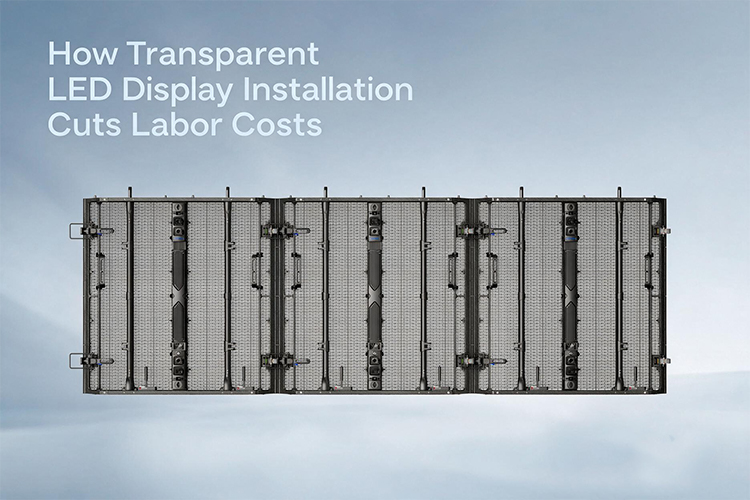
MAir uses a seamless, one-piece carbon-fiber frame to reduce cabinet weight while maintaining structural strength. The engineering objective is not simply to make the cabinet lighter, but to achieve a high strength-to-weight ratio. For touring equipment, this distinction is important because a cabinet needs to withstand repeated transportation, installation, dismantling, and handling rather than only perform well during a single installation.
However, weight is only one part of installation efficiency. A lightweight transparent LED cabinet can still be slow to install if its mechanical connections require repeated adjustment or complicated manual operations. This is why the locking and alignment system should be evaluated together with the cabinet structure.
Traditional mechanical connections can involve several repetitive steps: positioning two cabinets, aligning the connection points, operating the lock, checking the connection, and making adjustments if the cabinets are not perfectly aligned. When these operations are repeated across hundreds of cabinets, small delays accumulate quickly.
MAir addresses this process with a self-developed curved blade lock designed for one-handed operation, allowing the locking mechanism to pop out and engage without relying on a separate tool for every connection. Large positioning pins and a top magnetic attraction structure also help guide the cabinets into position before they are fully secured. This reduces the amount of manual adjustment required during cabinet alignment.
The same principle applies to the large latch structure with automatic locking and release. During installation, the latch can engage automatically; during dismantling, it releases to simplify removal. The benefit is not that one individual operation suddenly eliminates a large amount of work. Rather, it reduces the number of repetitive movements required across the entire display.
For professional LED display systems, this distinction matters. Installation efficiency is usually created by the accumulation of small mechanical improvements rather than by one single feature.
How Faster Installation Reduces Labor Hours
The relationship between installation speed and labor cost becomes clearer when the same screen is compared under controlled conditions. If the number of installers remains unchanged, reducing installation time directly reduces the total labor hours required for that stage of the project.
According to customer application feedback provided for MAir, a 200-square-meter display installation that previously required approximately 10 labor hours could be completed in around 6 hours with the same number of installers. This represents a 40% reduction in installation time.
The figure should be understood as application feedback rather than a guaranteed result for every project. Actual installation time can vary according to screen configuration, venue conditions, rigging method, crew experience, site access, weather, and other production variables. Nevertheless, the comparison demonstrates why installation efficiency should be considered when evaluating the operating cost of a transparent LED display.
The impact also extends beyond the labor invoice. In live production, time is often a constrained resource. A four-hour reduction in installation work can create additional time for signal testing, calibration, troubleshooting, stage preparation, or other production activities. For a touring crew, it can also provide more flexibility before the next scheduled load-in.
This is why simply asking how many people are needed to install a screen does not provide the complete picture. A better question is: How many labor hours are required to take the screen from the transport vehicle to a fully installed and operational display?
The same principle applies to dismantling. If a display takes less time to remove after an event, the crew can begin loading equipment sooner, which can affect the departure time of the entire production. In a touring environment, that can influence the schedule of transportation and the installation window at the next venue.
Why Touring Productions Need More Than Fast Installation
Touring productions introduce another variable: the relationship between installation, dismantling, and transportation. A transparent LED display does not simply arrive at a venue and get installed. It moves through a repeated operational cycle:
Transportation → Handling → Installation → Operation → Dismantling → Transportation
If one stage takes longer than expected, it can affect the stages that follow. A slow dismantling process can delay truck loading. Delayed loading can affect departure. A late arrival can shorten the installation window at the next venue, increasing pressure on the crew. For this reason, transportation design should be considered part of installation efficiency rather than a completely separate issue.
MAir transparent LED display for touring incorporates a 6-in-1 transport cart system that allows multiple cabinets to be handled and transported as a group. Instead of moving individual cabinets one at a time from the truck to the staging area, the system allows grouped cabinets to be moved closer to the installation location before they are deployed. This changes the handling workflow from repeated individual movement to a more consolidated process. For large touring LED displays, reducing the number of individual handling operations can help save labor between unloading and installation.
The same principle applies to installation configurations. MAir uses a common structure for hanging and ground-supported applications, reducing the need to change major structural components when the installation method changes. This can give production teams more flexibility when adapting the screen to different venues.
Another practical detail is the built-in level on the wind-resistant frame. Establishing the correct horizontal position is an important part of installing a large LED display. If installers need to repeatedly measure and adjust the structure, additional time is introduced into the workflow. Integrating a level into the structure allows the crew to check positioning during installation instead of treating measurement as a completely separate process. These details illustrate a broader engineering principle: a touring LED display should be designed around the complete workflow, not just the cabinet itself. Transport, staging, positioning, installation, dismantling, and repeated handling are interconnected.
How to Evaluate Transparent LED Display Installation Efficiency
When selecting a transparent LED display for rental or touring applications, buyers often focus on pixel pitch, brightness, refresh rate, transparency, cabinet dimensions, and weight. These specifications remain important, but they do not fully explain how efficiently the equipment can be deployed.
A more practical evaluation should consider the mechanical workflow. How many workers are needed to handle a cabinet? Can one person perform key locking operations? How easily do cabinets align? Does the connection system require tools? How quickly can the display be dismantled? Can multiple cabinets be transported together? Can the same structure support different installation methods?
These questions help move the evaluation from cabinet specifications to operational performance. For example, a cabinet may be lightweight, but if installers need several manual adjustments before every connection, the overall installation may still be slow. Similarly, a fast locking mechanism provides limited value if workers have difficulty moving and positioning the cabinet. The most effective systems address these factors together.
For touring companies and rental providers, it is also useful to evaluate installation performance based on a defined screen area rather than an individual cabinet. Comparing the labor hours required for 100㎡, 200㎡, or 500㎡ provides a more realistic indication of how the equipment will perform in actual projects. Ultimately, the relevant measurement is not simply how fast one transparent LED cabinet can be installed. It is how efficiently an entire display can move from unloading to installation, operation, dismantling, and transport.
For transparent LED displays, installation efficiency has a direct relationship with labor utilization and overall project productivity. Cabinet weight affects handling. Mechanical locking affects repetitive installation operations. Alignment affects the amount of adjustment required. Transport systems affect how efficiently equipment moves from the truck to the installation area. Together, these factors determine how many labor hours a production actually needs.
MAir demonstrates this approach through its lightweight carbon-fiber frame, one-handed curved blade lock, positioning and magnetic alignment structure, automatic latch system, and 6-in-1 transport cart. Rather than treating installation speed as a single feature, these elements address different stages of the same operational workflow.
For professional rental companies and touring production teams, the most useful way to evaluate a transparent LED display is therefore not simply to ask whether it is lightweight or whether it has a quick-lock system. The better question is whether its overall mechanical design can reduce unnecessary handling, repetitive adjustments, and installation time across the complete project. In large-scale and repeated touring applications, those saved minutes accumulate into labor hours. And labor hours, ultimately, are one of the most measurable costs in operating an LED display system.


+86-(0)731-84539619


Hunan Yestech Optoelectronic Co., Ltd. Terms of Service Privacy Policy Powered by szweb


