



ADDRESS
Blog/2026.08.18
For professional rental companies, event producers, and staging contractors, the cost of a transparent LED display should not be evaluated by purchase price alone. A lower price per square meter may look attractive during procurement, but the real cost of an LED display accumulates throughout its service life: how many applications it can support, how much labor it takes to install, how often it requires maintenance, how efficiently it can be deployed, and whether additional display types are needed to cover other production requirements. This is particularly important for rental businesses, where the value of an LED asset depends heavily on utilization. A transparent LED screen that performs exceptionally well in one application but cannot adapt to other production requirements may ultimately deliver less value than a more versatile system with a higher initial price. For this reason, a professional transparent LED display procurement strategy should focus on total cost of ownership (TCO), rather than purchase price alone.
Look Beyond the Initial Price of a Transparent LED Display
The first question in an LED procurement process is often straightforward: how much does the screen cost? A more useful question is how much it will cost to own and operate that screen over time. Total cost of ownership can include the initial equipment investment, transportation, installation and dismantling labor, maintenance, spare parts, storage, and the opportunity cost of equipment that remains idle between projects. For rental companies in particular, equipment utilization is critical. A display that can support a broader range of productions has more opportunities to generate rental revenue than equipment designed around a single application. This does not mean that every versatile LED display will automatically deliver a higher return on investment; utilization depends on the company's market, inventory, project mix, and rental rates. It does mean that application flexibility should be considered as part of the procurement decision, alongside specifications such as pixel pitch, brightness, refresh rate, transparency, and cabinet dimensions.
The same principle applies to transparent LED technology. A transparent LED display is particularly valuable when the production needs to preserve visual depth and allow lighting, performers, scenic elements, or architectural structures to remain visible behind the screen. However, not every production requires that visual relationship. Some events need a more complete LED surface for full-screen video, branding, graphics, or content-heavy sequences. If a rental company needs separate transparent and solid LED systems to cover these two requirements, the procurement decision effectively becomes a decision about maintaining two categories of equipment. That can mean two investments, additional inventory, separate maintenance requirements, and more equipment that needs to be transported and managed. The more useful procurement question is therefore not simply whether a transparent LED display performs well as a transparent screen, but how many production requirements the platform can realistically cover.
One Display Platform Can Reduce the Need for Duplicate Inventory
This is where configurable LED technology can have a direct impact on procurement efficiency. Consider a simplified example in which a rental company expects to serve projects requiring 100 square meters of transparent LED and another 100 square meters of solid LED. If those requirements must always be fulfilled by two separate display systems, the company may need to maintain 200 square meters of dedicated LED inventory. A display that can provide both transparent and solid visual states can potentially cover the same two visual requirements with one display platform. In this illustrative equipment-quantity comparison, the required display inventory could be reduced by 50%. That figure should not be interpreted as a guaranteed 50% reduction in total procurement cost, because actual savings depend on product pricing, project requirements, spare ratios, cabinet configurations, and the proportion of projects requiring each mode. The important point is that one platform serving multiple visual requirements can reduce the need to duplicate specialized equipment.
YES TECH's MT II transparent LED display takes this approach with a one-button system for switching between Transparent and Solid modes. The MT II is based on an H3.9-V7.8 platform, with standard 1000 × 500 mm and 500 × 500 mm cabinet options. In Transparent mode, the display is designed to preserve the see-through character required for open stage designs, while Solid mode provides a denser visual surface when the content needs greater separation from the environment behind the screen. The manufacturer's specifications list up to 50% transparency, a 7680 Hz refresh rate, and optional brightness up to 4500 nits for indoor and outdoor applications. The procurement significance is not simply that MT II has a switching function. It is that a rental company can consider one LED platform for two visual roles, potentially reducing the need to purchase separate transparent and solid display inventory.
Installation Labor Is Part of the Cost of an LED Display
Equipment procurement is only one part of the financial equation. For temporary LED applications, installation and dismantling can become recurring costs every time the equipment moves into a new venue. This is particularly relevant to concerts, festivals, touring productions, and corporate events, where crews often work within narrow installation windows. A cabinet that requires more handling steps or more people to position and lock can increase the number of crew-hours required for the project. The practical metric is therefore not simply whether a cabinet is “fast to install,” but how the design affects the overall installation workflow.
MT II is designed around one-person operation, with a large ergonomic handle and quick-lock mechanism intended to make installation and disassembly more straightforward. YES TECH states that its integrated quick-lock system supports flat configurations, ±15° curved configurations, 90° corner displays, and staggered cabinet splicing. For a rental company, this type of design can have a direct operational benefit: if fewer technicians are needed for routine cabinet handling and positioning, the required crew-hours may be reduced. The actual labor saving will always depend on the project, crew structure, installation method, and local labor rates, so it would be inaccurate to assign a universal percentage to MT II. A more reliable way to evaluate the benefit is to compare the crew size and installation time required for a typical project before and after adopting the equipment.
For example, labor cost can be considered through a simple relationship: Labor Cost = Crew Size × Working Hours × Labor Rate. If a display system allows the same installation to be completed with fewer crew members or fewer working hours, the resulting reduction in crew-hours can translate into lower project cost. The large handle and quick-lock design of MT II are therefore not merely ergonomic details. They are part of the equipment's operational economics. The official product information specifically identifies one-person operation and the quick-lock with large handle as features intended to make installation and disassembly faster and more comfortable.
Reliability Can Reduce Long-Term Maintenance and Downtime Costs
A transparent LED display also needs to be evaluated for the cost of keeping it operational. For rental companies, maintenance has two dimensions. There is the direct cost of inspection, repair, replacement parts, and technician time, and there is the potential business cost associated with equipment being unavailable for a scheduled project. A failure that occurs between events may require additional troubleshooting or replacement logistics; a failure during a live production can create much greater operational consequences. This is why reliability should be considered not only as a technical specification but also as a factor in long-term cost management.
Outdoor transparent LED applications can make this consideration even more important. Rain, humidity, temperature changes, and corrosive environments can place additional demands on LED display systems. MT II is specified for indoor and outdoor use with IP65 protection, while its magnesium-alloy dual-frame construction is designed to increase structural strength while maintaining high transparency. The product is rated for hanging installations up to 20 meters, and YES TECH reports that the system demonstrated stability at heights up to 24 meters under controlled testing conditions. These specifications do not eliminate maintenance requirements, but they indicate that the system is engineered for demanding rental and staging applications rather than being limited to short-term indoor use.
A useful real-world reference comes from the Da Nang International Fireworks Festival (DIFF) 2026 in Vietnam. During the 43-day festival, 190 square meters of YES TECH MT transparent LED displays were used on the central stage along Da Nang's waterfront. The environment presented several challenges relevant to outdoor LED equipment, including high humidity, rainfall, and salt-laden air near the Han River Estuary. According to the production team quoted by YES TECH, the MT display remained stable throughout the month-long event, with consistent image quality and color performance and no unexpected issues during the shows. The display also featured IP65 protection and corrosion-resistant materials for outdoor operation. While DIFF used the MT series rather than MT II, the case provides relevant evidence of the broader MT platform's approach to outdoor reliability; it should not be presented as an MT II project. For procurement teams, the lesson is straightforward: reliability demonstrated in demanding environments can be relevant to assessing maintenance risk and operational confidence, but individual product specifications and project results should always be evaluated separately.
Flexibility Can Increase the Value of the Same LED Inventory
Another way to reduce the effective cost of transparent LED procurement is to choose equipment that can adapt to different physical configurations. In staging applications, a screen may need to be flat for one project, curved for another, or integrated into a corner structure for a more complex stage design. If every change in configuration requires a completely different product, the inventory becomes more specialized. A more flexible platform can potentially cover a wider range of stage requirements without requiring additional display categories.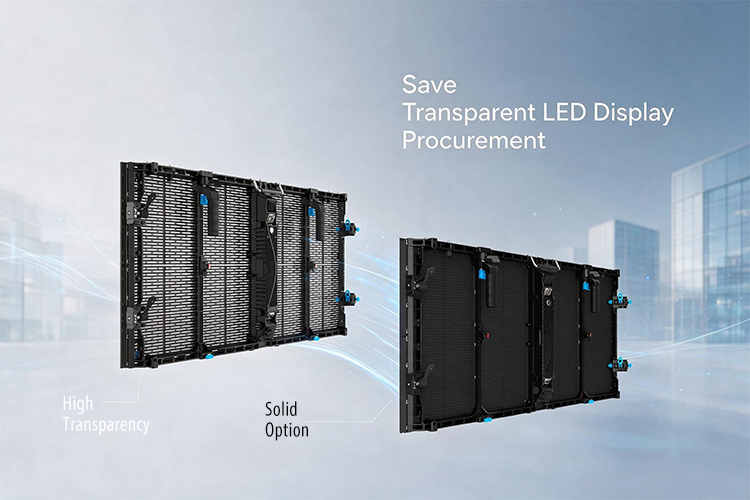
MT II supports ±15° concave and convex configurations and 90° corner splicing through its integrated quick-lock system. It also supports both hanging and stacking installation, using the same beam for the two methods. The system's 1000 × 500 mm and 500 × 500 mm cabinet formats provide additional options when planning different screen dimensions and stage layouts. Its hollow double-frame structure is designed to combine high transparency with structural strength, while the product supports hanging heights of up to 20 meters. These features matter from a procurement perspective because they expand the range of situations in which the same inventory can be deployed.
This is particularly relevant to rental businesses. A display that can be hung or stacked, configured as a flat wall or curved surface, and used in transparent or solid mode has more potential applications than a platform restricted to one installation method and one visual state. Again, flexibility does not automatically translate into a specific financial return. The value depends on how often the available configurations match the projects a rental company actually serves. The procurement principle, however, is clear: when evaluating a rental LED display, assess the number of real-world applications it can cover, not simply the number of features listed on its specification sheet.
A Better Way to Calculate the Cost of Transparent LED Procurement
The most useful approach is to evaluate transparent LED equipment through several cost categories rather than relying on the initial purchase price. Start with the equipment investment: how much LED inventory is required to cover the company's expected project mix? Then evaluate application coverage: can one platform meet both transparent and solid visual requirements? Next, examine installation efficiency: how many crew members and crew-hours are required for a typical deployment? Then consider maintenance and reliability: how is the display protected, what environments can it operate in, and what evidence exists from real projects? Finally, consider asset utilization: how many different types of projects can the same inventory realistically serve?
Under this framework, MT II's value is easier to understand. Its one-button Transparent/Solid switching can potentially reduce the need to maintain separate transparent and solid display inventory. Its one-person operation, large handle, and quick-lock design are intended to simplify installation and dismantling. Its ±15° curving, 90° corner splicing, hanging and stacking configurations broaden deployment options, while its magnesium-alloy double-frame structure, IP65 protection, and 20-meter hanging capability address structural and outdoor application requirements. These features do not mean that every customer will spend less simply by choosing MT II. The more accurate conclusion is that the platform gives procurement teams more variables to optimize when calculating the total cost of an LED display asset.
Smart Procurement Is About Total Value, Not the Lowest Price
The most cost-effective transparent LED display is not necessarily the one with the lowest purchase price. For professional users, a better purchasing decision considers what the equipment can do throughout its service life. If one display can cover transparent and solid visual requirements, the need for duplicate inventory may be reduced. If its cabinet design allows efficient one-person handling, installation labor can potentially be reduced. If its physical configuration supports hanging, stacking, curves, and corners, the same inventory can be applied to a broader range of stage designs. And if the system is engineered for demanding outdoor applications and supported by evidence from real-world deployments, the risk of maintenance-related disruption can be better managed.
That is the procurement logic behind MT II. Rather than positioning a transparent LED screen simply as a product with a certain transparency percentage, MT II combines Transparent/Solid switching, one-person operation, quick-lock installation, flexible configurations, outdoor capability, and structural performance into one rental and staging platform. Its purpose is not to promise an arbitrary percentage of savings, but to give professional buyers more ways to control the costs that accumulate after the purchase order is signed.
For rental companies and production teams, the better question is therefore not simply “How much does a transparent LED display cost?” It is “How much value can this display deliver across the projects, installations, crews, and operating conditions I expect it to serve?” That shift—from purchase price to total cost of ownership—is where smarter transparent LED display procurement begins.


+86-(0)731-84539619


Hunan Yestech Optoelectronic Co., Ltd. Terms of Service Privacy Policy Powered by szweb


