



ADDRESS
Blog/2026.08.27
Transparent LED displays have become an increasingly useful tool for concerts, festivals, touring productions, award ceremonies, and other large-scale live events. Unlike conventional LED walls, transparent LED displays allow lighting, scenic elements, performers, and structures behind the screen to remain visually connected with the content. This makes them attractive for stage designs where the LED display needs to contribute to depth and spatial layering rather than simply create a solid video surface.
For rental companies, however, buying a transparent LED display is not simply a matter of comparing transparency, pixel pitch, or brightness. Rental equipment is an operating asset. It will be transported, installed, dismantled, stored, serviced, and deployed again across different projects. A display that performs well on a specification sheet may not necessarily be the most efficient choice for a rental fleet.
1. Is the Transparent LED Display Designed for Rental or Fixed Installation?
The first question should be about the product's intended application.
Not every transparent LED display is designed for repeated rental use. A fixed-installation product may prioritize long-term installation, architectural integration, or permanent maintenance access. A rental display faces a different set of requirements because it may be assembled and dismantled repeatedly, transported between venues, and adapted to different stage configurations.
For rental companies, cabinet construction, mechanical connections, handling, installation workflow, protection, maintenance, and transportation should therefore be evaluated together. A useful question for the manufacturer is: How was this transparent LED display designed around repeated deployment? The answer should go beyond saying that the product is “lightweight” or “rental-ready.” A professional rental system should demonstrate how its cabinet structure, locking mechanism, transportation system, and serviceability support repeated event use.
2. How Much Does Each Cabinet Actually Weigh?
Cabinet weight is one of the most practical specifications for a rental LED display. Every cabinet has to be moved from the warehouse to a truck, from the truck to the venue, and from the venue floor to its final installation position. For touring productions, this process is repeated from one venue to another. Weight can therefore influence transportation, crew workload, handling procedures, and the demands placed on temporary structures.
However, rental companies should avoid evaluating weight in isolation. The more useful measurement is weight per square meter combined with cabinet coverage. A larger cabinet may cover more area with fewer units, potentially reducing the number of cabinets, mechanical connections, and alignment operations required for a large screen. This is why cabinet dimensions should be considered alongside cabinet weight. The question is not simply “How light is the cabinet?” It is “How efficiently can the complete display be transported and deployed?”
3. What Is the Transparency Level, and How Is It Achieved?
Transparency is obviously central to transparent LED, but it should not be treated as the only performance indicator. A higher transparency ratio can help preserve visibility of lighting, performers, scenic structures, or architectural elements behind the display. However, the useful level of transparency depends on the application, viewing distance, content, ambient light, and overall stage design.
Rental companies should therefore ask manufacturers to provide the actual transparency specification for each configuration or pixel pitch rather than treating a series-level figure as universal. It is also important to understand how transparency is achieved. The cabinet structure, LED arrangement, frame design, and handle or support structure can all influence the visual openness of the display. The objective should be to achieve an appropriate balance between transparency, image performance, structural integrity, and practical deployment.
4. Can It Handle Outdoor Rental Conditions?
For outdoor festivals and touring productions, environmental protection is not optional. Rain, humidity, temperature variation, dust, and wind can all affect an LED display during temporary outdoor deployment. Rental companies should therefore check the product's IP rating, operating environment, structural design, and documented wind or environmental performance.
But an IP rating should not be interpreted as a complete guarantee that a display can be installed anywhere outdoors. Actual deployment also depends on installation method, supporting structures, local weather conditions, engineering calculations, and applicable safety requirements. This distinction is important when evaluating outdoor transparent LED displays. A professional manufacturer should provide technical documentation for the product's environmental and structural capabilities rather than relying only on general marketing language.
5. What Are the Actual Installation Requirements?
Installation speed can have a direct operational impact on a rental company. The relevant question is not simply how quickly one cabinet can be connected. A large LED wall may contain hundreds of cabinets, meaning small differences in repetitive operations can accumulate into substantial differences in total crew time.
Rental companies should examine how cabinets are positioned, aligned, locked, released, and connected. They should also consider whether the system requires multiple technicians for routine handling and whether the same installation workflow can be repeated consistently across projects. For touring productions, a useful metric is total deployment time for a defined screen area, rather than an isolated cabinet installation claim. This makes it easier to compare equipment on an operational basis: how many people are required, how many cabinets need to be handled, how much alignment is necessary, and how long it takes to move from unloading to a completed display.
6. How Flexible Is the Cabinet for Different Stage Configurations?
Rental companies rarely know exactly how every future project will be designed. A transparent LED display may be required as a flat backdrop for one concert, a curved screen for another production, or part of a more complex structure for a festival or award show. A system that supports only one configuration can therefore limit the number of projects for which the inventory is suitable.
Before purchasing, ask whether the cabinet supports curved configurations, corner structures, staggered installation, hanging, stacking, or other deployment methods. This is not simply a question of creative freedom. Configuration flexibility can influence asset utilization. The more applications a rental fleet can realistically serve with the same equipment, the more opportunities there may be to deploy that inventory.
7. How Easy Is the Display to Maintain?
Serviceability is particularly important for rental equipment because the equipment is repeatedly handled. Modules, power components, connectors, and mechanical components can eventually require inspection or replacement. When a technical issue occurs shortly before an event, the ability to diagnose and service the equipment efficiently can be more important than a specification that looks impressive on paper.
Rental companies should ask how modules are replaced, where service access is located, whether components are modular, and whether technicians can perform routine maintenance without unnecessary cabinet disassembly. The goal is not to assume that any display will never fail. The goal is to understand how quickly and practically the system can be returned to service when maintenance is required.
8. What Does the Transportation System Look Like?
Transportation is often underestimated when evaluating rental LED equipment. A cabinet can be lightweight but still inefficient to move if it requires excessive manual handling or poorly organized packing. Conversely, a well-designed transport system can make a significant difference to loading, unloading, storage, and venue movement. Rental companies should therefore evaluate the cabinet together with its dolly, stacking, packing, and storage solutions.
For large-scale touring, this can become particularly important because transportation efficiency affects the entire production workflow. The useful question is not simply how many cabinets fit into a truck, but how many square meters can be transported, handled, and stored efficiently within the available logistics system.
9. What Evidence Supports the Manufacturer's Claims?
This may be the most important question of all. Technical specifications describe what a product is designed to achieve. Real projects demonstrate how the system performs in actual production environments. Rental companies should ask manufacturers for project references that are relevant to their intended applications. A product used successfully for an indoor corporate event does not necessarily provide the same evidence as a transparent LED display deployed outdoors at a large festival or touring production. Project evidence should ideally include the application, screen size, installation configuration, operating environment, and duration of use. This gives buyers a more meaningful basis for evaluating reliability than isolated marketing claims.
10. What Is the Total Value of the Equipment Over Its Rental Life?
Finally, rental companies should move beyond the purchase price. The real cost of a rental LED display can include transportation, installation labor, maintenance, spare parts, storage, crew requirements, and equipment availability. At the same time, the revenue potential of the equipment depends on how many projects it can serve and how efficiently it can be deployed. This makes asset utilization an important part of the purchasing decision.
A transparent LED display that covers multiple applications, moves efficiently between venues, installs quickly, and can be serviced practically may have a different long-term value from a product with a lower initial price but higher operating complexity. The most useful question is therefore not simply: “How much does this transparent LED display cost?” It is: “How efficiently can this display generate value throughout its rental life?”
How Does YES TECH MAir Address These Rental Requirements?
The YES TECH MAir Series was developed specifically around the requirements of large-scale outdoor rental and touring applications. Its design combines a 1000 × 1000 × 102 mm cabinet format with a one-piece carbon fiber molded frame and a cabinet weight of 19 kg. The platform is available in P5.9 and P7.8 configurations, with both solid and mesh options.
For large-format rental applications, the cabinet architecture is designed to reduce repetitive handling and installation operations. MAir uses positioning pins, magnetic positioning, a curved blade lock for single-person operation, and an automatic latch system. Its 6-in-1 dolly is designed for transportation, stacking, and storage, and YES TECH states that the system can transport up to 288 m² in a single truck under its specified configuration.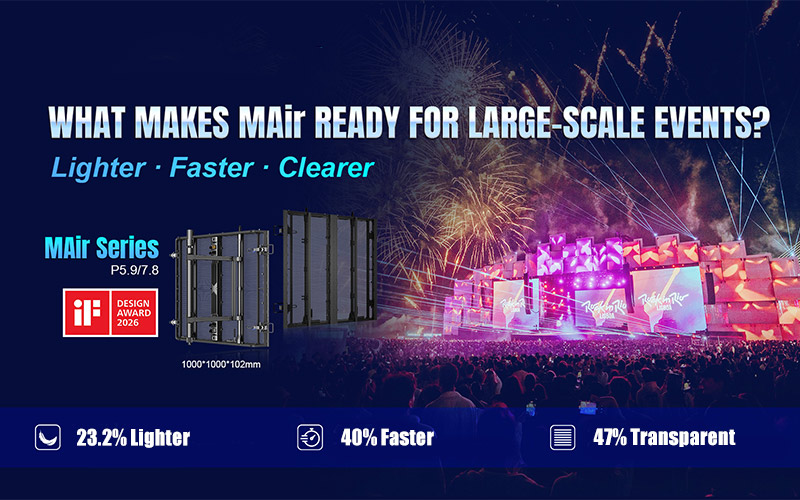
Outdoor performance is another consideration. MAir has an IP65 rating and is designed for outdoor operation. Its Air Frame configuration is specified for wind speeds of up to 20 m/s and hanging heights of up to 25 meters. These specifications should still be evaluated together with the actual installation structure, local conditions, engineering requirements, and applicable safety procedures for each project.
For stage design, MAir supports ±15° concave and convex configurations, 90-degree corner connections, and half-panel offset installation. Its P7.8 mesh configuration provides up to 50% transparency according to the current product specification, allowing lighting, scenic elements, and structures behind the display to remain part of the visual composition.
For rental companies, these features are most meaningful when viewed as a complete system rather than as isolated specifications. The purpose of evaluating cabinet weight, transparency, environmental protection, installation, transportation, flexibility, and serviceability is ultimately the same: to determine whether the equipment can perform efficiently across the full rental lifecycle.
A professional transparent LED display should therefore be judged not by one impressive specification, but by how well its optical, mechanical, logistical, and operational characteristics work together. For rental companies planning large-scale concerts, festivals, and touring productions, that is the more reliable way to select equipment—and to build an LED inventory that can deliver value project after project.


+86-(0)731-84539619


Hunan Yestech Optoelectronic Co., Ltd. Terms of Service Privacy Policy Powered by szweb


