



ADDRESS
Blog/2026.11.09
At a music festival, the stage is constantly changing with the performance. Video fills the backdrop, lighting reveals different parts of the set, and the space around the performers becomes part of the visual experience. LED screens help shape that composition through both the images they display and the physical structures they reveal or conceal.
Screen construction plays a role in how these elements work together. Transparent mesh displays allow lighting and scenery behind the screen to remain visible, while conventional solid LED walls establish an opaque backdrop. Each format gives stage designers different ways to combine video with the surrounding set.
These creative possibilities also need to work within the demands of an outdoor production. Comparing transparent and solid LED screens involves image performance, wind exposure, and installation requirements alongside the intended stage effect. Understanding how these factors connect provides a starting point for planning a music festival LED screen.
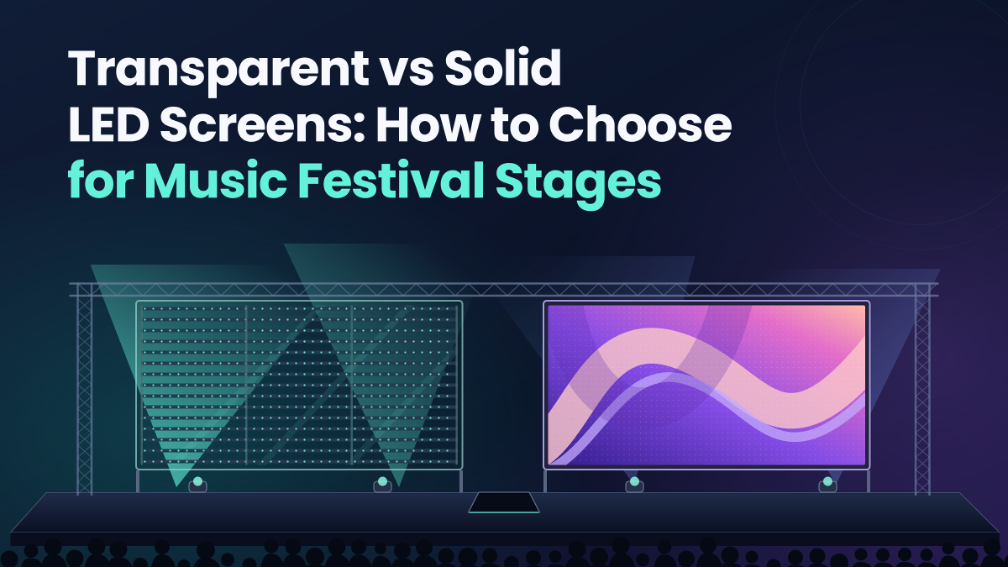
The main distinction is how each format handles the space behind the display. That difference affects lighting integration and the visual background, while image detail still depends on the selected screen's specifications.
|
Selection Factor |
Transparent LED Screen |
Solid LED Screen |
|
Stage Depth |
Keeps parts of the scene behind it visible |
Creates an opaque visual backdrop |
|
Lighting Integration |
Allows lighting behind the display to contribute |
Lighting behind the wall is hidden from view |
|
Image Background |
Visible scenery and rear lighting become part of the composition |
Separates displayed content from scenery behind it |
|
Fine Detail |
Check actual resolution against content and viewing distance |
Check actual resolution against content and viewing distance |
|
Structural Planning |
Assess the open structure and complete installation |
Assess the continuous surface and complete installation |
A transparent stage LED display can place video within the stage scenery. Lighting behind the screen remains part of the design, allowing a visual sequence to move between LED graphics and illuminated physical elements. This approach suits productions where depth and changing layers are central to the performance.
The result depends on the whole composition. Bright objects behind the display can compete with foreground video, while dark surroundings can make the openings less apparent. Review the screen with the intended lighting cues and sightlines from several audience positions.
For example, a sequence built around large graphic shapes can leave space for lighting behind the display to remain visible. A scene that depends on a uniform dark background needs closer coordination between the content and those rear lighting cues. Plan that relationship while developing the show visuals.
A solid wall creates a more distinct boundary between the displayed image and the space behind it. This can help when the production needs to hide backstage activity or maintain a consistent visual backdrop. Lighting can then frame the wall or operate elsewhere in the stage design.
Compare actual pixel pitch, resolution, brightness, and content at the planned screen size. Faces, small lettering, and detailed footage place different demands on a display from broad color fields or abstract motion graphics. Transparency alone does not establish which screen will reproduce them better.
For daylight performances, assess ambient light and screen orientation. At night, evaluate dimming and the relationship between LED brightness and stage lighting. A transparent display also needs its visible background considered when judging contrast.
If cameras will include the screen in their shots, test the complete camera and display setup. LED refresh and camera shutter timing interact, so a refresh-rate figure alone cannot settle the filming requirements.
Use representative material for the review: a performer close-up, the smallest planned lettering, dark footage, and the fastest visual sequence. Compare the result from audience positions and through the production cameras. This makes the assessment relevant to the show instead of relying on a demonstration loop.
Both formats need an installation designed for the site and operating conditions. A transparent construction may help air pass through, but screen selection still needs to account for the complete structure.
LED screen wind load depends on more than display area. Installation height, local exposure, wind direction, panel geometry, and the support system all matter. Use the selected system's engineering information and the applicable project requirements to establish the design and operating limits.
Visual transparency is not a direct wind-load reduction percentage. A screen described as 50% transparent should not automatically be assigned half the wind load of a solid wall. Airflow through the assembly and the resulting forces need their own assessment.
放图
Include the actual operating configuration in that assessment. Rear drapes, scenic coverings, and movable shutters can change the surface exposed to wind. The production team should agree on wind monitoring, action thresholds, and responsibilities before installation, with procedures covering construction, the show, and dismantling.
For a flown screen, calculate the installed load with its beams, cables, and accessories. Check the suspension layout and the supporting structure's capacity for the relevant vertical and lateral forces. A lighter cabinet can help with handling, but total installation requirements determine the structural arrangement.
A ground-supported screen needs a suitable support design, ground capacity, and anchoring or ballast arrangements. The screen format alone does not determine the amount of support required.
Build planning also includes access, assembly sequence, power distribution, cable routes, and maintenance space. Compare transport and crew requirements alongside rental or purchase cost. Confirm that the proposed layout can be assembled, tested, serviced, and removed within the available schedule. These checks turn a visually suitable screen into a workable festival installation.
Agree on service access before fixing the screen position. A panel that can be reached easily in a warehouse may be harder to access once lighting, scenery, and other equipment surround it. Reserve time for signal checks and a full content rehearsal after assembly.
Choose by the purpose of each display position. A main scenic backdrop and a side screen carrying live camera feeds can have different priorities within the same production. Comparing transparent vs solid LED screens becomes more useful when those jobs are defined separately.
|
Stage role |
First option to assess |
Main reason |
|
Layered scenic backdrop |
Transparent screen |
Preserves visibility of lighting and scenery behind the video |
|
Live performer close-ups |
Conventional solid screen |
Provides an opaque background for image magnification |
|
Text and detailed visual information |
Screen with sufficient effective resolution, often a solid wall |
Prioritizes legibility at the intended distance |
|
Stage combining scenery and camera feeds |
Transparent and solid screens in different positions |
Gives each display a defined creative or viewing task |
For a scenic backdrop, begin with the relationship between video, lighting, and physical set elements. Large graphic shapes and motion can be developed around an open stage composition. Check whether the design needs visibility through the entire wall or only selected areas.
For image magnification, commonly called IMAG, the audience needs to follow performers who may be difficult to see directly. Conventional solid screens are a practical starting point because they provide a background independent of activity behind the display. Confirm image detail, sightlines, and camera performance for the actual arrangement.
For sponsor messages, lyrics, or other text, test representative content at the intended size. A logo that looks clear on a control monitor may occupy too few pixels on the final screen layout. Content design and effective resolution should guide the choice together.
A hybrid layout can use transparent panels for the scenic stage and solid walls for dedicated viewing positions. Plan content routing so that camera feeds and stage graphics reach the right surfaces, and assess each structure separately.
This division also helps when one audience area needs a clear view of the performer while another display contributes to the stage design. Check which surface each audience zone will actually watch. The screen's role should remain clear throughout the show, including transitions between camera feeds and graphics.
Before selecting a product, define the screen roles, dimensions, audience distances, show lighting conditions, installation method, and available build time. These details provide a clear brief for evaluating suitable equipment.
For transparent LED screen rental, use this table to turn the brief into an initial shortlist:
|
Project requirement |
Evaluate first |
Confirm in the plan |
|---|---|---|
|
Changing stage widths or indoor dates |
MT II |
Two cabinet sizes and each venue's layout |
|
Transparent and solid effects on the same screen during a show |
MT II |
Optional shutter system included |
|
Broad outdoor transparent backdrop |
MAir |
1 × 1 m cabinet grid and dolly allocation |
|
Fixed mesh or solid look for a large outdoor stage |
MAir |
The separately specified version |
|
Tall outdoor hang or defined wind requirements |
MAir |
Published 25 m hanging and up to 20 m/s wind figures; site engineering |
|
Curves or 90° corners |
Both |
Cabinet layout against the stage drawing |
If your music festival stage calls for a transparent LED screen, choose YES TECH MT II to bring LED visuals, lighting, and stage depth together. At YES TECH, we recommend matching its transparent format to the stage roles and installation conditions established in the project brief.
放图
MT II offers at least 50% transparency, supporting compositions that keep lighting and scenery behind the display visible. Its hollow double-frame structure uses a magnesium alloy frame, while quick locks and large handles support installation and dismantling.
The series supports hanging and stacking configurations, using the same beam for both. This gives production teams installation options to assess against the stage layout. Curved arrangements, 90-degree corners, and staggered cabinet layouts also support different scenic forms.
An optional shutter system enables switching between transparent and solid modes. Our MT II series also offers a 7,680 Hz refresh rate, IP65 protection, and an optional high-brightness solution up to 4,500 nits. Select the configuration around the production's lighting, display, and installation requirements.
Kharkhorum Festival 2026 used nearly 2,000 m² of MT II across 13 LED video walls. The design combined an 11-meter-high curved central screen, irregular main side screens, and additional side and rear displays within a 360-degree visual concept.
The project shows how a transparent system can serve a large scenic environment across multiple display positions. Installation was completed over five days, with our technical support assisting the production on site. That schedule reflects this project's scale, team, and preparation.
For a new festival, use this application as a reference for layout possibilities. We can help review how our transparent display options fit your screen roles, creative concept, and planned installation.
Choosing transparent vs solid LED screens starts with the stage's purpose. Transparent screens suit designs that retain visible depth and integrate lighting behind the display. Conventional solid screens are a practical option for dedicated camera feeds and content that benefits from an opaque background. Hybrid layouts can address both needs within one festival.
Confirm the visual requirements, then evaluate wind loads, support arrangements, and the build plan for the selected configuration. When the brief calls for a transparent solution, YES TECH MT II offers an option supported by a large-scale festival application. Share your stage layout, screen dimensions, viewing distances, and installation conditions with us to discuss a suitable display solution.
1. Health and Safety Executive. Venue and site design.
https://www.hse.gov.uk/event-safety/venue-site-design.htm
2. Brompton Technology. ShutterSync.
https://www.bromptontech.com/features/shuttersync/


+86-(0)731-84539619


Hunan Yestech Optoelectronic Co., Ltd. Terms of Service Privacy Policy Powered by szweb


