



ADDRESS
Blog/2026.08.25
In the rental LED display business, every project can look different. A concert may require a large flat backdrop, a festival may call for several outdoor screens, a corporate event may use a relatively compact display, and a touring production may need the same equipment to be installed, dismantled and transported repeatedly across different venues. From the audience's perspective, these are completely different applications. From the rental company's perspective, however, they all depend on the same question: how efficiently can one LED display inventory serve different projects over time?
This is where LED cabinet standardization becomes important. Standardization is sometimes misunderstood as using exactly the same cabinet for every application. That is not the real objective. A professional rental LED display system needs enough flexibility to accommodate different screen sizes, pixel pitches and configurations, but it also benefits from consistency in the underlying cabinet platform, mechanical interfaces, service procedures and components. The goal is to make a rental fleet easier to deploy, maintain and reuse without sacrificing the flexibility required by live-event production.
For a rental company, this distinction matters because an LED cabinet is not normally purchased for a single installation. It is an asset expected to move through many production cycles. It may be packed into flight cases, transported to a venue, assembled by one crew, operated for several days, dismantled, inspected, stored and then sent to another project. Over years of operation, the efficiency of those repeated processes can have a greater impact on the value of the equipment than any single installation.
What Does Standardization Mean in a Rental LED Display?
At the cabinet level, standardization can involve several aspects of the system. Cabinet dimensions are one obvious example, but the concept extends to the mechanical structure, locking method, module architecture, power and signal connections, maintenance procedures, spare parts and installation accessories.
A standardized platform allows technicians to become familiar with a consistent workflow. If the same basic cabinet architecture is used across a fleet, the process of connecting cabinets, replacing modules, accessing power components and preparing equipment for transport becomes more predictable. This does not eliminate the need for project-specific engineering, but it reduces the number of completely different workflows a rental operation has to manage.
The distinction between standardization and uniformity is particularly important in rental applications. A standardized system can still offer different cabinet formats or pixel pitches. What matters is that these variations belong to a coherent platform rather than requiring completely independent equipment ecosystems.
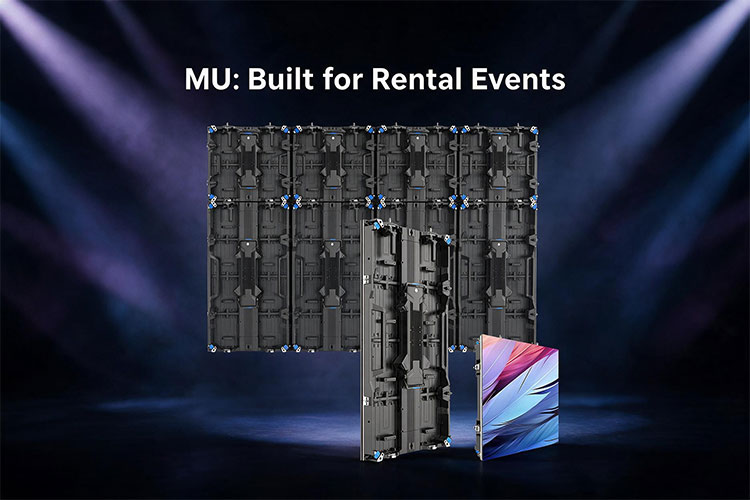
The YES TECH MU Series provides a practical example of this approach. The series uses a common cabinet platform across multiple pixel pitches and offers both 500 × 500 mm and 500 × 1000 mm cabinet formats. According to YES TECH's current product information, the MU frame accommodates all pixel pitches within the MU range, while the series is available for indoor and outdoor applications depending on configuration. The value here is not simply having two cabinet sizes. It is the ability to maintain a degree of consistency while giving production teams different ways to build the screen.
Why Standardization Matters More as a Rental Fleet Grows
For a small rental operation with only a limited number of LED cabinets, equipment differences may initially seem manageable. As the fleet grows, however, every additional cabinet platform introduces another set of parts, procedures and technical requirements.
Imagine a rental company operating several unrelated LED cabinet systems. Each system may have its own cabinet dimensions, spare modules, power boxes, receiving cards, locking mechanisms, flight cases and maintenance procedures. None of these differences necessarily makes an individual product poor, but together they increase operational complexity.
Warehouse management becomes more complicated because equipment must be identified and stored by system. Spare parts have to be tracked separately. Technicians need to know which components belong to which cabinet. Packing procedures may vary between projects. Training becomes more complicated, particularly when temporary crews or subcontractors are involved. Standardization cannot eliminate all of this complexity, because a professional rental fleet will often contain different products for different applications. It can, however, reduce unnecessary variation.
This is particularly important for companies that use LED displays across concerts, festivals, corporate events and touring productions. The more frequently a fleet is deployed, the more valuable a repeatable operating process becomes. In this context, standardization is best understood as a fleet-management strategy rather than simply a product-design feature.
Standardized Cabinets Can Simplify Inventory Management
Inventory is one of the less visible costs of an LED rental business. A rental company does not only manage LED cabinets. It also has to manage spare modules, power supplies, receiving cards, cables, accessories, flight cases, rigging components and other supporting equipment. Every additional cabinet platform can potentially expand the number of spare parts and accessories that have to be kept available.
This is where component commonality becomes important. If different configurations within a platform can share key components or follow the same service logic, the company can simplify part of its spare inventory and maintenance process. It does not mean that every component is interchangeable; compatibility always needs to be verified by the manufacturer for the specific model and configuration. But reducing unnecessary variation can make inventory planning more manageable.
For example, the MU Series uses a platform design in which different pixel pitches within the MU range can use the same frame. YES TECH specifically positions this architecture as a way to provide flexibility across pixel-pitch options and optimize return on investment. That distinction is important. A rental company may need different pixel pitches for different viewing distances or applications, but it does not necessarily want a completely different cabinet architecture every time the pixel pitch changes. A platform approach can separate those two decisions: the visual specification can change while the underlying cabinet system remains familiar.
Standardization Does Not Mean Giving Up Flexibility
This is perhaps the biggest misconception about standardization. Rental productions are inherently variable. A company cannot standardize every project into one fixed screen format because the requirements of a concert, sports event and corporate production are different. The useful form of standardization is therefore not about limiting what the screen can do. It is about standardizing the foundation while keeping deployment flexible.
The MU Series illustrates this principle through its two cabinet formats and multiple installation and splicing options. The 500 × 500 mm and 500 × 1000 mm cabinets can be vertically spliced, while the series supports ground stacking and hanging installation. It also supports curved splicing at ±7.5°, with ±15° available as an option. These capabilities do not make the system “non-standard.” They show how a standardized platform can still accommodate different production requirements.
For a rental company, this can be more useful than having a collection of highly specialized cabinets, each optimized for only one type of installation. A common platform with controlled variations can give the fleet both consistency and adaptability. The same principle applies to pixel pitch. A rental company may need fine-pitch LED for closer viewing distances and a different pitch for larger screens or outdoor applications. If those products share a common cabinet platform, technicians and warehouse teams may have fewer fundamentally different mechanical systems to manage. This is one reason the concept of platform design is becoming increasingly relevant in professional LED display development.
The Impact on Installation and Crew Training
Standardization also affects the human side of rental operations. LED screens are often installed under tight schedules, and the people building them may not be the same technicians from one event to the next. Touring productions can move between cities and countries, while local crews may support installation at individual venues. A cabinet that uses a familiar mechanical workflow can reduce the amount of product-specific knowledge required every time a new project begins.
This does not mean that training becomes unnecessary. LED display installation still requires qualified personnel, proper structural calculations, appropriate rigging practices and compliance with relevant safety requirements. Standardized equipment cannot replace professional engineering or safe working procedures. What it can do is make the equipment workflow more predictable.
If technicians already understand how a particular cabinet platform locks, aligns, hangs and interfaces with its accessories, they can transfer that knowledge between projects. Over a large number of deployments, this familiarity can contribute to faster setup and fewer avoidable handling errors. The MU Series, for example, is designed for single-person operation and uses a three-step hanging process, according to YES TECH. Its power box can also be changed in approximately five seconds. Those specifications are useful not because a five-second component change determines the performance of an entire rental fleet, but because they illustrate a broader design philosophy: the cabinet is being designed around repeated professional use rather than a single permanent installation.
Standardization and Maintenance Are Closely Connected
Maintenance is another area where standardization can have a practical impact. Rental LED cabinets inevitably require servicing. Modules can be damaged during transportation or installation, power components can require replacement, and connectors and other mechanical parts are subject to repeated handling. The exact maintenance requirements depend on the cabinet design and operating environment, but the principle remains the same: the easier it is for technicians to understand and access a system, the easier it is to keep the fleet in service.
A standardized maintenance workflow can reduce the number of procedures technicians have to learn. It can also make troubleshooting more systematic. The MU Series uses a modular design that supports both front and rear maintenance. YES TECH also specifies a removable power-box design intended to simplify service. For a rental company, the significance is operational. A cabinet that can be serviced without unnecessarily dismantling a larger screen structure can help reduce downtime, although actual service time will always depend on the fault, installation configuration and technician.
This is why maintenance should be considered when evaluating an LED rental cabinet before purchase. The initial purchase price is only one part of the cost. The equipment will continue to generate costs through storage, transportation, labor, spare parts and maintenance throughout its operating life.
Standardization Can Improve Asset Utilization
There is another reason rental companies pay attention to standardized equipment: utilization. An LED cabinet sitting in a warehouse is not generating rental revenue. The commercial value of a rental asset depends partly on how effectively it can be deployed across different projects.
A highly specialized cabinet may perform extremely well in one particular application but have limited use outside it. A flexible standardized platform can potentially serve a broader range of projects, which gives the rental company more opportunities to deploy the same inventory.
This does not mean that the most standardized cabinet is automatically the most profitable. Rental companies still need specialized equipment for applications such as transparent LED, high-brightness outdoor touring, fine-pitch indoor displays or creative structures. The right fleet is usually a combination of standardized core platforms and specialized products where the application genuinely requires them. The strategic objective is to avoid unnecessary fragmentation. A useful way to think about this is: Standardize what can be standardized. Specialize where specialization creates real value. That approach allows a rental company to build a fleet that is both manageable and commercially versatile.
Why Cabinet Compatibility Matters
Standardization becomes even more valuable when different products can work within a broader ecosystem. A rental company may not want every project to use exactly the same LED cabinet. Instead, it may need a primary screen system together with specialized products for corners, creative structures or other applications. Compatibility between product families can therefore extend the usefulness of an existing inventory.
YES TECH positions the MU Series as a platform that can be used with the MG9, MG10 and Xtra Series for additional creative configurations. The company also states that MU can be combined with Rubik cabinets to create multi-faceted configurations such as 90-degree corners.
This should not be confused with saying that all cabinets are interchangeable. Compatibility is specific to the products, connection systems and configurations supported by the manufacturer. The important point is that a rental company can potentially build a more integrated equipment ecosystem instead of treating every LED product as a completely isolated system. That can be particularly useful as productions become more varied.
A large screen may use MU cabinets for the primary display area, while another product is introduced where a specific geometry or visual effect is required. The value comes from combining standardized core equipment with specialized components when the project calls for them.
Standardization Is Ultimately About the Entire Rental Lifecycle
The strongest argument for LED cabinet standardization is not any single feature. It is the cumulative effect across the entire equipment lifecycle. A cabinet is purchased once, but it may be installed hundreds of times. It may pass through many technicians, venues, trucks and warehouses. Its modules may be replaced, its components serviced and its configuration changed repeatedly. That means the cabinet should be evaluated as part of an operating system.
How easily can it be packed? How consistently can it be installed? How familiar is the maintenance process? How many different spare parts need to be stocked? Can the same platform serve different pixel-pitch requirements? Can different cabinet formats support different screen dimensions? Can the equipment integrate with other products when a project becomes more complicated? These questions are often more relevant to a rental company's long-term operation than a single headline specification. This is also why the concept of total cost of ownership, rather than purchase price alone, is useful when comparing rental LED displays. Labor, maintenance, transportation, spare parts and asset utilization all contribute to the actual cost of operating an LED fleet.
How the MU Series Reflects a Standardized Rental Approach
The MU Series is not simply an example of a cabinet with multiple features. Its more relevant characteristic for rental companies is the platform approach behind those features. The same MU cabinet frame accommodates multiple pixel pitches within the series, while the 500 × 500 mm and 500 × 1000 mm cabinet formats provide different options for building large LED screens. The series is designed for indoor and outdoor configurations, depending on the selected model, and supports both stacking and hanging installation.
That combination gives rental companies a way to maintain a degree of consistency without forcing every project into the same physical configuration. The platform can also support curved splicing and integration with other YES TECH products when a production requires a different geometry. Its modular maintenance design and single-person operation further address the practical requirements of repeated rental deployment.
The broader lesson is more important than the individual specifications. A rental LED cabinet should not be evaluated only as a display surface. It should be considered as a component of a fleet that has to remain productive for years. For rental companies, standardization is ultimately about reducing unnecessary complexity while preserving the flexibility that makes rental equipment valuable in the first place. Every event may be different. The equipment workflow does not have to be.
A well-designed standardized LED cabinet platform allows rental companies to build different screens, support different productions and adapt to changing project requirements while keeping the underlying equipment system familiar. That can simplify inventory management, maintenance, training and deployment, while giving a rental fleet more opportunities to be reused across projects.
This is the real significance of LED cabinet standardization. It is not about making every LED screen identical. It is about creating a more consistent foundation from which different screens can be built. For a professional rental company, that foundation can determine not only how a display looks on the day of the event, but how efficiently that same equipment performs across the many projects that follow.


+86-(0)731-84539619


Hunan Yestech Optoelectronic Co., Ltd. Terms of Service Privacy Policy Powered by szweb


