



ADDRESS
Blog/2026.08.19
The material used to build an LED display cabinet may seem like a technical detail, but for professional rental applications, it can influence almost every stage of the product lifecycle. A rental LED screen is not installed once and left in place. Its cabinets are repeatedly transported, assembled, dismantled, stacked, hoisted and reconfigured for different events. Over time, these repeated operations place continuous demands on the cabinet's structural integrity, dimensional accuracy and mechanical components.
This is why the discussion around LED display cabinet materials is moving beyond a simple question of weight. For years, reducing cabinet weight was one of the most visible priorities in rental LED display development. Lighter cabinets can make transportation and handling easier, particularly when large quantities of equipment need to move between venues. But as rental LED displays are increasingly used for large festivals, touring productions, sports events and complex temporary structures, manufacturers and rental companies are paying greater attention to another question: how well does the cabinet maintain its performance throughout repeated use?
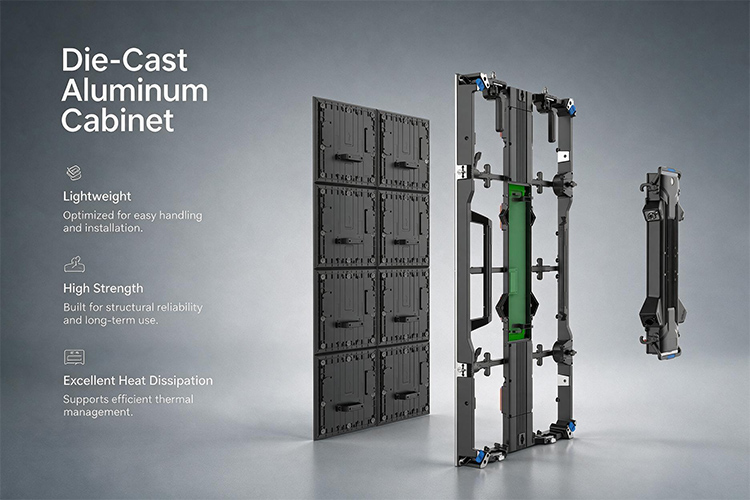
This is where die-cast aluminum has continued to play an important role. With its combination of structural rigidity, dimensional consistency, thermal conductivity and manufacturing flexibility, die-cast aluminum can provide a strong foundation for professional LED display cabinets. When properly engineered, it allows manufacturers to create complex structural forms while maintaining the precision required for cabinet-to-cabinet assembly. For rental applications, that combination is particularly valuable because reliability is determined not by a single installation, but by hundreds of installation and transportation cycles over the product's working life.
YES TECH's MU Series is built around this principle. Its cabinet and power control box use die-cast aluminum alloy as the structural foundation, while the overall design integrates precision, protection, installation efficiency and configuration flexibility. The result is not simply an aluminum LED cabinet, but a rental LED display platform designed around the demands of repeated professional deployment.
Why Material Choice Matters More in Rental LED Displays
A fixed-installation LED display and a rental LED display operate under fundamentally different conditions. A fixed screen may be installed on a building façade, in a commercial space or inside a venue and remain there for years. Once the structure has been aligned and secured, the cabinet may experience relatively little physical handling.
Rental LED cabinets face a much more dynamic environment. A single cabinet can be loaded into a truck, transported to a venue, carried into position, connected to neighboring cabinets, installed on a stage or structure, operated for several hours or days, dismantled and transported again. The process may then be repeated at another location. During a busy touring schedule, the same equipment can go through this cycle many times in a relatively short period.
That changes what “reliability” means. For rental equipment, structural durability is not only about surviving a single installation. It is about maintaining dimensional accuracy and mechanical performance after repeated handling. A cabinet that performs well when new but gradually develops connection problems, deformation or alignment issues after repeated use can create additional labor and maintenance costs.
This is one reason die-cast aluminum remains relevant in rental LED cabinet design. Rather than simply providing a rigid enclosure, a well-engineered die-cast structure can serve as a stable mechanical framework for the entire display system.
Die-Cast Aluminum Is About More Than Strength
The most obvious reason for using die-cast aluminum is structural performance, but strength is only one part of its value. High-pressure die casting allows aluminum alloy to be formed into precisely designed components with complex geometries. Instead of assembling a cabinet from numerous separate structural pieces, manufacturers can integrate multiple functional areas into a more unified structure. Critical surfaces and connection areas can then be machined to achieve the accuracy required for assembly.
This is particularly important for LED displays because large screens are made by connecting many individual cabinets into one visual surface. Imagine a large rental LED wall consisting of hundreds of cabinets. Each cabinet may only have a very small dimensional deviation, but these deviations can accumulate across the entire display. The result can be uneven cabinet lines, inconsistent connections or visible differences in screen flatness.
For this reason, dimensional consistency is not merely a manufacturing advantage. It directly affects the appearance and installation quality of the finished LED screen. A rigid die-cast aluminum structure can provide a stable foundation for these connections. When combined with accurately positioned locking and locating components, it helps create a more consistent relationship between adjacent cabinets.
This is especially relevant for rental LED displays because the cabinet must repeatedly return to the same mechanical reference points. The goal is not simply to make the cabinet strong enough to survive transportation. It is to make the cabinet predictable enough to perform consistently after transportation.
Precision Becomes Critical as LED Screens Get Larger
The larger the LED screen, the more important cabinet precision becomes. On a small display, minor inconsistencies may be difficult to notice. On a large stage screen or outdoor festival wall, however, the same deviation can become increasingly visible because hundreds of cabinets are working together as a single surface. Cabinet precision therefore affects more than mechanical assembly. It contributes to the visual quality of the entire LED display.
This is one of the advantages of integrating die-cast aluminum into a carefully engineered cabinet structure. The casting process can support repeatable production of complex structural components, while secondary machining can refine critical connection areas. For a professional rental LED display, this provides a foundation for consistent installation. The importance of this becomes even clearer when screens need to be reconfigured. Rental cabinets may be installed horizontally, vertically or in different combinations depending on the project. The cabinet therefore needs to maintain consistent mechanical relationships regardless of where it is deployed.
MU is designed with this requirement in mind. Its die-cast aluminum cabinet structure provides the precision-oriented foundation needed for repeated assembly, while its mechanical design supports efficient cabinet connection and positioning. In other words, the value of die-cast aluminum is not simply that the cabinet is made from metal. Its real value lies in how accurately that material can be turned into a repeatable structural system.
Thermal Performance Is Another Part of Cabinet Reliability
LED display reliability is also closely connected to thermal management. LED modules, receiving cards, power supplies and other electronic components generate heat during operation. In high-brightness applications, especially outdoor LED displays operating for extended periods, managing this heat becomes an important part of maintaining stable performance.
Aluminum has good thermal conductivity, which makes it useful as part of an LED cabinet's thermal management strategy. A well-designed aluminum structure can participate in heat transfer and help distribute heat away from internal components. However, once again, the material itself is only one part of the solution. Effective thermal performance depends on the complete cabinet architecture, including component placement, airflow, power system design and heat dissipation pathways.
This is why die-cast aluminum should not be viewed as a standalone technical feature. Its advantage becomes meaningful when the material is integrated into a broader structural and thermal design. For professional rental LED displays, this integrated approach is increasingly important. The cabinet must protect its internal components during transportation and installation, then provide an appropriate operating environment once the screen is powered on.
From Structural Protection to Practical Installation
A rental LED cabinet also needs to balance structural rigidity with practical operation. Technicians do not interact with a cabinet only after it has been installed. They need to carry it, position it, connect it and lock it into place. If these processes are complicated, the material quality of the cabinet cannot compensate for an inefficient workflow. MU combines its die-cast aluminum structure with installation-oriented mechanical features. The large handle and holder provide practical gripping and positioning points, while the quick-lock design helps simplify cabinet connection during installation.
These features are particularly useful when large screens need to be assembled within limited production windows. A rental LED screen may contain hundreds of cabinets, so even small improvements to individual cabinet operations can have a cumulative effect on installation time. The relationship between material and installation design is therefore important. A rigid cabinet provides structural stability, but the connection system determines how effectively that structure can be used in the field. This is one reason modern die-cast aluminum LED cabinets should be evaluated as complete systems rather than simply by material specifications.
A Die-Cast Aluminum Cabinet Must Also Be Built for Flexibility
Another consideration for rental applications is configuration. Rental companies typically need equipment that can serve different events rather than a cabinet designed for only one fixed screen size. The same inventory may be used for a concert stage, a sports event, a corporate production or an outdoor festival. MU is available in both 500 × 500 mm and 500 × 1000 mm cabinet formats, allowing different screen dimensions and structural configurations to be created from the same product family. Optional 2-in-1 and 4-in-1 schemes further expand its configuration flexibility.
The series also covers multiple pixel pitches. Indoor options include P1.9, P2.6, P2.9, P3.9 and P4.8, while outdoor options include P2.9, P3.9 and P4.8. This combination means the die-cast aluminum cabinet is not tied to one particular viewing environment. The same underlying cabinet philosophy can support different applications according to pixel pitch, screen size and project requirements. For rental operators, this flexibility can be as important as structural performance because equipment needs to generate value across multiple projects rather than a single installation.
Why Die-Cast Aluminum Fits the Demands of Modern Rental LED Screens
The growing interest in die-cast aluminum LED cabinets reflects a broader change in how professional LED displays are evaluated. A modern rental LED screen needs to perform across several dimensions at once. It needs to provide visual quality for the audience, structural reliability for the equipment, precision for the installation crew and flexibility for the rental company.
Die-cast aluminum can contribute to these requirements through a combination of structural rigidity, dimensional consistency, thermal conductivity and manufacturing precision. But its effectiveness ultimately depends on how it is engineered into the cabinet. That distinction is important. Simply replacing another material with aluminum does not automatically create a better LED display cabinet. A reliable die-cast aluminum cabinet requires appropriate structural geometry, accurate casting, precision machining, dependable connection mechanisms and practical maintenance and installation design.
MU reflects this more comprehensive approach. Its die-cast aluminum cabinet and power control box establish the structural foundation, while its mechanical design addresses the practical requirements of repeated rental deployment. Flexible cabinet sizes and multiple pixel pitches allow the same platform to support different applications, from indoor events to outdoor productions.
Its deployment across events such as Moorea Festival 2026, Cocorico Electro 2026, Terres du Son 2026 and the Nanterre Basket Show 2026 also illustrates the type of environments in which rental LED cabinets need to operate: temporary, fast-moving and highly production-driven. Ultimately, the question is not whether die-cast aluminum is simply “stronger” than every alternative material. The more meaningful question is whether the material can be engineered into a cabinet that remains precise, durable and practical throughout repeated use.
For professional rental LED displays, that is the standard that matters. As LED screens continue to move between festivals, touring stages, sports venues and other temporary productions, cabinet design will play an increasingly important role in overall system performance. Die-cast aluminum provides a strong structural foundation, but engineering determines how much value that foundation delivers. That is the direction represented by MU: not aluminum for the sake of aluminum, but die-cast aluminum integrated into a rental LED cabinet designed for precision, protection, flexibility and repeated professional deployment.


+86-(0)731-84539619


Hunan Yestech Optoelectronic Co., Ltd. Terms of Service Privacy Policy Powered by szweb


