



ADDRESS
Blog/2026.08.24
When evaluating an LED display, attention often goes first to pixel pitch, brightness, refresh rate, contrast, or transparency. These specifications directly affect image quality, so they are naturally easy to understand and compare. Yet for professional rental, touring, and staging applications, another part of the display can be just as important: the cabinet structure.
An LED cabinet is more than a housing for LED modules and electronics. It is the mechanical interface between the display components and the installation environment. It has to support the internal components, maintain the cabinet's geometry, transfer mechanical loads, connect with adjacent cabinets, and remain stable when the display is stacked, hung, transported, dismantled, and installed again. Industry discussions of LED cabinet engineering similarly identify the cabinet as the mechanical backbone of a display system, with modularity, precision, durability, and structural reliability all closely connected.
This becomes even more important for transparent LED displays. Their open visual architecture creates different requirements for structural design, while rental applications add repeated handling and multiple installation configurations to the equation. A structurally reliable LED display therefore cannot be defined by one material, one reinforcement component, or one specification. Its performance comes from the interaction between material, geometry, load paths, connections, dimensional accuracy, modularity, and lifecycle requirements. Understanding these principles also helps explain how the structural design of the YES TECH MT II is intended to support demanding professional applications.
What Actually Makes an LED Cabinet Structurally Reliable?
Structural reliability begins with a simple engineering principle: a cabinet must be able to perform its mechanical function without excessive deformation or loss of dimensional accuracy under the loads it is designed to withstand. For an LED display, those loads can come from several sources. The cabinet has its own weight, adjacent cabinets create connection forces, hanging installations introduce suspended loads, stacking creates vertical loads, and transportation or repeated handling can introduce short-duration mechanical impacts.
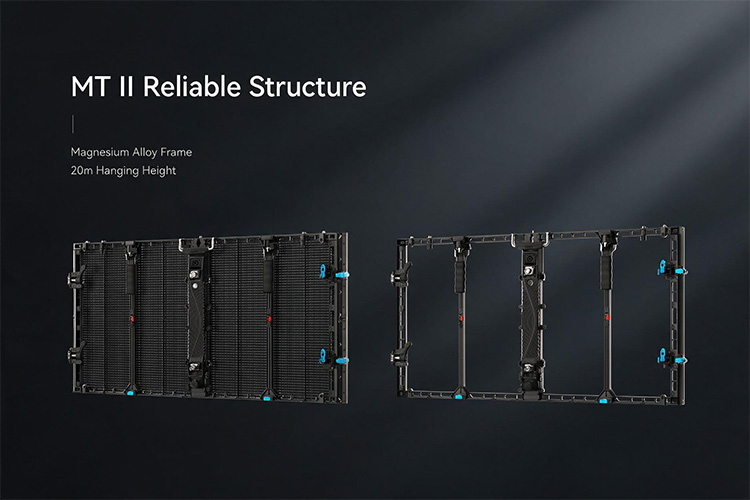
A reliable cabinet therefore needs a structure that manages these different conditions in a predictable way. The frame must provide sufficient rigidity, while connection points must be capable of transferring loads into the supporting structure. At the same time, the cabinet needs to maintain its designed geometry so that multiple cabinets can form a consistent display surface. This is particularly important in rental LED applications because a cabinet is not necessarily installed once and left in place. It may be assembled and dismantled repeatedly throughout its service life.
This is why structural reliability should be viewed as a system-level characteristic rather than a single specification. Material strength matters, but so do frame geometry, connection design, manufacturing tolerances, and the way the cabinet interacts with neighboring cabinets. A structurally efficient design uses these elements together rather than relying on additional material alone.
Why Is Load Path Important in LED Display Design?
One of the fundamental concepts in structural engineering is the load path: the route through which a force travels from the point where it is applied to the structure that ultimately supports it. In an LED cabinet, mechanical loads should not simply accumulate in one component. They need to be transferred through the structural frame and connection system in a controlled way.
For example, when a cabinet is suspended, the weight of the cabinet and the cabinets connected to it creates a load that must ultimately be transferred to the rigging or supporting structure. When cabinets are stacked, the load path changes because forces are transferred vertically through the connected cabinet structure and into the base. When multiple cabinets form a large display, the connections between cabinets also become part of the overall mechanical system. The cabinet is therefore not an isolated object; its behavior depends on how it interacts with the surrounding structure.
Poorly considered load paths can create localized stress concentrations or excessive deformation. A structurally optimized cabinet instead attempts to guide forces through the parts of the structure designed to carry them. This is one reason why simply adding material does not necessarily produce a better LED cabinet. Structural efficiency comes from where material is placed, how structural members interact, and how forces move through the system.
For transparent LED displays, this principle is particularly relevant because the cabinet must combine an open visual architecture with adequate mechanical support. The structural solution therefore needs to be carefully integrated rather than added as an afterthought.
Why Do Cabinet Connections Matter as Much as the Frame?
The frame is only one part of an LED cabinet's mechanical system. Once multiple cabinets are assembled into a larger display, the connection system becomes equally important. Locks, alignment features, connection points, and other mechanical interfaces determine how individual cabinets interact with each other and how the overall structure behaves.
There is an important distinction between structural connection and visual alignment. A connection needs to help transfer mechanical forces, but it may also need to maintain the relative position of adjacent cabinets. If two cabinets are mechanically connected but their positions cannot be controlled accurately, the result may still be an uneven or misaligned LED wall. For large displays, small inconsistencies between individual cabinets can become increasingly visible across the complete screen.
This is particularly relevant to rental LED displays, where connections may be engaged and released many times. A rental cabinet needs repeatable assembly: the crew should be able to connect cabinets in different venues while maintaining consistent mechanical relationships. This is why connection design should be considered part of the cabinet's overall engineering rather than simply an installation accessory.
A professional LED display cabinet should therefore answer two questions simultaneously: Can the connection reliably transfer the required mechanical forces, and can it repeatedly position adjacent cabinets with sufficient accuracy? The answer to both affects the stability and appearance of the final LED structure.
Why Do Manufacturing Tolerances Matter for Large LED Walls?
Another important but often overlooked factor is manufacturing tolerance. No manufactured component can be produced with mathematically perfect dimensions. Every frame, module, connector, and mechanical interface has a defined dimensional tolerance. In a single cabinet, a small deviation may be difficult to notice. Across a large LED wall, however, multiple tolerances can accumulate.
This is known as tolerance stack-up. The final geometry of a display depends not only on the dimensions of the cabinet itself, but also on the relationship between modules, frame components, locating features, locks, and adjacent cabinets. As the number of cabinets increases, maintaining consistent alignment becomes increasingly important.
The relationship between mechanical precision and visual performance is especially clear in LED displays. An uneven cabinet surface or inconsistent connection can produce visible gaps, steps, or irregularities in the display plane. In other words, mechanical accuracy eventually becomes visual accuracy. Industry engineering guidance for LED cabinets likewise emphasizes the importance of cabinet-to-cabinet alignment and tolerance control in maintaining consistent splicing.
For large rental displays, this means structural design cannot be separated from manufacturing precision. A frame may have sufficient theoretical strength, but if the complete cabinet system cannot maintain consistent geometry, its real-world performance will still be limited.
Why Does Modularity Matter in Rental LED Display Design?
Modularity is another fundamental principle of professional LED cabinet design. Unlike many fixed-installation displays, rental LED systems are designed around repeated deployment. Equipment may be transported to a venue, assembled into one configuration, dismantled after the event, and later rebuilt into a completely different structure. This makes the cabinet a reconfigurable mechanical building block. Its dimensions and connection architecture determine how efficiently it can be combined with other cabinets and how much freedom production teams have when adapting a screen to a particular venue.
Transparent LED displays can benefit particularly from this modular approach because their applications are not limited to conventional rectangular walls. They may be used as stage layers, scenic surfaces, architectural elements, exhibition structures, or other creative configurations. In these situations, modularity is not simply a transportation advantage. It provides geometric adaptability.
This principle is reflected in the MT II design. The system uses 1000 × 500 mm and 500 × 500 mm cabinet formats, giving production teams different building blocks for larger display areas and more constrained or geometrically complex sections. The purpose of offering multiple cabinet formats is not simply to provide different sizes. It is to give the installation system more control over the final geometry.
In professional LED production, that distinction matters. A modular cabinet should not only be easy to move; it should also be capable of becoming part of a larger mechanical structure without unnecessarily limiting the design.
How Does Cabinet Geometry Influence Creative LED Structures?
The geometry of an LED cabinet directly influences the geometry of the final display. A conventional LED wall is usually thought of as a flat rectangular surface, but modern rental and staging applications increasingly require curved, cornered, staggered, or spatial configurations.
This creates a mechanical challenge because adjacent cabinets must be able to form controlled geometric relationships. A curved LED wall, for example, is not simply a flat wall that has been physically bent. Each connection between cabinets introduces a defined angular relationship, and the accumulated angles determine the final curvature of the structure. The mechanical system must therefore provide predictable positioning while maintaining the stability of the connected cabinets.
MT II is designed around this type of structural flexibility. Its architecture supports ±15° concave and convex curved splicing, allowing cabinets to form controlled curved surfaces rather than being restricted to a single flat plane. The system also supports 90° corner configurations and staggered splicing, expanding the range of spatial structures that can be created. YES TECH's second-generation MT documentation specifically identifies these structural capabilities alongside its magnesium-alloy frame development.
The engineering significance goes beyond creative appearance. A 90° configuration allows two display planes to intersect, while staggered splicing can introduce changes in depth and visual layering. In this sense, creative LED structures are ultimately built from mechanical relationships between cabinets. The frame and connection system determine how much geometric freedom a production team can actually use.
How Does MT II Apply These Structural Principles?
The MT II see-through LED display brings these different engineering considerations together in a transparent LED display designed for professional rental and staging environments. Its structural development uses a magnesium-alloy dual-frame architecture, moving the discussion beyond simply reducing cabinet weight or increasing transparency. The objective is to create a structural system that can support the mechanical requirements of repeated professional deployment while maintaining the visual characteristics expected from a transparent LED display. YES TECH describes the second-generation MT series as a structural redesign focused on durability and professional staging requirements.
Material selection is an important part of this approach. Magnesium alloy has a relatively low density, which makes it attractive for applications where structural efficiency and weight management are both important. But material alone does not determine structural performance. The value comes from combining the material with the geometry of the frame, the cabinet's connection system, and the intended load paths.
For a rental LED display, this balance has practical consequences. Every kilogram affects handling and transportation, but structural stability cannot be sacrificed simply to achieve a lighter cabinet. The more useful engineering target is a suitable strength-to-weight relationship combined with repeatable mechanical performance. MT II's structural design reflects this principle by integrating the magnesium-alloy frame into a broader cabinet architecture rather than treating lightweight construction as an isolated product feature.
How Does MT II Support Stability Across Different Installation Methods?
Structural stability also needs to be considered in relation to how the LED display is installed. A rental cabinet may be used in a ground-stacked wall for one event and as part of a suspended structure for another. These configurations introduce different load conditions and different requirements for mechanical connections.
MT II supports both hanging and stacking configurations, allowing the same cabinet platform to adapt to different production environments. Its hanging capability extends to up to 20 meters, which places greater importance on predictable connections, structural rigidity, and overall cabinet alignment when the display is installed at height.
The benefit of this approach is not simply that the product can be installed in more ways. It means that the structural system is designed around the reality of professional production, where rental equipment needs to adapt to different venues and stage structures. Instead of treating each installation method as an entirely separate product requirement, a versatile cabinet architecture allows the same basic system to support multiple deployment scenarios. This is an important distinction between a display designed primarily as a visual surface and one designed as a professional rental system. The latter needs to maintain mechanical reliability across installation, operation, dismantling, transportation, and future redeployment.
What Should Professionals Look for in an LED Display Cabinet?
When evaluating an LED display cabinet, professionals should therefore look beyond weight, material, or a single structural specification. The more meaningful question is how the complete mechanical system behaves.
How are loads transferred through the cabinet? How are adjacent cabinets connected? How is alignment maintained? How much dimensional tolerance exists between mechanical components? Can the cabinet support different installation configurations? Can the structure withstand repeated assembly and dismantling? And does the cabinet architecture give production teams enough flexibility to create the required geometry?
These questions are particularly important for transparent LED displays because structural requirements and visual requirements are closely connected. The frame must provide mechanical stability without undermining the visual openness of the display. At the same time, the cabinet needs to remain practical for transportation, installation, maintenance, and repeated rental use.
MT II provides a practical example of this integrated approach. Its magnesium-alloy structural architecture, dual-frame design, modular cabinet formats, curved and corner configurations, and hanging and stacking capabilities are not independent features. They form a broader mechanical system intended to support the way professional transparent LED displays are actually deployed.
Conclusion: Structural Reliability Is a System, Not a Single Feature
The structural reliability of an LED display cabinet is determined by much more than whether the frame is heavy, thick, or manufactured from a particular material. A professional cabinet needs to manage loads through predictable paths, maintain dimensional accuracy, connect reliably with adjacent cabinets, support different installation configurations, and withstand the repeated mechanical demands of rental deployment.
This becomes increasingly important as transparent LED technology moves into larger and more complex applications. Transparent LED displays are no longer limited to simple flat surfaces. They are being used for curved structures, corners, layered configurations, suspended displays, touring productions, festivals, exhibitions, and other environments where the cabinet becomes part of a larger temporary structure.
The engineering challenge is therefore to create a cabinet that is structurally reliable without sacrificing modularity and creative flexibility. MT II approaches this challenge through its magnesium-alloy dual-frame architecture, modular cabinet formats, flexible splicing configurations, and support for both hanging and stacking applications.
Ultimately, a reliable LED display cabinet is not defined by one impressive specification. Its value comes from how material, geometry, load path, connection, precision, and deployment flexibility work together as one mechanical system. For professional rental and staging applications, that integrated approach is what allows an LED display to remain stable not only during one installation, but throughout the repeated cycle of transportation, assembly, operation, dismantling, and redeployment. And that is where structural engineering becomes more than a hidden technical detail: it becomes part of the performance, reliability, and creative potential of the LED display itself.


+86-(0)731-84539619


Hunan Yestech Optoelectronic Co., Ltd. Terms of Service Privacy Policy Powered by szweb


