



ADDRESS
Blog/2026.09.01
When people evaluate an LED display, attention usually goes to the specifications that are directly visible on screen: pixel pitch, brightness, refresh rate, contrast, resolution, and color performance. Yet behind every LED display is another engineering system that receives far less attention—the cabinet.
The cabinet determines how LED modules are supported, connected, transported, installed, and protected. For fixed indoor displays, its material may not be the first consideration. For professional rental, touring, and outdoor LED displays, however, the situation is different. A cabinet may be repeatedly transported between venues, handled by installation crews, suspended above a stage, exposed to changing weather, and assembled into a display covering hundreds or even thousands of square meters. Under these conditions, the material used to construct the cabinet can have a direct influence on the overall usability and structural efficiency of the display.
This is one reason carbon fiber has attracted increasing attention in high-performance LED cabinet design. Carbon fiber is not simply a premium-looking material or a way to make a cabinet appear more technologically advanced. When used as part of a properly engineered composite structure, carbon fiber can offer a combination of low density, high specific strength, high specific stiffness, dimensional stability, and resistance to many forms of environmental degradation. These characteristics make it particularly interesting for applications where structural performance and weight have to be considered simultaneously.
For LED display cabinets, that combination matters because the objective is not simply to make a cabinet strong. The objective is to create a structure that can provide the required mechanical performance while remaining light enough to be practical for transportation, installation, suspension, and repeated touring.
Why Carbon Fiber Is Different From Conventional Cabinet Materials
In structural applications, carbon fiber is normally used as part of a carbon-fiber-reinforced polymer, or CFRP. Carbon fibers provide the primary reinforcement, while the polymer matrix binds the fibers together and transfers loads through the composite structure. Unlike conventional metals, whose properties can generally be treated as relatively uniform in different directions, carbon-fiber composites are highly dependent on fiber orientation and laminate design.
This characteristic is important because it allows the structure to be engineered around its intended loads. Carbon fibers can be arranged in different directions to provide reinforcement where it is needed, rather than relying on a uniform material distribution. As a result, the performance of a finished carbon-fiber component depends not only on the carbon fiber itself but also on the fiber type, resin system, fiber orientation, laminate architecture, geometry, manufacturing process, and connection design. This is why a technically accurate discussion of carbon fiber should focus on the complete composite structure, rather than making broad claims about the raw material.
One of the most important advantages of a well-designed carbon-fiber composite is its relationship between mechanical performance and density. Carbon-fiber composites can achieve high specific strength and specific stiffness, meaning that substantial mechanical performance can be achieved without the mass associated with many conventional structural materials. This does not mean that carbon fiber is universally stronger or better than aluminum or steel. Different materials remain appropriate for different applications. The advantage becomes particularly relevant when reducing structural mass is itself an important engineering objective.
For an LED cabinet, this distinction is significant. A single cabinet may only represent a small portion of the total weight of a display, but large rental systems can contain hundreds of cabinets. A difference in cabinet mass therefore becomes multiplied across the complete installation. The result can affect transportation requirements, handling, lifting, installation procedures, and the total load imposed on temporary structures. The benefit of lightweight construction is consequently not limited to the person carrying the cabinet. It can extend across the entire lifecycle of the display.
Less Weight Can Change the Way an LED Display Is Deployed
A professional rental LED display is fundamentally different from a permanent fixed installation because the equipment is designed to move. A touring display may be installed in one city, dismantled after an event, transported to another venue, and assembled again under a tight production schedule. The same cabinet may experience this cycle many times throughout its service life. Every kilogram therefore has a practical consequence.
Reducing cabinet weight can make equipment easier to move around a venue and can reduce the physical effort required during installation and dismantling. At larger scales, it can also contribute to more efficient transportation because the total mass of the display becomes a significant logistical consideration. For suspended applications, the relationship between cabinet weight and the complete structure becomes even more important. A large LED screen does not exist independently; it is supported by truss, rigging, suspension systems, motors, or other structural elements depending on the installation. Lower cabinet mass can therefore contribute to reducing the dead load that the supporting system has to carry, provided the complete installation remains within its engineered limits.
This is particularly relevant to large touring productions, where displays are frequently flown above stages and audiences. In such applications, the objective is not to pursue minimum weight at any cost. The cabinet must still satisfy the required structural and safety criteria. The value of carbon fiber is that it can help engineers pursue a more efficient relationship between mass and mechanical performance. This is one of the fundamental reasons carbon fiber has become associated with weight-sensitive engineering applications.
Structural Stiffness Matters as Much as Strength
Strength is only one part of cabinet performance. For LED display structures, stiffness can be equally important because the cabinet must maintain its geometry under the loads encountered during installation and operation. A structure with sufficient ultimate strength may still experience unwanted deformation if its stiffness is inadequate for the application. For an LED display, geometry matters because multiple cabinets have to connect accurately to form one continuous screen surface.
This becomes particularly important when the display is large. Small dimensional deviations can accumulate across multiple cabinets, and structural deformation can affect the consistency of the overall display surface. The issue is not simply whether the cabinet will break. It is whether the cabinet can maintain the required geometry under the conditions for which it was designed.
Carbon-fiber composites are attractive in this context because their stiffness-to-weight performance can be highly efficient when the laminate and structural geometry are appropriately engineered. The directional nature of composite reinforcement also allows designers to concentrate stiffness where structural loads require it.
Again, the correct conclusion is not that carbon fiber automatically produces a stiffer cabinet than every metal alternative. The performance of the finished cabinet depends on the complete design. What carbon fiber offers is the ability to pursue high structural efficiency without relying solely on increasing material thickness or overall mass. For large-format LED displays, that distinction can be valuable.
Why Carbon Fiber Is Particularly Relevant to Outdoor Transparent LED
The advantages of carbon fiber become even more interesting when applied to transparent LED displays. A transparent LED display is fundamentally different from a conventional closed cabinet. Its structure must preserve open areas so that the environment behind the display remains partially visible. Depending on the design, the open structure can also allow air to pass through the screen, creating the basis for a blow-through LED display.
This creates a different structural challenge. The cabinet has to provide mechanical support without turning the display into a visually heavy enclosure. At the same time, an outdoor transparent LED display must operate under environmental conditions that may include wind, rain, humidity, dust, temperature changes, and prolonged exposure to sunlight.
The material therefore becomes part of the design equation. A heavier structure may provide the required mechanical performance, but excessive mass can reduce the practical advantages of a transparent touring display. A very open structure may improve transparency and airflow, but the structural frame still needs to provide appropriate stiffness and load-bearing capability.
Carbon fiber provides another route for balancing these requirements.
Because composite structures can be engineered through fiber orientation and geometry, carbon fiber can be used to create lightweight structural components that maintain the mechanical characteristics required by the application. This is particularly useful when the display needs to combine transparency, low weight, structural performance, and mobility.
For outdoor applications, another benefit is that carbon-fiber composites do not rust in the way ferrous steel does. However, professional engineering should not translate this into the claim that carbon fiber is completely immune to environmental degradation. The resin matrix, protective layers, metal interfaces, fasteners, and other components of the cabinet can still be affected by environmental exposure. Proper material selection and system-level protection remain essential. The important point is that carbon fiber can remove one category of concern associated with conventional ferrous structural materials while providing a different set of engineering characteristics suited to lightweight construction.
Carbon Fiber and Repeated Use
The value of a rental LED cabinet is closely connected to how many times it can be deployed in real working conditions. Unlike a permanent installation, rental equipment is subjected to repeated handling. Cabinets are moved in and out of flight cases, stacked, transported, connected, disconnected, installed, dismantled, and transported again. Over time, these repeated mechanical cycles place demands on the cabinet structure and its connection points.
Carbon-fiber composites have different fatigue behavior from metals, and their performance depends on the specific composite architecture and loading conditions. It would therefore be inaccurate to describe carbon fiber as fatigue-proof. A properly engineered composite can, however, provide strong fatigue performance for its intended application when the material system, structure, interfaces, and manufacturing quality are appropriately controlled. This is another reason why the value of carbon fiber should be evaluated at the cabinet level rather than simply by looking at the material specification. The frame, joints, mounting points, module supports, and interfaces all contribute to the durability of the finished cabinet. Carbon fiber can provide an efficient structural foundation, but the complete product must be engineered to handle the actual mechanical conditions associated with professional use. For touring LED applications, that systems-level approach is essential.
Dimensional Stability Can Also Matter
LED displays are large precision assemblies. Every cabinet contributes to the geometry of the final screen, which means the structural material must behave predictably under changing conditions. Temperature is one of those conditions. Like all materials, carbon-fiber composites experience thermal effects. However, the thermal expansion behavior of a CFRP component can be significantly influenced by fiber orientation and laminate design. This gives composite engineers the ability to develop structures with controlled thermal expansion characteristics in specific directions.
That can be useful for LED cabinets exposed to changing environmental temperatures or heat generated during operation. The important distinction is that carbon fiber should not be described as having “zero thermal expansion.” A finished composite is a combination of fiber and matrix, and its thermal behavior depends on the complete construction. A professionally engineered carbon-fiber cabinet therefore uses the material's thermal characteristics as part of the structural design rather than relying on an absolute claim of zero expansion. For large LED displays, predictable dimensional behavior can support consistent cabinet alignment and help maintain the geometry of the overall display system.
The Value of Carbon Fiber Is Ultimately About Structural Efficiency
When all these characteristics are considered together, the real value of carbon fiber in LED cabinets becomes clearer. It is not simply that carbon fiber is light. It is that carbon fiber can offer a favorable combination of low density, mechanical performance, stiffness-to-weight efficiency, directional reinforcement, and controlled material behavior.
That combination becomes particularly useful when the display has to move. For a fixed indoor LED display, cabinet weight may have relatively little influence on day-to-day operation once installation is complete. For a touring LED display, weight remains relevant throughout the product's lifecycle. For an outdoor transparent LED display, the challenge becomes even more complex because the cabinet has to combine an open architecture with sufficient structural performance.
This is why carbon fiber has become an interesting material direction for next-generation LED cabinets. It provides designers with more than another material option. It provides another way to think about structural efficiency. Instead of asking only how much material is required to make a cabinet sufficiently strong, engineers can consider how the material can be distributed and oriented to achieve the required performance with less unnecessary mass. That shift is especially meaningful for large-scale applications.
MAir: Carbon Fiber Engineered for Outdoor Transparent LED
This is where the discussion moves from material technology to an actual LED display application. YES TECH's MAir is an outdoor transparent LED display developed around the requirements of touring and large-scale outdoor events. Its cabinet uses a carbon-fiber structural frame, applying the lightweight and high-performance characteristics of composite construction to a professional LED display system.
The MAir cabinet measures 1000 × 1000 mm and weighs approximately 19 kg. At the system level, this lightweight construction is particularly meaningful for large transparent LED installations, where hundreds of cabinets can form a substantial display area. Reducing the mass of each cabinet can contribute to easier handling and lower overall system weight during transportation and installation.
MAir takes the application of carbon fiber further through an industry-first seamless one-piece molded carbon fiber frame. Here, carbon fiber is not simply used as a decorative surface or secondary visual element. It forms a fundamental part of the cabinet's structural architecture, allowing the frame design and composite material to be developed together. This approach is particularly relevant to the requirements of an outdoor transparent LED display. MAir's P7.8 configuration provides up to 47% transparency, maintaining an open visual structure while supporting large-scale stage applications. The system is designed with IP65 protection, while YES TECH specifies wind resistance up to 20 m/s and hanging installation capability up to 25 meters under its stated configurations.
These specifications are not independent benefits. They work together as part of a cabinet designed for real outdoor deployment. The lightweight carbon-fiber structure supports the mobility requirements of touring. The transparent architecture preserves the visual openness expected from a transparent LED display. The structural design provides the foundation required for large-scale installation, while outdoor protection and wind-performance specifications address the environmental conditions associated with professional events.
This is the practical significance of carbon fiber in MAir. The goal is not to use an advanced material simply because it is associated with aerospace or high-performance products. The goal is to use that material where its characteristics can solve a real problem in LED display engineering.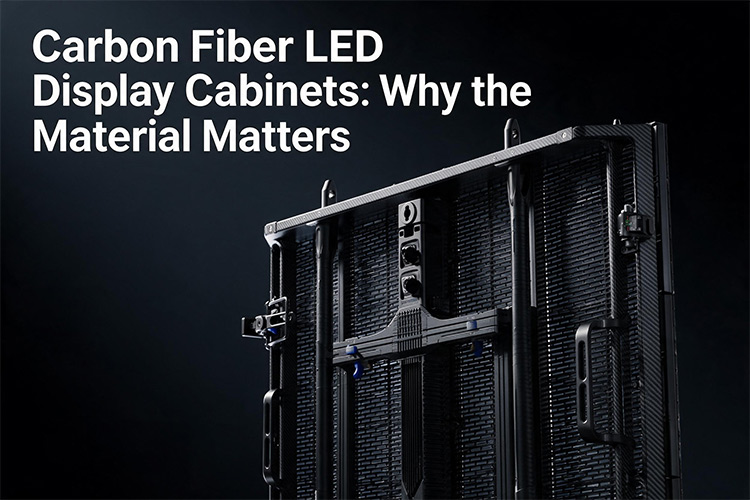
A Different Approach to the LED Cabinet
As LED displays continue to become larger, lighter, more mobile, and more visually integrated into their surroundings, cabinet design will become increasingly important. The next generation of LED display development will not be defined only by higher pixel density or brighter LEDs. The physical structure behind the display will also determine how efficiently that technology can be transported, installed, suspended, and deployed.
Carbon fiber offers one possible direction. Its value lies in the relationship between material properties and structural design: low density combined with high specific mechanical performance, directional reinforcement, controlled thermal behavior, and a construction approach that can be tailored to demanding applications. For rental and touring LED displays, this can translate into a lighter and more efficient physical system. For outdoor transparent LED and blow-through LED display applications, it can help engineers pursue the difficult balance between open architecture and structural performance.
MAir demonstrates how that material concept can be applied to a real professional LED cabinet. By combining a carbon-fiber structural frame with an industry-first seamless one-piece molded carbon fiber frame, a lightweight 19 kg cabinet, up to 47% transparency in its P7.8 configuration, IP65 protection, and outdoor installation capabilities, MAir brings carbon-fiber engineering into an LED display system designed for the demands of modern touring and outdoor production.
The broader lesson is straightforward: the cabinet material is not merely a construction choice. It is part of the performance of the display itself. When the right material is combined with the right structural design, reducing weight does not have to mean compromising the requirements of professional LED applications. Instead, it can become an opportunity to rethink how the entire display is designed, transported, installed, and used. And that is where carbon fiber becomes more than a material. It becomes an engineering advantage for the next generation of LED display cabinets.


+86-(0)731-84539619


Hunan Yestech Optoelectronic Co., Ltd. Terms of Service Privacy Policy Powered by szweb


