



ADDRESS
Blog/2026.09.08
As LED displays continue to grow in size, large-format LED screens have become a defining element of concerts, festivals, stadium productions, outdoor ceremonies, and large-scale commercial events. A screen covering several hundred square meters can create an extraordinary visual impact, but increasing screen size does more than add more cabinets. It fundamentally changes the engineering conditions that the display structure must withstand.
This is an important distinction for LED display manufacturers, rental companies, staging professionals, and system integrators. A small LED wall and a large LED wall may use the same basic display technology, yet their structural requirements can be very different. Once a display becomes larger, higher, wider, or more exposed to outdoor conditions, factors such as load distribution, connection forces, wind pressure, structural deformation, and support configuration become increasingly important. In other words, scaling an LED screen is not simply a matter of adding more LED cabinets. The larger the screen becomes, the more important it is to understand how the entire display behaves as a structural system.
The Structural Challenge Grows Faster Than Screen Area
At first glance, increasing the size of an LED display appears straightforward. If one cabinet forms part of a screen, adding more cabinets creates a larger screen. However, the structural behavior of the finished display is not simply the sum of individual cabinets. A larger LED screen creates a larger continuous surface. Its total self-weight increases as more cabinets, modules, power components, and structural accessories are added. At the same time, the screen occupies a greater area that can interact with external forces, particularly when it is installed outdoors. The resulting structural requirements therefore depend not only on the weight of the display itself, but also on how that weight and those external forces move through the entire system.
This becomes especially important when an LED wall is suspended above the ground. A screen installed several meters high does not experience the same structural conditions as one positioned close to the ground. As the suspended area increases, the supporting structure must accommodate the accumulated load while maintaining the required alignment and stability of the display. The connection points between cabinets, support beams, frames, and suspension systems consequently become part of one interconnected load path.
The concept of load path is fundamental to structural engineering. Every force acting on a structure needs a controlled route toward the supporting structure and ultimately to the ground or another suitable load-bearing point. In a large LED display, the load path may involve the cabinet frame, cabinet connections, support frames, hanging beams, suspension points, and ground-support elements. If any part of this system is poorly designed or inadequately matched to the scale of the screen, increasing the number of cabinets does not necessarily result in a stronger overall installation. This is why large LED display engineering must be considered at the system level rather than cabinet by cabinet. A cabinet can be mechanically robust on its own, but the performance of a large LED wall depends on how hundreds of individual components work together as one structure.
Larger LED Walls Create More Complex Load Conditions
One of the most important changes that occurs as an LED screen becomes larger is the distribution of load across the entire structure. In a small display, the forces involved may be relatively limited and easier to control. As the screen grows, however, the accumulated load must be transferred through a larger number of connections and support points. Consider a large outdoor LED wall suspended from a structural support system. The weight of the display acts downward, but the structural system must also account for forces that do not act vertically. Outdoor installations can be exposed to wind pressure, gusts, vibration, repeated loading, and changes in environmental conditions. These forces can act across the surface of the display and introduce additional stress into the cabinet connections and support structure.
Wind is particularly significant because an LED screen behaves differently from a small isolated object when its surface area becomes very large. A larger display presents a larger surface to the surrounding airflow. The resulting wind pressure must be transferred through the screen structure and into the supporting system. This means that simply increasing the number of cabinets can increase not only the total weight but also the structural demands created by environmental forces.
The geometry of the screen also matters. A very wide display may introduce different load-distribution characteristics from a tall display. A suspended wall, a ground-stacked wall, and a configuration integrated into a larger stage structure can each create different structural conditions. The location of support points, the span between them, and the stiffness of the frame all influence how forces are distributed throughout the display.
For this reason, large LED screen structural design should consider the relationship between the display area, support configuration, connection system, and environmental conditions. The objective is not simply to make individual components stronger. It is to create a controlled structural system in which loads are distributed efficiently and deformation remains within acceptable limits.
Structural Stiffness Matters as Much as Load Capacity
When discussing the structure of a large LED display, load-bearing capacity is often the first consideration. However, structural engineering involves more than determining how much weight a structure can carry. Stiffness and deformation control are equally important, particularly for a large, visually continuous LED wall. As the screen becomes larger, even small structural movements can become more noticeable across the overall display. A minor displacement at one location may appear insignificant when looking at a single cabinet, but the same displacement can become more visible when repeated across a wall spanning many meters.
This is particularly relevant to LED displays because the screen surface is made up of numerous precisely aligned cabinets and modules. The visual quality of the finished wall depends not only on pixel performance but also on the physical relationship between adjacent sections. Excessive movement, uneven loading, or structural deformation can affect the consistency of the overall display and place additional stress on mechanical connections.
Structural stiffness therefore becomes an important design parameter. A sufficiently rigid system can better control movement and maintain the intended geometry of the screen under operating conditions. This is one reason why large-format LED display engineering requires more than simply increasing material thickness or adding reinforcement wherever possible. Engineers must consider where forces enter the system, where they travel, and how the structure responds as a whole.
Material selection also plays a role. Different materials offer different combinations of strength, stiffness, weight, corrosion resistance, and manufacturing precision. For rental LED displays used repeatedly in demanding environments, the structural material must also withstand handling, assembly, disassembly, transportation, and environmental exposure over the product's service life. The result is a multidimensional engineering problem. A high-quality large LED display structure must balance mechanical strength, rigidity, durability, connection performance, weight, and practical usability rather than optimizing only one parameter.
Why System-Level Structural Design Becomes Essential at Large Scale
Once an LED screen reaches a significant physical scale, the distinction between a cabinet and a screen system becomes increasingly important.
A cabinet is one component of the installation. The finished LED wall is the system. Its structural performance is determined by the interaction between cabinets, frames, connectors, support structures, suspension points, and environmental forces. This system-level perspective becomes especially important for rental applications. Rental LED displays may be assembled in different configurations from project to project. One event may require a ground-stacked wall, while another may require a large suspended screen. The same product may therefore encounter different load paths and different environmental conditions throughout its working life.
A structural system designed specifically for large-format applications needs to accommodate these realities. It should provide a defined way for loads to move through the display and into the supporting structure, while maintaining sufficient stability under expected operating conditions.
This is also why structural reinforcement should not be viewed as an isolated feature. A reinforced frame, for example, has limited value if the connection between the frame and the supporting structure cannot effectively transfer the applied forces. Likewise, a strong cabinet alone does not automatically create a structurally optimized LED wall.
The engineering objective is to create continuity between the different structural elements. The cabinet, connection mechanism, support frame, and suspension or stacking system must function together. As the display grows, this integrated approach becomes increasingly important because the consequences of uneven load distribution or uncontrolled movement can become more significant.
For professional LED display projects, this means structural design should be evaluated according to the intended scale and application rather than by looking at individual specifications in isolation. Questions such as How large is the screen? How is it supported? How high is it installed? What environmental forces will it encounter? Where are the primary load paths? are all part of the engineering assessment.
How MEGA Addresses the Structural Demands of Large-Format LED Displays
The structural requirements of a large LED screen are ultimately determined by how well its physical architecture responds to real-world loads. This principle is reflected in the design of the YES TECH MEGA Series, which was developed specifically for large-scale outdoor LED display applications.
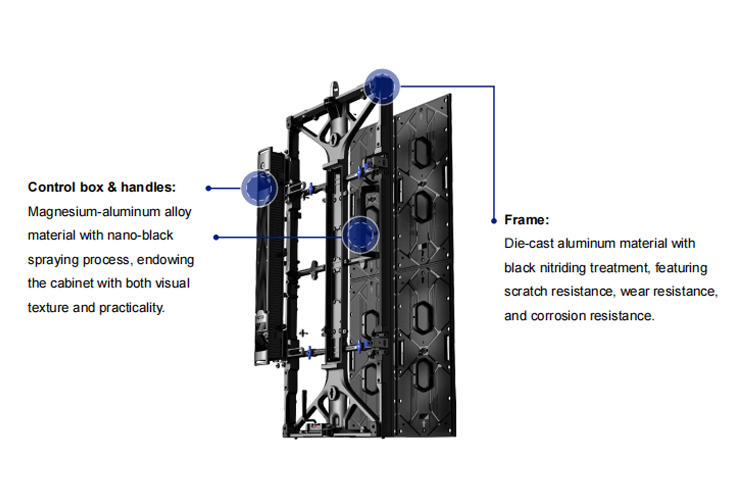
MEGA uses a central load-bearing design to address the structural demands of large rental configurations. Rather than treating the cabinet as an isolated visual panel, the design focuses on how loads are carried through the overall screen structure. The system supports hanging installations of up to 25 meters, demonstrating its focus on large-format applications where structural stability becomes a critical engineering consideration.
The system also incorporates a reinforced wind bracing system designed to resist wind pressure and enhance overall stability. This is particularly relevant for large outdoor LED walls, where increasing display area can significantly increase exposure to environmental forces. By incorporating wind bracing into the structural system, MEGA is designed to provide a more stable framework for large-scale installations rather than relying solely on the individual cabinet structure.
Material engineering further supports this structural approach. The MEGA frame uses die-cast aluminum with black nitriding treatment, providing resistance to scratches, wear, and corrosion while maintaining the mechanical characteristics required for professional rental applications. The control box and handles use magnesium-aluminum alloy with a nano-black spraying process, combining a refined surface finish with practical durability for repeated professional use.
The MEGA cabinet measures 500 × 1000 × 86 mm, providing a large-format configuration for outdoor rental applications. Its structural architecture is complemented by a universal hanging and stacking system, allowing the display to be configured according to different large-scale installation requirements. What makes this approach significant is that the structural design is not based on a single reinforcement feature. It combines material engineering, load-bearing architecture, wind resistance, and support-system design into one structural concept. This reflects a broader principle in large LED display engineering: as the screen becomes larger, structural performance must be designed as a system rather than treated as a collection of individual cabinets.
Scaling an LED Screen Requires Scaling Its Engineering
The growth of large-format LED displays is creating new possibilities for event production, but larger visual surfaces also introduce more demanding engineering requirements. Increasing the number of cabinets increases more than the pixel area. It changes the weight distribution, load paths, wind exposure, connection forces, structural stiffness, and requirements placed on the supporting system.
For this reason, selecting a large LED screen should involve more than comparing pixel pitch, brightness, refresh rate, or cabinet dimensions. Structural architecture is equally important, particularly for suspended and outdoor applications where the display must operate as part of a larger engineered system. A well-designed large LED display should therefore be evaluated from the inside out: how materials contribute to structural performance, how loads are transferred, how the display responds to environmental forces, and how the cabinet structure interacts with its supporting system.
The YES TECH MEGA Series takes this system-level approach to large-format LED display design. Its central load-bearing architecture, reinforced wind bracing system, durable die-cast aluminum frame, and magnesium-aluminum alloy components are engineered around the demands of large-scale rental applications. When an LED screen grows from a wall into a large-scale structure, its engineering must grow with it. MEGA is built around that principle—delivering the structural foundation required for large-format LED displays where scale, stability, and outdoor performance matter.


+86-(0)731-84539619


Hunan Yestech Optoelectronic Co., Ltd. Terms of Service Privacy Policy Powered by szweb


