



ADDRESS
Blog/2026.09.02
Not every LED display designed for outdoor use is necessarily ready for outdoor rental. The distinction is important because a fixed outdoor LED display and a rental LED display operate under very different conditions. A fixed installation may be transported once, installed in a predetermined location, and remain there for years. An outdoor rental LED display, by contrast, can move from one venue to another, be assembled and dismantled repeatedly, operate under changing environmental conditions, and then return to storage before being deployed again for the next event. This means choosing an LED display for outdoor events requires more than checking brightness, pixel pitch, or IP rating. A truly rental-ready outdoor LED screen needs to perform reliably throughout the entire rental lifecycle, from transportation and installation to operation, dismantling, maintenance, and redeployment.
Outdoor LED Display Performance Starts With the Environment
The first requirement for any outdoor LED display is the ability to maintain stable performance under changing environmental conditions. Outdoor events expose an LED screen to rain, dust, sunlight, temperature fluctuations, and other environmental variables that are largely absent from controlled indoor venues. However, weather protection should be viewed as a foundation rather than the complete definition of outdoor readiness. When evaluating an outdoor rental LED screen, protection against water and dust is important, but it is only one part of the equation. The display also needs to maintain consistent visual performance when ambient light changes dramatically throughout the day. A screen used for a daytime festival may face intense sunlight for several hours before continuing into an evening concert, when the surrounding environment becomes much darker. The requirements for image visibility, brightness, contrast, grayscale performance, calibration, and content reproduction therefore change over the course of a single event.
A professional outdoor rental LED display should be evaluated as a complete visual system rather than by one specification. Brightness determines whether content remains visible under strong ambient light, while contrast and image processing influence how clearly that content is perceived. At the same time, appropriate environmental protection helps maintain stable operation in outdoor conditions. An IP rating is an important reference for outdoor LED applications, but it should not be treated as the sole indicator of suitability. Rental screens also experience repeated handling and temporary installations, so the durability of cabinets, connectors, modules, and structural interfaces becomes part of long-term reliability. In other words, outdoor readiness is not defined by weather resistance alone; it is the combination of environmental protection, visual performance, and operational durability.
Outdoor Rental Is a Different Operating Model
The biggest difference between a fixed installation and a rental LED display is not where the screen is used, but how often the screen is used. A fixed LED display typically follows a relatively simple lifecycle: installation, operation, and long-term service. A professional rental LED display follows a much more demanding cycle: Storage → Transportation → Setup → Operation → Dismantling → Transportation → Maintenance → Redeployment. Every stage introduces opportunities for wear, damage, or operational inefficiency. This is why an LED display for rental companies has to be engineered for repeated use. An LED cabinet is not simply a structure that holds LED modules; it is a component that will be handled by technicians, moved between locations, connected and disconnected repeatedly, and exposed to the physical demands of live-event production. For rental companies, this has direct business implications.
A screen that performs well during a single event but requires excessive maintenance or suffers from frequent handling-related issues can create hidden operating costs. Transportation, labor, replacement components, troubleshooting, and downtime all affect the real cost of ownership of an LED video wall. A better way to evaluate a rental LED screen for live events is therefore to ask a broader question: how reliably can the product perform across repeated rental cycles? This shifts the focus from the initial installation to long-term fleet efficiency. The value of a professional outdoor rental LED display is not simply that it works on stage; its value comes from its ability to keep working project after project.
The LED Cabinet Is Part of the Rental System
For an outdoor rental LED display, cabinet design has a broader role than simply defining the physical size of the screen. The LED display cabinet is where the visual system, structural system, and rental workflow meet. Cabinet construction affects how a display is transported, handled, assembled, configured, serviced, and stored. A cabinet that is difficult to handle can place greater demands on the crew. A cabinet that is difficult to configure can limit stage design. A cabinet that is difficult to service can increase downtime. This is why professional rental LED display manufacturers increasingly treat the cabinet as an integrated system rather than a passive enclosure.
Modularity is especially important because outdoor rental projects rarely have exactly the same requirements. One production may require a large rectangular LED video wall, while another may use several smaller surfaces or different screen proportions. A modular rental LED display should therefore provide enough flexibility to adapt to different event formats without forcing the production team to redesign the entire structure around the screen. Different cabinet formats can support different screen proportions and installation requirements, while modular connection systems can allow the same LED display fleet to be reused across a broader range of applications. For rental companies, that flexibility can improve asset utilization because the same inventory can serve concerts, festivals, sporting events, corporate events, touring productions, exhibitions, and other temporary installations. The underlying principle is simple: a rental LED display should adapt to the production rather than forcing the production to adapt to the display.
Reliability Matters Beyond the Moment the Screen Turns On
In live events, reliability is often discussed in terms of whether the display operates during the show. For rental applications, that definition is too narrow. Reliability begins before the screen reaches the venue and continues after the event ends. A cabinet may be transported in a road case or truck, moved through a venue, installed in a temporary structure, operated for many hours, dismantled immediately after the event, and then prepared for another project. A design that performs reliably through this complete process is much more valuable than one optimized only for the operating phase. This makes mechanical durability an important consideration when choosing a rental LED display for outdoor events. Repeated assembly and dismantling place stress on physical connections, cabinet interfaces, handles, locks, connectors, and other components. Over time, these details can have a significant effect on fleet reliability.
For professional rental companies, consistency is particularly important. The goal is not simply to achieve excellent performance on one project, but to maintain predictable performance across many projects with different crews, venues, environmental conditions, and installation configurations. That is also why quality control and manufacturing consistency matter. A rental LED fleet may contain dozens or hundreds of cabinets, and uneven mechanical or visual performance can make deployment more complicated. A professional outdoor rental LED display needs to function as a repeatable system, not simply as a collection of individual cabinets.
Serviceability Is Part of Performance
Another important factor is serviceability. A rental LED display rarely has the luxury of extended downtime. If a fixed outdoor LED display develops a problem, a technician may be able to schedule a service visit without affecting another project. Rental equipment works on a much tighter schedule. An outdoor LED screen may be required at another venue shortly after the current event, meaning troubleshooting, component replacement, and testing need to happen efficiently. This makes accessibility an important part of LED display design. Maintenance should not be treated as something separate from performance. In rental applications, maintainability directly affects uptime.
Buyers should therefore consider how easily LED modules, power components, data connections, and other serviceable parts can be inspected, replaced, or tested. The simpler it is to identify and resolve an issue, the easier it is for a rental company to keep its inventory available for the next project. A professional rental LED display therefore needs to balance three requirements: performance during operation, durability during handling, and serviceability after repeated use. This is particularly important for an LED display for rental companies, because equipment generates value only when it is available for deployment.
Configuration Flexibility Matters on Temporary Stages
An outdoor LED screen used for rental applications also needs to work with a wide range of stage structures and event formats. Unlike a fixed commercial installation, a rental LED display rarely has one permanent position or one predefined screen size. It may become the main LED video wall at a festival, a side screen at a concert, part of a corporate event backdrop, or a modular display within a touring production. Each application can require a different aspect ratio, screen dimension, orientation, or structural arrangement. This makes configuration flexibility an important part of outdoor rental readiness.
A professional LED rental display should provide a modular platform that can be adapted to different production requirements without sacrificing consistency across the fleet. For event production companies, this flexibility can be particularly valuable because it allows one product family to cover a wider range of jobs. The objective is not to build one screen for one venue; it is to build a rental asset that can repeatedly adapt to different venues. In this sense, flexibility is not simply a creative feature. It is also an operational and commercial advantage.
What Should You Look for in an Outdoor Rental LED Display?
There is no single specification that determines whether an LED display is ready for outdoor rental. A more useful evaluation considers the complete application. First, assess outdoor protection: can the display handle the environmental conditions expected at the event site? Second, evaluate image performance: can the outdoor LED display deliver clear and consistent content under changing ambient light? Third, consider rental durability: can the LED cabinet withstand repeated transportation, handling, installation, dismantling, and redeployment? Fourth, examine configuration flexibility: can the display adapt to different screen sizes, layouts, stage structures, and event formats? Finally, consider serviceability and lifecycle efficiency: can technicians maintain the equipment efficiently, and can the rental company keep the inventory productive between projects? These criteria provide a more complete framework than comparing pixel pitch or purchase price alone. For a rental business, the best professional rental LED display is not necessarily the one with the longest specification list. It is the one that combines reliable visual performance with a design that fits the realities of repeated rental operations.
Why MU Works as a Rental LED Display for Outdoor Events
When these requirements are considered as a complete workflow, the importance of a rental-focused LED display becomes clearer. MU is designed around the practical requirements of professional LED rental applications, where the screen may need to move between venues, accommodate different stage configurations, and remain ready for repeated deployment. As a professional rental LED display, MU uses a modular cabinet platform with both 500×500 mm and 500×1000 mm formats. This gives rental companies greater flexibility when building different screen sizes and layouts from the same product family. For productions ranging from concerts and festivals to corporate events, touring shows, and temporary outdoor installations, this modular approach allows the same rental LED display platform to serve different production requirements.
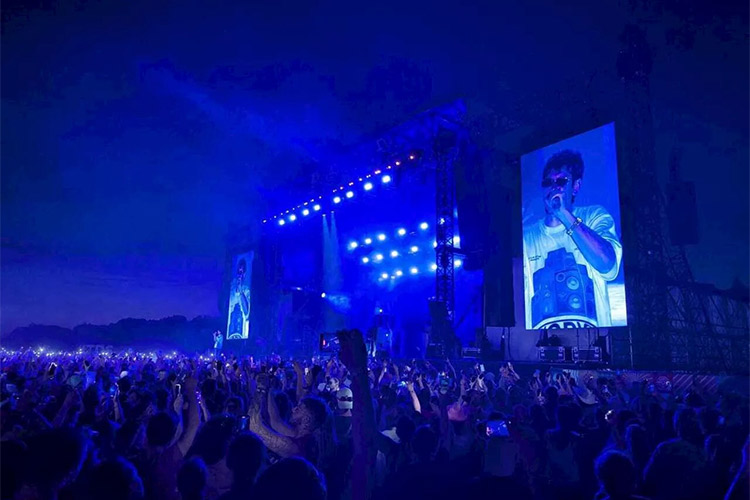
For companies looking for an outdoor rental LED screen, cabinet design is particularly important because the equipment has to function as part of a much larger operational system. MU uses a die-cast aluminum cabinet, with the 500×500 mm cabinet weighing approximately 7.6 kg and the 500×1000 mm version approximately 12.6 kg. Rather than viewing these figures simply as weight specifications, they can be considered in the context of handling, transportation, configuration, and repeated deployment. The two cabinet formats also make MU a flexible modular rental LED display for productions where screen dimensions and configurations change from one event to another. This can be useful for LED rental displays for concerts and festivals, live events, touring productions, and temporary installations where the screen needs to adapt to the production instead of being tied to one fixed layout.
More broadly, MU is intended to function as a rental LED screen for live events, not simply as an outdoor display temporarily placed at an event site. Its modular cabinet platform and rental-oriented construction are designed around the repeated-use nature of professional rental equipment. This makes MU relevant to rental companies that need an LED display for outdoor events capable of supporting different project requirements while remaining part of a consistent rental workflow. The goal is not simply to deliver a screen that performs outdoors once. It is to provide a rental LED display that can move efficiently through the full lifecycle of professional event production, from inventory and transportation to deployment, operation, maintenance, and the next project.
The Real Definition of an Outdoor Rental-Ready LED Display
The phrase “outdoor LED display” can describe many different products, but outdoor rental LED display implies a broader standard of operational readiness. A rental screen needs to withstand changing environmental conditions, maintain visual performance, support different configurations, tolerate repeated handling, and remain serviceable throughout a demanding lifecycle. Its success cannot be measured only by how bright or impressive the screen looks on the first day of an event. A more meaningful question is whether the rental LED display can deliver consistent performance across the tenth project, the fiftieth project, and the next deployment after that.
That is what makes an LED display truly ready for outdoor rental. For rental companies, the right investment is therefore not simply an outdoor LED screen that can operate under outdoor conditions. It is a professional rental LED display engineered around the realities of repeated use—one that can adapt to different productions, maintain reliable image performance, integrate into the rental workflow, and remain productive throughout its working lifecycle.
Outdoor rental is not simply outdoor installation made temporary. It is a different operating model. And the LED display needs to be designed for that model from the beginning.


+86-(0)731-84539619


Hunan Yestech Optoelectronic Co., Ltd. Terms of Service Privacy Policy Powered by szweb


