



ADDRESS
Blog/2026.09.08
Transparent LED screens have changed the way LED displays are used in modern stage production. Instead of creating a solid digital wall, a transparent LED display allows lighting, performers, scenery, architecture, and other visual elements to remain visible behind the screen. This makes transparent LED technology particularly valuable for concerts, festivals, live events, corporate productions, and creative stage design.
However, transparency creates an important engineering challenge. The more open a screen structure becomes, the less physical material there is between the audience and the background. For a professional rental LED screen, that does not mean structural requirements become less important. In many applications, they become more demanding.
A transparent LED screen still needs to support its own weight, withstand repeated installation and dismantling, maintain alignment across multiple cabinets, and remain stable when installed at significant heights. For large-scale stage applications, the structural design of the LED display can directly affect installation efficiency, screen reliability, and the range of stage configurations that production teams can achieve.
This is where YES TECH MT II takes a different approach. Designed as an upgraded transparent rental LED screen platform, MT II combines a high-transparency display structure with a magnesium-alloy hollow dual-frame design. The result is a transparent LED display that does not treat structural strength and visual openness as competing priorities. Instead, its structure is designed to support both.
Why Structural Design Matters in a Transparent LED Screen
A conventional LED video wall is relatively straightforward from a structural perspective. Its cabinets form a largely solid surface, and the frame provides a continuous structural perimeter around the display. A transparent LED screen has a fundamentally different architecture. Its open design is essential to achieving transparency, but it also means that structural components must be carefully positioned and engineered without unnecessarily obstructing the visual field.
This creates a key design principle: a transparent LED screen needs structural efficiency, not simply less structure. For rental and staging applications, this distinction matters even more. An LED display used for touring productions may be assembled, transported, installed, dismantled, and reconfigured repeatedly. A stage LED screen may also need to be suspended above the stage rather than simply placed on the ground. As screen size and installation height increase, the structural requirements become increasingly important.
The frame therefore has to perform several functions at the same time. It needs to maintain cabinet rigidity, provide reliable connection points, support the weight of the LED display, maintain consistent cabinet alignment, and accommodate the mechanical forces created during installation. At the same time, it should preserve as much of the screen's open area as possible.
This is particularly important for transparent LED displays because the structure itself becomes part of the visual experience. Excessive framing can reduce the perceived openness of the screen, while insufficient structural support can limit where and how the display can be installed. A well-engineered transparent LED screen therefore does not simply maximize transparency. It balances transparency, structural strength, installation flexibility, and operational reliability.
How MT II Balances Transparency and Structural Strength
The MT II series addresses this challenge through a magnesium-alloy hollow dual-frame structure. According to YES TECH, the design is intended to provide both high transparency and strong load-bearing capability, while reinforcing ribs within the structure increase its overall strength. The concept is important because the structural frame does not need to become a solid visual barrier in order to provide mechanical stability. Instead, the hollow dual-frame architecture creates a more efficient structural path while leaving more of the screen visually open.
MT II offers at least 50% transparency, allowing stage elements and lighting effects behind the LED display to remain part of the overall visual composition. This is especially useful when the LED screen is being used as more than a conventional backdrop. Designers can place the display in front of physical scenery, performers, lighting fixtures, or architectural elements without completely blocking them from view. At the same time, the magnesium-alloy structure is designed for the demands of rental and staging applications. The combination of a lightweight material and reinforced structural architecture helps the LED display maintain a practical balance between handling and mechanical performance.
This balance is one of the most important considerations when evaluating a transparent LED screen. A screen that is highly transparent but structurally restrictive may look impressive in a specification sheet but provide limited value in real production environments. Conversely, a screen with a very heavy structural frame may offer strength but compromise transparency, transportation, installation speed, and stage aesthetics. MT II is designed around the idea that these requirements should be addressed together.
Why Hanging Height Changes the Structural Requirements
One of the clearest examples of why structural engineering matters is suspended installation. A transparent LED display installed at ground level is subject to a different set of mechanical considerations from one suspended above a stage. Once an LED screen is hung vertically, the load is transferred through the cabinet connections and suspension system. As the screen becomes larger or is installed higher, the structural design of the cabinet and its connection points becomes increasingly important.
MT II is designed to support hanging installations up to 20 meters, making it suitable for large-scale stage environments where a transparent LED screen needs to become part of an elevated scenic structure. The significance of a 20-meter hanging capability is not simply the number itself. It expands the range of stage designs in which a transparent LED display can be used. A screen can become a large suspended visual layer above or behind performers, form part of a multi-level stage, or contribute to the vertical scale of a festival or concert production.
For production teams, this also highlights an important distinction between a transparent LED screen designed for staging and a transparent display designed primarily for architectural or commercial applications. A professional rental LED screen has to consider not only image quality and transparency but also the mechanical demands of temporary installation, repeated handling, and complex stage configurations. MT II's hollow dual-frame structure is specifically designed to support this type of application while retaining the visual openness expected from a transparent LED display.
Structural Strength Is Also About Installation Reliability
Structural design does not only determine whether an LED display can carry a load. It also influences how easily the screen can be installed and how consistently multiple cabinets can be assembled into a larger LED video wall. For rental productions, installation time has a direct impact on operating efficiency. Crews often work within tight schedules, and a screen may need to be assembled and dismantled within a limited production window. Every additional mechanical step can increase labor requirements and the possibility of installation errors.
MT II uses an integrated quick-lock system and a large handle designed to make installation and disassembly easier for a single operator. The system supports multiple configurations, including curved LED screens with ±15° adjustment, 90-degree corner configurations, and staggered cabinet splicing.
These features demonstrate why the structural system of a rental LED screen should be evaluated together with its installation system. A strong frame that is difficult to assemble does not necessarily create an efficient rental product. The goal is to combine structural integrity with practical handling. For touring and live-event applications, this becomes especially valuable. A transparent LED display may be used as a flat wall for one production, a curved stage element for another, and a three-dimensional scenic structure for a third. The cabinet and connection system therefore need to accommodate changes in configuration without requiring completely different hardware for every application. MT II is built around this modular approach, allowing the same LED display platform to be adapted to different stage geometries.
Why Lightweight Construction Still Matters
Structural strength and lightweight construction are sometimes treated as opposing concepts. In professional LED display design, however, the goal is not simply to make a cabinet as strong as possible. The goal is to achieve the required structural performance with an efficient material and frame architecture. This matters because every kilogram affects the practical side of a rental LED screen. Heavier cabinets can increase transportation requirements, handling effort, installation labor, and the structural demands placed on supporting systems.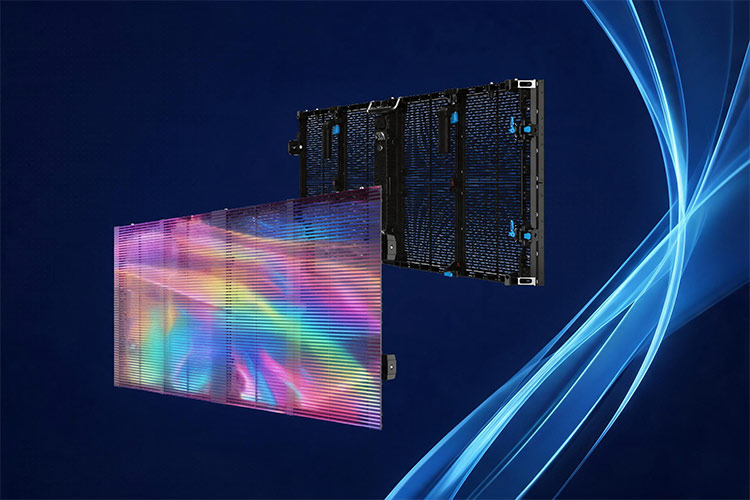
MT II uses magnesium alloy for its frame, while the hollow dual-frame structure is designed to provide structural reinforcement without turning the transparent LED screen into a heavy solid structure. The standard cabinet formats include 1000 × 500 × 83 mm and 500 × 500 × 83 mm, providing both a larger primary cabinet and a half-size format for more flexible screen layouts. This is particularly useful for stage applications where screen dimensions and geometry can change from project to project. Larger cabinets can help speed up the construction of a large LED video wall, while smaller cabinets can provide greater flexibility when working around corners, scenic elements, or irregular stage structures. The point is not simply that a transparent LED screen should be lightweight. It is that its weight, structure, cabinet size, and installation system should be engineered as one system.
Transparency Is Only One Part of a Professional LED Display
When comparing transparent LED screens, transparency is often one of the first specifications buyers look at. It is certainly important, but it should not be considered in isolation. A professional transparent LED display needs to deliver visual performance as well as mechanical performance. MT II supports a 7680Hz refresh rate, consistent color performance, and optional brightness up to 4500 nits, depending on configuration. It is also rated IP65 and designed for indoor and outdoor applications. These specifications allow the same transparent LED screen platform to address a wider range of event environments, from indoor productions to outdoor festivals and large-scale live events.
The high refresh rate is particularly relevant for stage production and camera-facing applications, where LED screens may appear on broadcast or event cameras. Meanwhile, the available high-brightness configuration provides the luminance needed for outdoor environments where ambient light can significantly affect screen visibility. This is why the evaluation of a transparent LED display should move beyond a single question such as “How transparent is it?” A more useful evaluation asks: How well does the screen balance transparency, image quality, structural performance, installation efficiency, and environmental protection? That broader perspective is more relevant to rental companies, staging professionals, and production teams because these are the factors that determine whether an LED display can perform reliably in real-world applications.
One Transparent LED Screen, More Stage Possibilities
Another structural advantage of MT II is that the same platform can support both hanging and stacking installation. YES TECH specifies that the same beam can be used for both configurations, helping reduce equipment requirements and simplify setup. This is a practical consideration for LED rental companies. A rental inventory becomes more valuable when one LED display platform can serve multiple production scenarios rather than being limited to a single installation method.
For example, a transparent LED screen can be used as a suspended backdrop for a concert, a stacked screen for a lower stage structure, a curved visual element, or a 90-degree corner display. When the same cabinet system can accommodate these different configurations, production teams gain more flexibility without necessarily expanding their inventory of specialized accessories. The result is a more versatile rental LED screen system, rather than simply another transparent LED panel.
This versatility also changes the role of the transparent LED display in stage design. Instead of treating the screen as a flat rectangular surface, designers can use it as a spatial element. It can define the boundaries of a stage while allowing light to pass through, create depth between different scenic layers, or follow the geometry of a curved or angular structure. That is where structural engineering directly contributes to creative freedom.
What to Look for When Choosing a Transparent LED Screen
For event producers, rental companies, and stage designers, choosing a transparent LED screen should involve more than comparing pixel pitch and transparency percentages. The structural system deserves equal attention. First, consider how the frame is designed. Does it provide sufficient rigidity while maintaining the visual openness expected from a transparent LED display? Second, examine the supported installation methods. Can the screen be safely stacked and suspended? Is the connection system designed for fast deployment and repeated use? Third, consider whether the cabinet can adapt to creative stage geometries, including curves, corners, and staggered configurations.
Environmental protection is another important consideration for outdoor productions. An IP65-rated LED display can provide protection against dust and water ingress, which is particularly relevant for temporary outdoor events. Image performance should also be evaluated according to the intended environment, including brightness and refresh rate. Finally, consider the total workflow rather than the cabinet alone. A transparent LED screen is part of a larger production system that includes transportation, rigging, installation, configuration, operation, and dismantling. The best design is one that performs reliably across that entire workflow.
A Strong Transparent LED Screen Starts With the Right Structural Balance
Transparency and structural strength are not mutually exclusive goals. In a professionally engineered LED display, they should support each other. A transparent LED screen needs an open visual structure to create its signature see-through effect, but it also needs a reliable mechanical framework to perform in demanding rental and staging environments. The challenge is therefore not simply to remove material and increase transparency. It is to develop a structural architecture that provides strength where it is needed while preserving openness where it matters visually.
The YES TECH MT II series approaches this challenge with a magnesium-alloy hollow dual-frame structure, at least 50% transparency, support for hanging installations up to 20 meters, and a modular quick-lock system designed for different stage configurations. Combined with a 7680Hz refresh rate, IP65 protection, optional brightness up to 4500 nits, and both hanging and stacking installation options, MT II is designed as a complete transparent rental LED display solution rather than simply a transparent LED panel. For modern stage production, that distinction matters. The value of a transparent LED display is not determined by transparency alone. It comes from how effectively the screen combines visual openness, structural reliability, installation flexibility, and professional LED performance.
Ultimately, the strongest transparent LED screen is not the one that simply has the least visible structure. It is the one that provides enough structural performance to expand what production teams can safely and efficiently build—without compromising the visual freedom that makes transparent LED technology so compelling. For projects that require a transparent LED screen for touring, concerts, festivals, or large-scale stage installations, MT II offers a practical balance between transparency and structural performance, giving designers more freedom to turn an LED display into an integral part of the stage itself.


+86-(0)731-84539619


Hunan Yestech Optoelectronic Co., Ltd. Terms of Service Privacy Policy Powered by szweb


