



ADDRESS
Blog/2026.04.29
Ask any rental operator—especially those handling large-scale touring walls—what determines whether a project turns a profit, and the answer rarely starts with pixel pitch or brightness. It starts with efficiency: the time between a truck leaving the warehouse and a screen going live on stage, the crew required to assemble a wall before doors open, and the turnaround window between events.
Image quality across mid-to-high-end rental LED displays has largely converged. What still varies widely is how a screen performs throughout its operational life-cycle: how quickly it ships, how quickly it can be installed, and how many times it can be deployed per year before components wear out. This is the part of the business that doesn’t show up on spec sheets—and increasingly, it’s what separates profitable operators from struggling ones.
Cabinet-Level Efficiency as the Foundation of Touring ROI
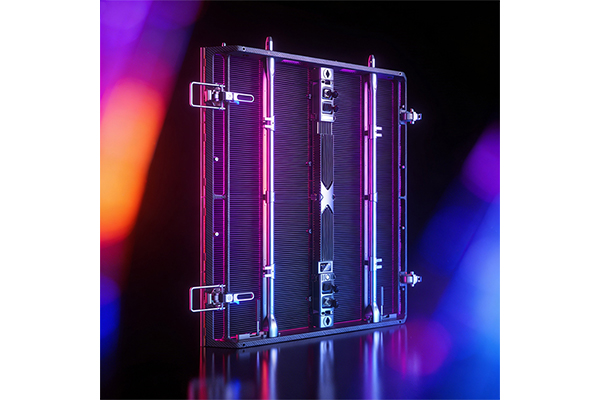
For large installations—often requiring over 1,000 sqm of video wall—smaller cabinet sizes like 500×500 mm can slow down deployment due to the sheer number of units required. While many operators turn to 1×1 m or 1×0.5 m panels to improve efficiency, MAir takes it further with a 1×1 m transparent cabinet, reducing installation time by roughly 4 times compared to smaller panels. In addition to the larger cabinet size, MAir’s features bigger 500×250 mm modules, which not only provide greater efficiency but also is also left-right interchangeable, eliminating the need to check orientation during installation.
However, size alone is not enough. MAir increases cabinet dimensions without a proportional increase in weight. For a 1 sqm area, it is significantly lighter than four traditional 500×500 cabinets. This is made possible by its carbon fiber frame—a pioneering approach in the industry. Carbon fiber is well known for its exceptional strength-to-weight ratio, enabling a lightweight structure without compromising durability.
Transport Optimization: Reducing Time Between Warehouse and Stage
Since touring carts are commonly used for transporting large quantities of LED display panels, and loading and unloading time is a significant factor, MAir introduces a smarter design with dedicated transport carts that hold 6 cabinets each and can be stacked. This is also where the weight reduction from the carbon fiber frame starts to pay off in practice.
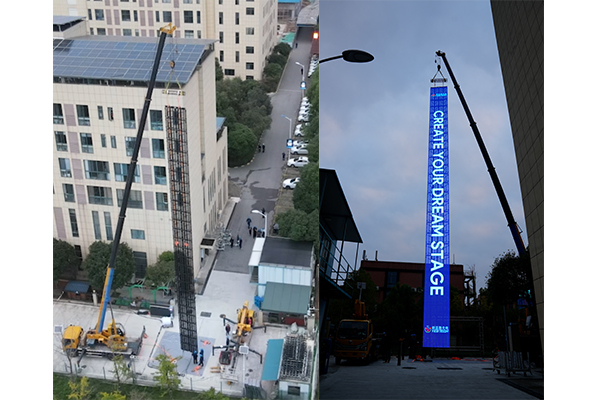
The carts can be connected and are equipped with bottom pin locks. This means you can position the carts on site—whether across 10 m or 20 m—then release the pin locks to connect them. You then simply secure one row of cabinets to the hanging beam, without needing to lift each cabinet individually. Row by row, a massive 10×20 m or even 20×20 m screen can be built. Recent hanging tests have demonstrated stable performance at heights of up to 28 meters. Just imagine how a 28 m high video wall can deliver outstanding visual quality to tens of thousands of audience members.
Installation Speed and Structural Stability in High-Risk Touring Environments
Large-scale rental projects often operate within load-in windows measured in hours. Every design decision in the cabinet—how modules align, how locks engage, and whether a single worker can handle a unit or requires assistance—directly translates into crew hours and schedule risk.
YES TECH’s MAir is designed for both efficiency and stability in installation. Instead of using 1 or 3 top pins for cabinet splicing in the industry, it uses 2 large positioning pins on the top, deployed directly into the cabinet’s metal support structure. This ensures even pressure distribution and delivers greater stability in outdoor conditions. Paired with an air-frame structure on the back, the system can withstand wind speeds of up to 20 m/s. MAir also features a pre-hanging function that holds each cabinet in place before locking, thanks to its magnetic top design. In addition, the patented quick-lock system on both sides enables installation to be completed in seconds.
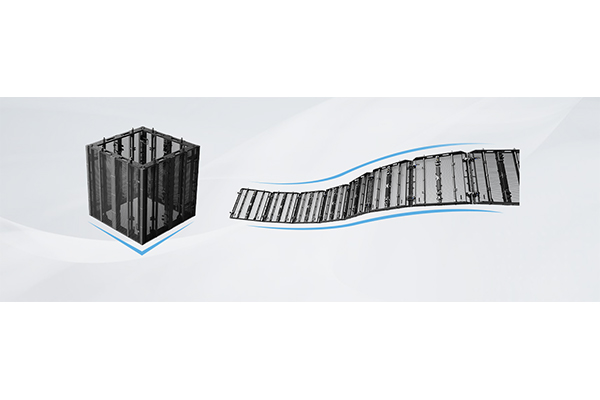
Beyond speed, MAir expands creative possibilities in concert stage design, where non-rectangular screen shapes are increasingly in demand. It supports joins at ±15° for curved surfaces and 90° for right-angle structures. What once required custom fabrication—such as square columns, cylindrical screens, or freeform stage elements—can now be built using standard stock.
Why Rental LED Must Be Designed as a Unified Operational System
Taken individually, each of the design choices discussed so far produces a measurable but modest efficiency gain. A lighter cabinet, a faster lock, a quick-release brace, a transport cart sized to the fleet — in isolation, none of these would justify rebuilding an operational workflow around a new product.
The meaningful gain comes from integration. Efficiency bottlenecks in rental operations rarely sit inside a single stage; they sit in the transitions between stages — a cabinet waiting for rigging after coming off the truck, bracing starting only after assembly wraps, a failed module identified faster than it can be swapped. When transport, rigging, assembly, and maintenance are treated as separate problems, these transitions absorb the savings each stage produced on its own.
This is the gap YES TECH set out to close with MAir. Rather than optimizing a cabinet and leaving the surrounding workflow to operators, this rental LED display was developed as a full rental solution — cabinet, transport cart, locking mechanism, bracing, and maintenance workflow designed against one another from the outset.
For operators running high-frequency projects in large-scale venues, that system-level coherence is where MAir's operational value actually sits, and it is the basis on which YES TECH positions the product against conventional rental offerings.
MAir in the Field: Carpe Nox 2026, Albufeira
At Carpe Nox 2026 in Albufeira, MAir was deployed in a large-scale New Year’s Eve production, catering to a high-density audience in Portugal. The system featured a wide rectangular LED gateway that seamlessly integrated into the main stage architecture, serving as both a striking visual focal point and a broadcast-ready display. Operating in a challenging nighttime environment, MAir delivered high-resolution visuals with a 7680Hz refresh rate, ensuring smooth live broadcast capture and precise synchronization of countdown content. The system's advanced design and performance helped maintain clarity even during dynamic lighting changes and intense stage effects.
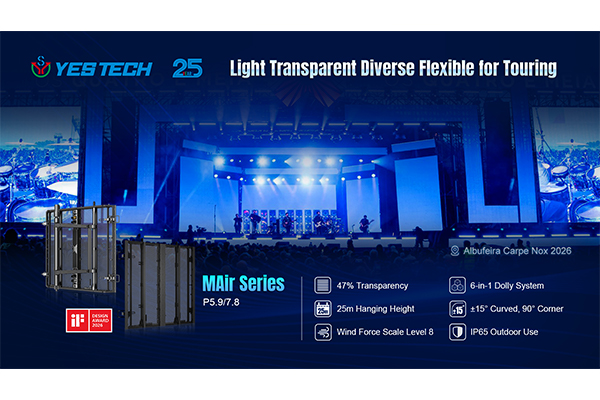
Additionally, MAir’s structural innovation significantly reduced rigging load, allowing for faster setup and teardown. The integrated transport carts played a critical role in enabling fast pre-rig staging, streamlining the load-in process, and reducing on-site congestion during high-pressure hours. This deployment marked MAir’s debut on a major event stage, and it exceeded expectations, showcasing the system’s reliability and efficiency in a real-world touring environment. Its flawless performance confirmed its ability to handle complex, large-scale live productions with ease.
In large-scale rental, profitability is not built on individual rental fees but on how many times a fleet can complete the cycle from warehouse to stage within a given year. Every design choice that shortens loading time, cuts crew hours, reduces cabinet wear, or simplifies on-site troubleshooting feeds directly into that turnover rate — and, ultimately, into margin.
This is the underlying logic that MAir is built around. From its carbon fiber integrated frame to its dedicated transport cart, single-handed curved lock, and quick-release bracing, the rental LED product is engineered less as a display and more as an operational system for high-frequency, high-end deployment. For operators serving large-scale performances, that system-level approach is what makes MAir a practical answer to the efficiency pressures the rental market now faces.
To discuss how MAir fits into your specific project requirements or fleet planning, get in touch with YES TECH today!


+86-(0)731-84539619


Hunan Yestech Optoelectronic Co., Ltd. Terms of Service Privacy Policy Powered by szweb


