



ADDRESS
Blog/2026.10.15
When choosing an LED display for professional rental applications, cabinet design deserves as much attention as image quality and pixel pitch. For rental companies, an LED cabinet is not simply a housing for display modules. It is a core equipment component that must fit the company's inventory strategy, technical requirements, handling procedures, and project mix. The way a cabinet is designed can influence how effectively the equipment is deployed across different events and how easily the system can be evaluated throughout its service life.
Carbon fiber has attracted attention in LED display design because of its high strength-to-weight ratio. However, the value of a carbon fiber cabinet should not be judged by material choice alone. Its construction, integration with other structural components, cabinet dimensions, and intended applications all matter. A lightweight design is useful only when it serves the practical requirements of professional display systems.
The YES TECH MAir Series applies carbon fiber to the cabinet's main frame through a seamless, one-piece molded design. Combined with metal support structures, this construction provides a distinctive approach to developing an outdoor transparent LED display for rental and touring applications. For rental companies considering their next equipment investment, MAir offers an opportunity to examine a broader question: how should the design of an LED cabinet be evaluated beyond its headline specifications?
A Carbon Fiber Cabinet Should Be Evaluated as a Complete Structure
The first consideration is how carbon fiber is incorporated into the cabinet. The term "carbon fiber LED display" can describe products with different structural arrangements, so it does not automatically indicate that two cabinets have equivalent designs or performance. Carbon fiber may be used in selected structural elements, or it may form a more integrated part of the cabinet frame. Understanding this distinction is essential when comparing products.
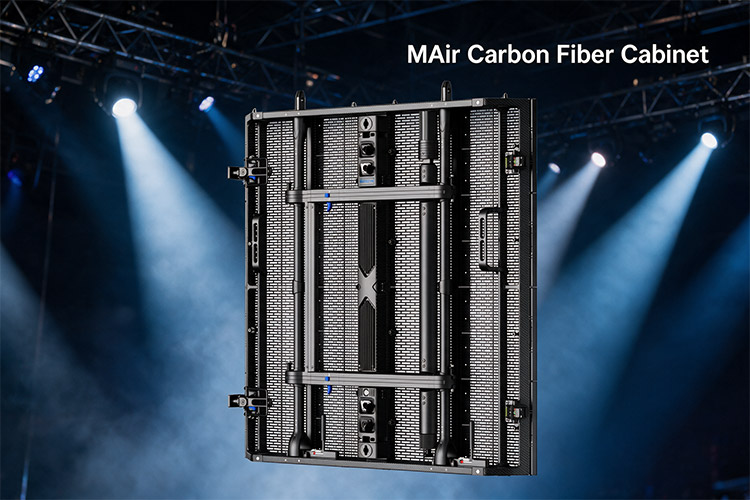
YES TECH MAir features a seamless, one-piece molded carbon fiber frame as its main cabinet structure. Its design also incorporates metal support components. This combination matters because a cabinet's structural behavior depends on the complete assembly rather than on one material in isolation. The frame, internal supports, connections, and other components must work together within the intended application.
For technical buyers, the relevant question is therefore not simply whether a cabinet uses carbon fiber. It is how the material is integrated into the product and what role it plays in the overall structure. Procurement teams should look at the manufacturer's documented design, applicable load specifications, connection details, and installation requirements before drawing conclusions about performance.
The one-piece molded construction of MAir provides a clear design feature to assess. Rather than describing the product only in terms of its material, buyers can evaluate the cabinet as an integrated structural component. This is a more useful basis for technical comparison because it considers the construction approach as well as the material itself.
At the same time, a one-piece frame should not be treated as automatic proof of superior performance under every condition. Actual performance depends on the complete engineering design and the operating conditions for which the product is specified. For rental companies, a careful evaluation combines construction details with documented technical information and the requirements of their intended projects.
Why Structural Design Matters When Comparing Rental Equipment
Rental LED displays operate within a different business model from equipment designed exclusively for a permanent installation. A rental cabinet may be used at multiple venues, handled by different crews, and incorporated into different screen configurations over time. As a result, the cabinet needs to be evaluated as a reusable equipment component rather than as a structure designed for a single fixed environment.
In this context, structural design affects more than the initial appearance or weight of the product. It determines the physical platform on which the display modules and associated components are assembled. It also influences what technical information a rental company needs to understand before purchasing, deploying, or maintaining the equipment.
MAir's carbon fiber cabinet frame is designed around the requirements of professional outdoor rental applications. Its integrated frame and metal support structures form part of a coordinated cabinet design. This gives technical buyers a specific structure to assess when comparing MAir with alternative rental display systems.
A useful comparison should consider the cabinet's documented weight, dimensions, structural specifications, connection system, supported configurations, and maintenance procedures. Buyers should also confirm which components are replaceable, what inspection procedures the manufacturer recommends, and what technical support is available. These questions help establish whether the equipment fits the company's operational requirements without relying on assumptions about the material alone.
It is equally important to distinguish cabinet specifications from those of the complete installation. A cabinet's structural characteristics do not independently determine the capacity of a hanging system, the requirements of a supporting structure, or the suitability of a particular installation. Those decisions require the applicable system specifications and project-specific engineering assessment.
For rental companies, the advantage of a well-documented cabinet design is that it provides a clearer basis for planning. When the cabinet's construction and intended use are understood, the technical team can make more informed decisions about system configuration, handling procedures, and project suitability.
Cabinet Weight Is Only One Part of the Equipment Specification
Weight is an important specification, but it should be interpreted in relation to cabinet size and the complete equipment configuration. Comparing two products by weight alone can produce an incomplete picture if their dimensions, structural designs, or supported applications differ.
According to YES TECH's current product information, the MAir 1000 × 1000 × 102 mm cabinet weighs 19 kg. Its 1000 × 1000 mm format provides a nominal cabinet area of one square meter. This makes the cabinet dimensions and weight useful reference points when calculating the equipment requirements for a proposed screen.
For example, a technical buyer evaluating a large display can use cabinet-level specifications to estimate the number of cabinets needed for a given screen area and calculate the corresponding cabinet weight. However, that calculation does not represent the total installed system weight. Supporting structures, rigging equipment, power and signal components, accessories, and the selected configuration must also be included in the final assessment.
The same principle applies when comparing products made with different materials. A lower cabinet weight does not, by itself, demonstrate that a product offers better structural performance, greater durability, or lower ownership costs. Those conclusions require comparable specifications and evidence relevant to the application.
The value of MAir's carbon fiber cabinet should therefore be considered alongside its dimensions, integrated frame design, metal support components, and intended use in outdoor rental environments. This creates a more complete basis for evaluating the equipment than focusing on the material or weight as an isolated selling point.
For procurement teams, this approach also helps avoid misleading comparisons. Instead of asking which cabinet is lightest, buyers can ask whether a particular cabinet provides the required combination of dimensions, structural specifications, handling characteristics, and application compatibility for their fleet.
A Better Basis for Technical Procurement and Fleet Planning
For rental companies, purchasing decisions need to account for the projects the equipment is expected to serve. A display used primarily for a fixed installation may have different priorities from a system intended for outdoor concerts, festivals, and touring productions. The appropriate cabinet is the one whose documented capabilities align with the company's actual work.
MAir combines a carbon fiber cabinet frame with metal support structures and offers both solid and mesh configurations. According to YES TECH's published product information, the solid version supports P5.9, while the mesh version is available in P5.9 and P7.8. The P7.8 mesh configuration offers up to 47% transparency. These options give buyers several technical considerations to evaluate when matching the product to a project's visual requirements.
However, configuration should be assessed separately from cabinet construction. Pixel pitch affects the display's image characteristics and its suitability for particular viewing conditions. The choice between solid and mesh configurations affects the visual relationship between the displayed content and the background. The carbon fiber frame, meanwhile, is a structural design feature. Keeping these considerations separate makes it easier to determine which specifications matter most for a given project.
A structured procurement review should begin with the intended applications. Buyers can then establish the required display configuration, cabinet dimensions, installation method, environmental protection requirements, and applicable structural specifications. The manufacturer's technical documentation should be used to verify that the selected product meets those requirements.
It is also worth reviewing the practical information needed after purchase. This includes available technical documentation, inspection guidance, maintenance procedures, spare-parts arrangements, and access to product support. These factors do not replace the assessment of the cabinet itself, but they help rental companies understand what is involved in managing the equipment over time.
For MAir, the carbon fiber frame is one element of a larger product specification. The strongest procurement decision comes from evaluating the frame alongside the complete cabinet design, display options, and project requirements, rather than assuming that any single feature determines the overall value of the system.
Assessing Long-Term Value Without Relying on Material Claims Alone
The long-term value of rental equipment depends on how well it serves the company's applications over time. Purchase price is only one part of that assessment. Rental companies may also need to consider equipment utilization, maintenance requirements, handling procedures, spare-parts availability, and the cost of supporting the system across its intended service life.
Carbon fiber can be relevant to this assessment because it changes the material basis of the cabinet's main frame. Yet the presence of carbon fiber does not, on its own, establish a particular service life, maintenance interval, repair cost, or return on investment. Those outcomes depend on the complete product design, operating conditions, maintenance practices, and commercial circumstances.
A more reliable approach is to establish the information required to assess the equipment before purchase. Buyers should review the manufacturer's specifications, understand the construction and replaceable components, and confirm the inspection and maintenance procedures that apply to the product. Where a particular durability or lifecycle claim is important to the purchase decision, it should be supported by relevant technical documentation or verifiable operating evidence.
This approach is especially useful when comparing different cabinet designs. Rather than assigning a fixed advantage to a material, the buyer can evaluate whether the complete product meets the technical and operational requirements of the intended rental fleet. It also provides a more defensible basis for comparing alternatives because the same criteria can be applied across products.
YES TECH MAir's one-piece molded carbon fiber frame provides a distinct structural approach within its outdoor transparent LED cabinet design. Its value for a rental company should be considered in combination with the cabinet's dimensions, weight, metal support structures, display configurations, and documented application requirements. That evaluation gives buyers a clearer understanding of what the product offers without relying on unsupported assumptions about material performance.
Evaluate the Cabinet, Not Just the Material
Carbon fiber is an important feature of the YES TECH MAir cabinet, but its significance extends beyond a simple material label. MAir uses a seamless, one-piece molded carbon fiber frame as the cabinet's main structure and combines it with metal support components. This construction gives rental companies a specific structural design to evaluate when considering equipment for professional outdoor applications.
The most useful assessment goes beyond the question of whether a cabinet is made from carbon fiber. Buyers should examine how the material is integrated into the structure, review the complete technical specifications, confirm the supported display configurations, and assess the product against the requirements of their intended projects.
For rental companies planning an equipment investment, this approach supports more informed decisions. By considering cabinet construction, dimensions, weight, configuration, documented performance, and long-term service requirements together, buyers can determine whether YES TECH MAir fits their technical needs and business model.
Ultimately, the value of a carbon fiber LED cabinet should be established through the design and specifications of the complete product—not through material claims alone. That is the more rigorous way to assess MAir and compare it with other professional rental LED display solutions.


+86-(0)731-84539619


Hunan Yestech Optoelectronic Co., Ltd. Terms of Service Privacy Policy Powered by szweb


