



ADDRESS
Blog/2026.09.21
For an outdoor event, choosing an LED display is often straightforward when the screen is relatively small. Pixel pitch, brightness, weather protection, viewing distance, and image quality usually dominate the discussion. But as the screen gets larger, the decision becomes more complicated. A large LED wall is no longer just a display surface. Its weight, structure, wind exposure, transportation, installation, and relationship with the stage all become part of the production.
This is particularly important for concerts, festivals, and touring productions, where LED screens can cover hundreds of square meters and may need to be transported from one venue to another. A design that works well for a conventional outdoor LED wall may not address every challenge created by a much larger and more open stage structure.
This is where transparent outdoor LED takes a different approach. Instead of treating the LED wall as a completely solid surface, a transparent display allows part of the surrounding stage environment to remain visible. YES TECH MAir takes this concept further with a 1000 × 1000 × 102 mm cabinet, a carbon-fiber frame, up to 47% transparency on its P7.8 configuration, a blow-through structure, and a touring-oriented mechanical system. It is designed specifically for large-scale outdoor rental applications, including concerts and award ceremonies.
The important question, then, is not simply whether MAir is lighter or more transparent than a conventional outdoor LED display. Different outdoor LED products have different specifications and structures. The more useful question is: what changes when the LED screen becomes large enough that the screen itself starts affecting the engineering and logistics of the production?
When a Screen Gets Bigger, Its Structure Matters More
A large LED wall places greater demands on its supporting structure simply because there is more equipment to handle and more screen area exposed to the surrounding environment. Weight accumulates as cabinet count increases, while the overall dimensions of the display can make transportation, rigging, installation, and dismantling more demanding.
Traditional outdoor LED displays are still widely used for large-scale applications, and solid LED walls remain an effective choice when a production needs a strong, continuous visual surface. The issue is not that a solid LED wall is unsuitable for large events. Rather, once a production requires a large screen together with an open stage design, creative geometry, and frequent touring, the physical design of the display becomes increasingly important. MAir approaches this challenge with a 1000 × 1000 mm cabinet built around a one-piece carbon-fiber frame and central metal support rods. YES TECH lists the transparent cabinet at 19 kg and describes the frame as combining low weight with structural strength. The current product information specifies P5.95 and P7.8 versions, with outdoor operation and IP65 protection.
The significance of the large cabinet is not simply that it covers more area. A 1 m × 1 m cabinet means that each cabinet represents 1 square meter of display area. Compared with constructing the same area from four 500 × 500 mm cabinets, a 1000 × 1000 mm cabinet reduces the number of individual cabinets and cabinet-to-cabinet connections required for the same nominal area. YES TECH specifically describes this as an advantage of the MAir carbon-fiber cabinet for large-format touring applications.
For a large production, that difference can affect the entire workflow. Fewer cabinets mean fewer individual units to position and connect, while the larger format can simplify alignment when building a large display surface. It does not mean that every installation will automatically be faster, because installation time depends on the crew, structure, screen configuration, venue, and other factors. But the cabinet architecture is designed with large-scale deployment in mind.
Bigger Screens Also Make Airflow More Important
One of the biggest differences between a conventional solid outdoor LED wall and a transparent blow-through display appears when the screen becomes large and is installed outdoors. A solid LED wall presents a relatively continuous surface to the surrounding environment. As screen area increases, wind becomes an increasingly important engineering consideration. The actual wind load of any installation depends on many variables, including screen dimensions, cabinet design, mounting method, supporting structure, local wind conditions, and installation configuration. A larger screen does not automatically mean a particular wind load, but the scale of the structure makes airflow and structural engineering increasingly relevant.
MAir uses a blow-through cabinet structure designed to allow airflow through the display. The product is specified for wind speeds up to 20 m/s and hanging heights up to 25 meters. YES TECH also specifies an ultimate tensile strength of 51 kN for the MAir structure. These specifications should not be interpreted as meaning that a MAir installation can be used at any height or under any wind conditions without engineering assessment. Actual installation requirements must still be determined according to the complete structure, venue conditions, rigging method, local regulations, and the applicable safety requirements.
What the design does provide is a different way to approach large outdoor LED structures. Instead of making transparency an aesthetic feature alone, MAir incorporates airflow into the physical architecture of the display. That becomes increasingly relevant as the screen grows larger and the production moves into demanding outdoor environments.
Bigger Doesn't Have to Mean Heavier
For touring productions, screen weight has consequences beyond simply lifting a cabinet. An LED display may be loaded onto a truck, moved through a venue, lifted into position, connected into a larger wall, dismantled after the event, and transported again to the next location. A touring screen therefore has to be considered as part of a repeated logistics cycle rather than a one-time installation.
This is one reason MAir places considerable emphasis on its carbon-fiber frame. The transparent cabinet is listed at 19 kg, while the 1000 × 1000 × 102 mm format provides a relatively large display area per cabinet. The relationship between cabinet size and weight is particularly relevant. A 1 m² cabinet that weighs 19 kg corresponds to a cabinet-level weight of approximately 19 kg per square meter before considering the rest of the installation system. That figure should not be confused with the total installed system weight, which will also depend on structural components, power and signal systems, accessories, and the specific configuration.
For rental companies, however, cabinet weight is still an important operational factor. A lighter cabinet can be easier to handle during positioning and dismantling, while a larger cabinet can reduce the number of individual units required to build a given screen area. This is where MAir's design philosophy differs from simply making an outdoor LED cabinet smaller. It combines a large-format cabinet with a lightweight structural approach, targeting the practical requirements of large-scale touring.
Large Outdoor LED Is Not Always Better as a Solid Wall
Another thing that changes as the screen becomes larger is its visual relationship with the stage. A large solid LED wall can create a strong visual backdrop, but it can also become a dominant physical element in the stage design. For some productions, that is exactly what the designer wants. For others, the screen needs to work together with lighting, scenic structures, performers, and the physical architecture of the stage. This is where transparent LED offers a different design approach.
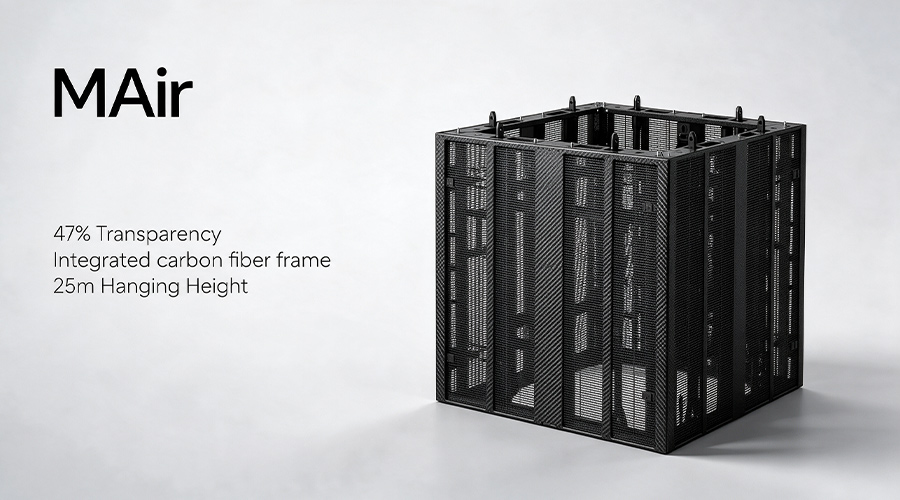
MAir's P7.8 configuration provides up to 47% transparency according to YES TECH's current product information. The transparent structure allows visual elements behind the screen to remain part of the overall stage composition rather than being completely hidden by a solid LED surface. That can be particularly useful for outdoor concerts and festivals where the LED display is not intended to function as an isolated rectangle. Designers can use LED content while maintaining visual depth between the screen, lighting, scenic elements, and performers.
The result is not simply a “see-through screen.” It is a different relationship between LED and stage design. This distinction becomes more important as productions become larger. A large LED wall can occupy a significant portion of the audience's visual field. When that wall is transparent, designers have more opportunities to build layers into the stage instead of treating the LED surface as the final visual boundary.
Large Format Can Also Mean More Creative Geometry
Large outdoor LED does not have to remain flat. MAir is a 1000 × 1000 mm cabinet, but YES TECH designed the system to support ±15° concave and convex curves, 90° corners, and half-box offset configurations. This allows the display to move beyond the conventional flat-wall format. A large LED structure can curve around a stage element, form a corner, or be arranged into more complex spatial configurations. The importance of this becomes clear in modern festival and concert design. LED is increasingly integrated with lighting, truss, scenic elements, and architectural structures. The screen may be used as a backdrop in one section of the stage and as a three-dimensional visual element in another.
MAir has already been used in this type of application. At Rock in Rio Lisboa 2026, approximately 427 m² of MAir P7.8 was used in a stage design that incorporated large LED surfaces and cube-shaped structures. YES TECH reported that the configuration used the display's transparency, 90-degree corners, and blow-through structure to maintain an open and layered stage environment. This is an important distinction from simply saying that a cabinet “supports curves.” The practical value comes from what the geometry allows designers to do with a large outdoor LED system.
The Larger the Production, the More Installation Efficiency Matters
A large screen also means more installation work. If a production uses hundreds of square meters of LED, even small differences in cabinet handling and connection can become significant across the entire installation. This is why touring LED systems increasingly focus on mechanical systems that reduce unnecessary steps. MAir uses large positioning pins and magnetic positioning at the top, a patented curved blade lock for cabinet connection, and a large automatic latch at the bottom. YES TECH describes the system as supporting single-person cabinet operation and faster assembly.
Again, “single-person operation” should be understood at the cabinet-handling and connection level rather than as a claim that a complete large-scale LED structure can be installed safely by one person. Large outdoor productions still require appropriately trained crews and proper installation procedures. The benefit is that the cabinet is designed around repeated rental use. When a screen moves from one venue to another, the mechanical workflow matters just as much as the display specification.
MAir also uses a 6-in-1 dolly system for transport and storage. YES TECH states that the system can support direct stacking and efficient transport, and its launch information says the configuration can fit up to 288 m² of display into a single truck. For touring productions, that is a useful way to think about efficiency: not just how quickly the screen can be installed, but how efficiently the equipment moves between venues.
Outdoor Protection Still Matters as the Screen Becomes More Complex
Transparency and blow-through construction do not eliminate the need for environmental protection. MAir uses IP65 protection, and YES TECH states that its Black Seal Potting Technology provides full encapsulation of the cabinet modules, with front and rear protection reaching IP65. For outdoor events, this matters because the screen may be exposed to dust, rain, and changing environmental conditions. However, IP65 is only one part of an outdoor deployment strategy. The actual installation must also account for weather, wind, supporting structures, power distribution, signal systems, drainage, maintenance access, and venue requirements. This is another reason why a large outdoor LED display should be evaluated as a complete system rather than by a single specification.
What Really Changes When the Screen Gets Bigger?
The most important change is that the LED display stops being just a visual device and becomes part of the production infrastructure. With a relatively small screen, a production team can often focus primarily on image quality and basic installation requirements. As the screen grows, more questions appear. How much does the display weigh? How many cabinets are required? How will the screen be transported? How will it be supported? How will wind affect the structure? How quickly can the crew assemble it? Can the screen integrate with the stage instead of simply sitting behind it? Can the same equipment be reused at the next venue?
These questions are closely connected. A large-format cabinet can reduce the number of individual cabinets required for a given area. A lightweight structural design can make cabinet handling easier. A blow-through structure can address the airflow considerations associated with large outdoor screens. Transparency can allow the LED display to integrate more naturally with the physical stage. Curved and corner configurations can give designers more options for shaping the visual environment. A touring-oriented transport system can make moving the equipment between venues more efficient.
MAir brings these elements together in one platform: a 1000 × 1000 × 102 mm outdoor transparent cabinet, 19 kg transparent configuration, up to 47% transparency, carbon-fiber structural frame, blow-through design, IP65 protection, up to 20 m/s wind-speed specification, up to 25 m hanging height, ±15° curves, 90° corners, and an integrated 6-in-1 dolly system.
Conclusion: Bigger Screens Require a Different Way to Think About LED
The question is not whether a traditional outdoor LED display can be used for a large event. It certainly can, and solid outdoor LED remains an important solution for concerts, festivals, sports, advertising, and other applications where a continuous visual surface is required. The question is what happens when the screen becomes very large, has to travel between venues, needs to operate outdoors, and is expected to become part of an increasingly complex stage design.
At that point, screen size affects more than image area. It affects structure, airflow, transportation, handling, installation, and the way the display interacts with the stage. MAir approaches those challenges through a combination of large-format cabinet design, lightweight carbon-fiber construction, transparent and blow-through architecture, outdoor protection, creative configurations, and touring-oriented logistics. Its 1000 × 1000 mm cabinet provides a large display area per cabinet, while the 19 kg transparent configuration and integrated transport system are designed around the practical demands of large-scale rental use.
So, when an outdoor LED screen gets bigger, the right comparison is no longer simply about brightness, resolution, or cabinet size. It becomes a question of how the entire display system handles the scale of the production. For large concerts, festivals, and touring stages, that means looking beyond the screen itself—to how it moves, how it is installed, how it responds to the outdoor environment, and how naturally it can become part of the stage. That is the point where a large outdoor LED display stops being just a bigger screen and starts becoming a more complete touring solution.


+86-(0)731-84539619


Hunan Yestech Optoelectronic Co., Ltd. Terms of Service Privacy Policy Powered by szweb


