



ADDRESS
Blog/2026.08.13
When people evaluate an LED display, they usually focus on specifications such as pixel pitch, brightness, refresh rate, grayscale, contrast ratio, and color consistency. These parameters are important because they define the display’s optical and electronic performance. However, specifications alone do not determine how a large LED screen will perform in a real installation. The mechanical accuracy of the installation is another critical factor, particularly for large-format rental LED displays and touring LED screens that are repeatedly assembled and dismantled.
Installation accuracy is sometimes misunderstood as simply making sure that LED cabinets are connected in the right order. In professional applications, it involves much more: the relative positioning of adjacent cabinets, horizontal leveling, cabinet-to-cabinet alignment, locking, surface consistency, and the ability to repeat the same installation process reliably. When these elements are properly controlled, hundreds of LED cabinets can function visually and mechanically as one coherent display. When they are not, even small deviations can become increasingly noticeable as the screen grows.
This is why installation accuracy should be considered part of LED display engineering rather than merely an installation task. A well-designed rental LED display should not force installers to rely entirely on visual judgment, repeated manual adjustment, or individual experience. Instead, the cabinet itself should provide mechanisms that make accurate positioning, leveling, locking, and disassembly easier and more repeatable.
Installation Accuracy Is More Than Making LED Cabinets Line Up
For a large LED display, installation accuracy begins with the relationship between individual cabinets. Each cabinet is a relatively small part of the overall screen, but once dozens or hundreds of cabinets are assembled together, the accuracy of every connection contributes to the geometry of the entire display.
Cabinet-to-cabinet alignment is therefore fundamental. Adjacent cabinets need to reach their intended positions in the horizontal and vertical directions while maintaining consistent connections across the display surface. If one cabinet is slightly higher, lower, forward, or backward than its neighbor, the difference may be insignificant when looking at a single cabinet. Across a large LED wall, however, repeated deviations can create uneven joints or an inconsistent surface.
This is particularly relevant to large rental LED screens, where installers often need to build substantial display areas within a limited amount of time. A small positioning error does not necessarily remain small. When similar deviations occur across multiple cabinets, they can accumulate and require additional adjustment.
Horizontal leveling is another important part of the process. The initial cabinets establish a physical reference for the rows that follow. If the starting position is not correctly leveled, installers may need to compensate for the deviation as more cabinets are added. This can turn a straightforward assembly process into a repeated cycle of installation, checking, adjustment, and reinstallation.
The same principle applies to cabinet positioning and locking. A cabinet must first be brought into the correct position before the locking mechanism can secure it. If positioning depends primarily on visual estimation, installers may spend additional time determining whether two cabinets are correctly aligned before locking them together. The objective of a professional LED display installation system, therefore, is not simply to connect cabinets. It is to create a predictable mechanical relationship between them.
This matters because the audience ultimately sees the entire LED display as one visual surface rather than a collection of individual cabinets. Consistent cabinet alignment can contribute to a cleaner display surface and reduce visually distracting variations between cabinet joints. Installation accuracy does not replace pixel calibration or other display technologies, but it provides the mechanical foundation on which the final visual performance is built.
Why Installation Accuracy Matters Even More for Rental and Touring LED Displays
Installation accuracy becomes particularly important when an LED display is designed for rental and touring applications. Unlike a fixed LED installation that may remain in one location for years, a rental LED display can be assembled, dismantled, transported, and reassembled repeatedly.
A touring LED display may be installed at a concert venue one day, transported to another city shortly afterward, and configured differently for the next event. The available installation time may be restricted by venue access, rehearsals, production schedules, or other stage activities. The installation crew may also vary from project to project. Under these conditions, accuracy cannot depend entirely on having unlimited time or an exceptionally experienced technician. What matters is repeatable installation accuracy.
A professional rental LED display should help installers achieve a consistent result across different projects and configurations. The cabinet needs to provide clear physical references and intuitive mechanisms so that the installer does not have to repeatedly measure, visually estimate, or manually correct every connection.
This is also why installation efficiency and installation accuracy should not be treated as competing objectives. A common assumption is that a faster installation must involve more compromises in precision. In well-engineered rental LED systems, the opposite can be true. When the cabinet provides an effective positioning mechanism, an intuitive locking system, and a clear leveling reference, the installer can spend less time correcting errors while achieving a more consistent result. The distinction between fast installation and accurate installation is therefore important. The goal should not be to make installers work faster through additional manual effort. The goal should be to make the correct installation process itself faster and easier.
For touring applications, this principle extends across the entire rental lifecycle. Installation, commissioning, operation, teardown, transportation, and reinstallation are connected stages of the same workflow. A cabinet design that only considers the moment when the screen is first assembled does not fully address the needs of rental production.
How Cabinet Design Can Improve LED Display Installation Accuracy
Installation accuracy should not be left entirely to the installation crew. It can be influenced directly by cabinet engineering. A well-designed rental LED display should help the installer answer several basic questions during assembly: Where should this cabinet be positioned? Is it horizontally aligned? Has it been securely connected? Can it be released efficiently when the display needs to be dismantled?
The first requirement is accurate positioning. A physical positioning mechanism can establish a defined reference between adjacent cabinets and reduce dependence on visual judgment. Instead of repeatedly moving a cabinet until it appears to be in the correct location, the installer can use the cabinet interface to guide it into position.
The second requirement is leveling. For large LED walls, the installer needs a practical way to identify the horizontal position of the cabinet during assembly. Integrating a leveling reference into the cabinet structure can make this information immediately available rather than requiring a separate checking process at every stage.
The third is locking. Once the cabinet has reached the correct position, the locking mechanism should secure it efficiently without introducing unnecessary complexity into the workflow. An intuitive locking system can reduce the number of manual operations required and help maintain a consistent installation sequence.
Disassembly also needs to be considered. Rental LED displays are not permanent structures, so teardown is an integral part of their operation. If a cabinet can be installed accurately but is difficult to release, the overall workflow is still inefficient. A well-engineered cabinet should therefore consider both sides of the process: how the cabinet connects and how it comes apart. These details may appear relatively small compared with major specifications such as pixel pitch or brightness, but they can have a significant practical effect when repeated across a large rental LED display. The most effective approach is to integrate these functions into the cabinet itself, turning installation accuracy from something that installers have to create manually into something that the product actively supports.
How MAir Turns Installation Accuracy Into a Cabinet-Level Design Principle
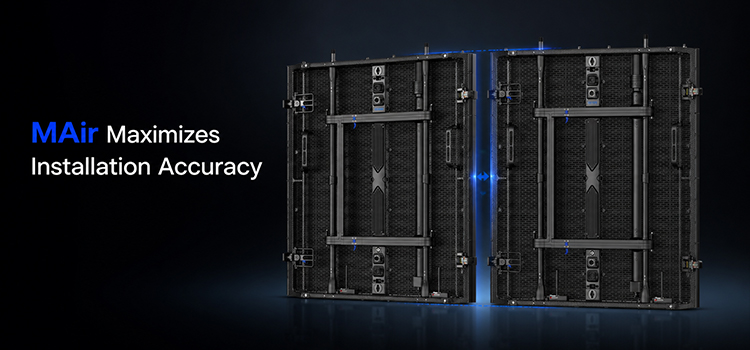
This installation-oriented approach is one of the areas where MAir goes beyond simply pursuing a faster installation process. MAir see-through LED display considers the practical installation workflow at the cabinet level, integrating positioning, leveling, locking, and disassembly features to help installers achieve accurate and efficient assembly. One of the key elements is the large positioning pin with a top magnetic suction design. Positioning is the first step toward accurate cabinet assembly, and the positioning system provides a defined physical reference between cabinets. The large positioning pin helps guide the cabinet into the intended position, while the magnetic suction design assists the positioning process. The result is faster and more precise cabinet alignment with less reliance on visual estimation and repeated manual adjustment.
This is particularly valuable when a large number of cabinets need to be assembled into a continuous LED display. The objective is not simply to make one cabinet easier to install. It is to establish a repeatable positioning process across the entire screen. Once the cabinet has been positioned, MAir's leveling and locking design continues the same principle. Each cabinet's air frame comes standard with a built-in level, providing an immediate visual reference for checking the horizontal position during installation. Instead of treating leveling as a completely separate operation, installers can identify the cabinet's horizontal status directly from the cabinet structure and make adjustments when necessary before continuing with the assembly.
This seemingly simple feature addresses an important issue in large LED screen installation: maintaining a consistent horizontal reference as the display expands. The installer can follow a more straightforward process of positioning the cabinet, checking the level, making any required adjustment, and then securing the connection.
The locking mechanism is designed with the same emphasis on practical operation. MAir features a self-developed curved blade lock with one-touch pop-up and single-handed operation, allowing the installer to secure the cabinet more conveniently after positioning. The value of this design is not limited to speed. A locking mechanism that can be operated intuitively and with one hand can simplify the workflow and reduce unnecessary manipulation during cabinet assembly, particularly in the demanding conditions of rental and touring production. The combination of positioning, leveling, and locking creates a more controlled installation sequence:
Position → Level → Lock.
Each stage addresses a different aspect of installation accuracy, but together they form a coherent cabinet assembly process. MAir also considers what happens after the event. Its large latch structure automatically rebounds during disassembly, making the cabinet easier to release and remove. This reduces the amount of manual handling required during teardown and supports a more efficient transition from installation to dismantling.
This is an important distinction for rental LED displays. Installation should not be viewed as an isolated event that ends once the screen is powered on. The product will eventually need to be dismantled, transported, and installed again. A cabinet designed around the entire rental workflow therefore needs to support both assembly and disassembly.
Taken together, these mechanisms demonstrate that MAir's approach is not based on a single installation feature. The positioning pin addresses cabinet alignment, the built-in level provides a direct horizontal reference, the curved blade lock simplifies secure connection, and the large automatic-rebound latch supports efficient disassembly. Each feature addresses a different point in the installation cycle. The result is a cabinet design in which installation accuracy, convenience, and efficiency are considered together rather than separately.
Why Repeatable Installation Accuracy Matters to LED Display Performance
For professional rental and touring applications, the real value of installation accuracy is not achieving a perfect result once. It is achieving a consistent result repeatedly. A large LED display can involve hundreds of mechanical connections. If every connection requires extensive manual adjustment, installation time increases and the possibility of inconsistency becomes greater. If the cabinet itself provides clear positioning, leveling, and locking references, the installation crew can work through a more predictable process.
This is why installation-friendly design has become an important consideration when evaluating rental LED displays. Product performance should be considered from the perspective of the entire workflow rather than only the final display specifications.
A high refresh rate cannot compensate for an improperly aligned cabinet. A high-brightness LED display cannot eliminate the need for accurate mechanical assembly. Advanced image processing cannot replace a consistent physical display surface. The optical and electronic characteristics of an LED display are important, but they operate within a physical system that also needs to be correctly assembled. For touring LED displays, this becomes even more relevant because the same cabinets may need to deliver consistent performance across multiple venues and repeated installation cycles. The best installation design is therefore not necessarily the one with the greatest number of mechanisms. It is the one that reduces uncertainty at the points where installers repeatedly need to make decisions.
Where should the cabinet go?
Is it level?
Is it securely locked?
How can it be released efficiently?
MAir addresses these practical questions directly through its cabinet-level design. Ultimately, LED display installation accuracy is not just about making cabinets look aligned. It is about creating a repeatable mechanical foundation for the entire display system. For rental and touring LED applications, where installation time, consistency, and operational efficiency all matter, that foundation becomes increasingly important.
MAir takes this principle into the cabinet itself. Its large positioning pin with top magnetic suction, built-in level, self-developed curved blade lock, and large automatic-rebound latch work together across the installation and teardown process. Rather than asking installers to compensate for cabinet design through additional manual adjustment, MAir is engineered to make accurate positioning, leveling, locking, and disassembly more intuitive. A professional rental LED display should not only be easy to install. It should make accurate installation easier to achieve—and easier to repeat.


+86-(0)731-84539619


Hunan Yestech Optoelectronic Co., Ltd. Terms of Service Privacy Policy Powered by szweb


