



ADDRESS
Blog/2026.08.06
For transparent LED rental displays, visual performance is only one part of a successful design. Behind every large-scale stage, outdoor event, and touring production is a more fundamental engineering challenge: how to ensure the cabinet remains stable and maintains its original shape when exposed to different types of mechanical stress.
Unlike fixed LED displays, rental LED cabinets are designed for frequent transportation, installation, dismantling, and reuse. During their service life, cabinets experience various external forces, including the cabinet’s own weight, lifting tension during rigging, pressure between connected cabinets, and impact or vibration during transportation. If the cabinet structure lacks sufficient rigidity, these forces can gradually cause deformation, affecting both mechanical reliability and the final visual performance of the LED display.
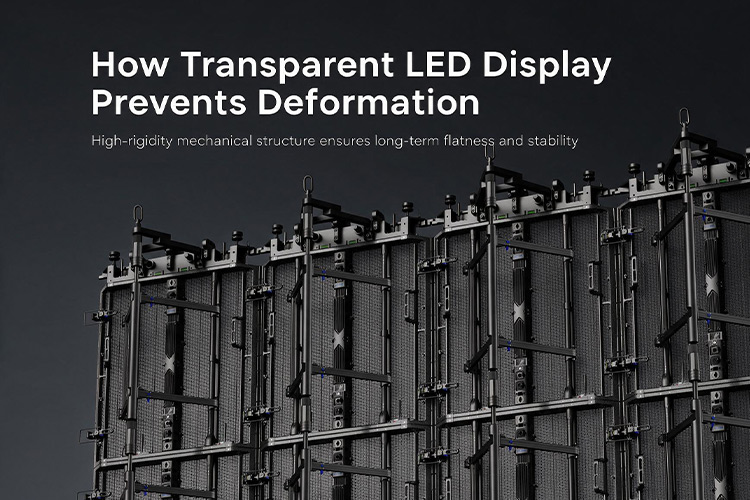
For transparent LED rental cabinets, deformation control is even more challenging. The open structure required to achieve high transparency means the cabinet must maintain strength while using less material than traditional solid LED cabinets. Therefore, professional transparent LED rental cabinets rely on advanced structural engineering to achieve a balance between lightweight design and resistance to deformation under load.
The Structural Design Behind Deformation Resistance
The foundation of cabinet stability is the frame structure. The frame is responsible for carrying the weight of LED modules, transferring external forces, and maintaining the overall geometry of the cabinet during operation. Traditional LED cabinets often use enclosed structures, where more material naturally contributes to rigidity. Transparent LED cabinets, however, require an open design to maximize transparency and airflow. This means manufacturers need to optimize the cabinet structure rather than simply adding more material.
High-quality transparent LED rental cabinets typically use high-strength lightweight materials, such as aluminum alloys, combined with optimized frame structures. By reinforcing key load-bearing areas, improving the frame profile design, and reducing unnecessary connection points, the cabinet can achieve higher rigidity while maintaining a lightweight construction.
A well-designed cabinet should remain structurally stable when subjected to external forces. The frame should resist bending, the cabinet edges should maintain alignment, and the module mounting surface should remain flat. This is essential because even minor deformation in a single cabinet can become more noticeable when hundreds of cabinets are assembled into a large LED video wall.
Optimized Load Distribution Prevents Local Stress Concentration
Cabinet deformation is not always caused by insufficient overall strength. In many cases, deformation occurs because stress is concentrated in specific weak areas. A professional LED rental cabinet design considers the entire load transfer path — how the weight of the modules is transferred to the frame, how lifting forces are distributed through the cabinet structure, and how connected cabinets share external pressure after assembly.
By designing a balanced load-bearing structure, external forces can be distributed more evenly throughout the cabinet instead of being concentrated at individual points. This reduces stress on critical components such as connection areas, locking mechanisms, and supporting structures.
Effective load distribution helps prevent several long-term issues, including frame distortion, fatigue around locking systems, and gradual dimensional changes caused by repeated installation cycles. For rental applications, where equipment may be assembled and disassembled hundreds of times, maintaining consistent structural accuracy is essential.
Precision Manufacturing Ensures Long-Term Dimensional Accuracy
Structural design alone cannot guarantee deformation resistance without precise manufacturing. For rental LED displays, cabinet accuracy directly affects the quality of the final installation. When multiple cabinets are connected together, small dimensional errors can accumulate across the entire screen. A slight deviation in cabinet flatness or alignment may result in uneven surfaces, visible gaps, or inconsistent image performance on large LED displays.
Therefore, professional rental LED cabinet production requires strict control over manufacturing precision, including frame accuracy, cabinet flatness, connection point consistency, and overall dimensional tolerance. High manufacturing precision allows individual cabinets to fit together seamlessly, creating a smooth and uniform display surface even in large-scale applications.
Balancing Lightweight Design and Structural Strength
Weight reduction is another important consideration for transparent LED rental displays. Touring productions and temporary events require equipment that is easy to transport, install, and dismantle. However, reducing weight cannot come at the expense of structural performance. Effective lightweight design is achieved through material innovation and structural optimization rather than simply removing materials.
High-strength materials can replace heavier conventional components, while optimized frame structures reduce unnecessary weight without compromising rigidity. The goal is to create a cabinet that is easier to handle while still maintaining the mechanical strength required for demanding applications. This balance between portability and durability has become a key standard for next-generation transparent LED rental solutions.
MAir: Structural Innovation for Superior Deformation Resistance
As transparent LED displays move into more demanding outdoor and touring applications, cabinet structures face higher requirements. Larger screen sizes, higher installation positions, and repeated rigging operations require cabinets that can maintain their shape under significant mechanical stress.
YES TECH MAir was designed with structural strength as one of its core priorities. Through advanced materials and optimized force distribution, MAir provides a new approach to improving cabinet rigidity while maintaining the lightweight advantages required for rental applications.
Industry-First Carbon Fiber Seamless One-Piece Molded Frame
One of the key structural innovations of MAir is its industry-first carbon fiber seamless one-piece molded frame. Carbon fiber is known for its excellent strength-to-weight ratio, providing high rigidity while significantly reducing weight compared with traditional metal structures. By applying carbon fiber technology to the cabinet frame, MAir achieves a lightweight design without sacrificing structural strength.
The seamless one-piece molded construction also reduces potential weak points commonly found in traditional assembled structures. With fewer structural joints, external forces can be transferred more evenly across the frame, helping the cabinet maintain its original geometry under load.
Dual Load-Bearing Structure for More Balanced Force Distribution
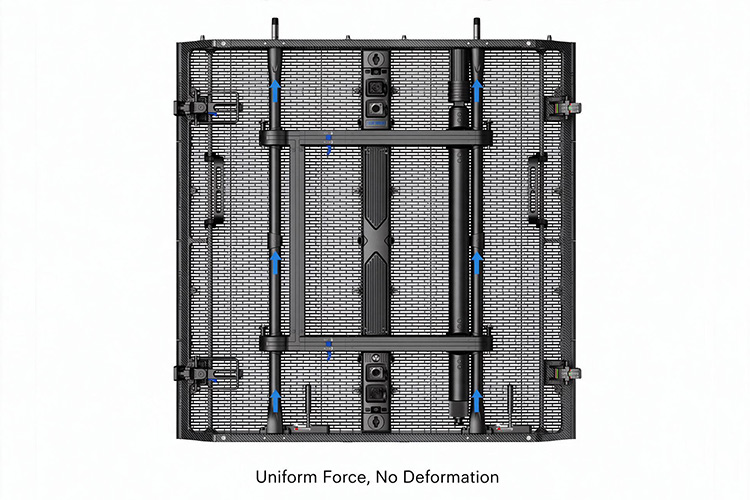
Beyond material innovation, MAir further improves structural performance through its internal load-bearing design. Unlike some conventional transparent LED cabinets that rely on a single internal supporting structure, MAir incorporates two internal metal bars as key load-bearing components. This dual-support structure allows forces to be distributed more evenly across the cabinet.
When the cabinet is exposed to lifting tension, stacking pressure, or transportation impact, the internal structure works together to share the load. By reducing stress concentration in individual areas, the design improves overall cabinet rigidity and minimizes the risk of deformation. This optimized force distribution is particularly important for large LED displays, where the stability of every individual cabinet directly affects the flatness and reliability of the entire screen.
Air Frame Creates a Stable Support Structure
In real-world installations, cabinet strength must work together with the supporting structure to maintain stability. MAir is equipped with an Air Frame system that creates a triangular support structure when deployed. In engineering applications, triangular structures are widely recognized for their stability because they effectively distribute external forces and reduce movement caused by applied loads.
During stacking and hanging applications, the Air Frame provides additional support points for the cabinet structure. This helps reduce stress concentration and improves overall stability during installation, especially for large-format transparent LED displays. By combining cabinet rigidity with a stable supporting structure, MAir provides a more reliable solution for complex stage and outdoor applications.
High Tensile Strength for Heavy-Duty Touring Applications
For large-scale touring productions, hanging height and structural load capacity are critical factors. MAir has achieved a tensile strength of 51kN and supports hanging installations up to 25 meters. These capabilities demonstrate the strength of its structural design and provide greater confidence for demanding applications where cabinets must withstand significant mechanical loads. High tensile strength not only improves safety margins during installation but also helps maintain cabinet integrity throughout repeated use.
Preventing deformation under load requires more than simply increasing material thickness. It requires a complete structural engineering approach that combines material selection, frame design, load distribution, manufacturing precision, and support systems. For transparent LED rental cabinets, maintaining structural integrity is essential to achieving reliable performance in touring, outdoor events, and large-scale productions.
Through its carbon fiber seamless one-piece molded frame, dual load-bearing structure, Air Frame support system, and high tensile strength design, YES TECH MAir demonstrates how modern transparent LED rental cabinets can achieve both lightweight portability and exceptional deformation resistance under demanding conditions.


+86-(0)731-84539619


Hunan Yestech Optoelectronic Co., Ltd. Terms of Service Privacy Policy Powered by szweb


