



ADDRESS
Blog/2026.08.06
Transparent LED displays have become an important part of modern stage design, offering a unique combination of visual impact and spatial openness. From international concert tours and music festivals to outdoor celebrations and large-scale live productions, transparent LED screens allow designers to create immersive visual experiences while maintaining visibility of the surrounding environment.
However, for rental applications, achieving a high transparency effect is only one part of the challenge. Behind every successful touring project is a more fundamental requirement: structural stability. Unlike fixed installation LED displays, rental transparent LED displays are designed for repeated use in demanding environments. They need to be transported between venues, installed and dismantled within short timeframes, and frequently adapted to different stage structures. During this process, cabinets are continuously exposed to vibration, impact, bending forces, and dynamic loads.
Over time, these repeated mechanical stresses can affect the physical structure of the display. If a cabinet lacks sufficient rigidity, deformation may gradually occur, causing problems that go far beyond appearance. For professional rental companies, deformation resistance is directly related to display quality, installation efficiency, safety, and long-term operational value.
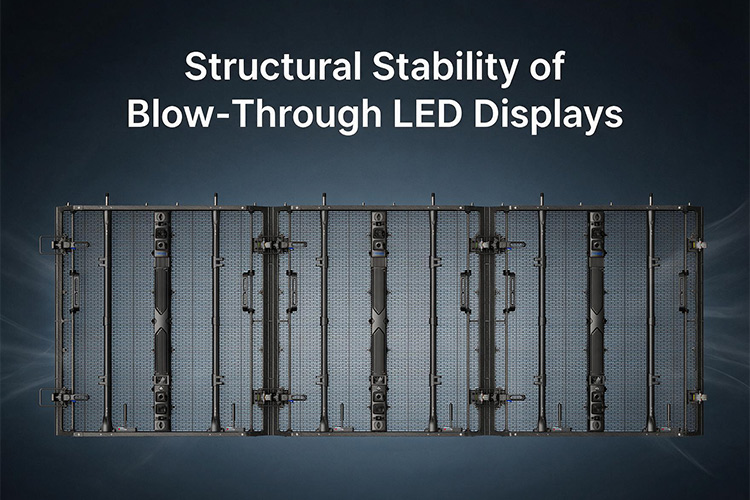
Why Deformation Resistance Is Critical for Touring Transparent LED Displays
The working environment of a touring LED display is fundamentally different from that of a fixed LED installation. A fixed outdoor LED screen may remain mounted in the same location for years, while a rental transparent LED display may experience hundreds of transportation and assembly cycles throughout its service life.
Each transportation process introduces mechanical stress. Road vibration during truck transportation, impact during loading and unloading, and repeated connection and separation of cabinets all create pressure on the cabinet structure. In addition, many touring applications require suspended installation, meaning the display must continuously withstand its own weight and dynamic forces generated by movement and environmental conditions.
Outdoor transparent LED displays face even more complex conditions. Wind pressure, temperature changes, and humidity can place additional demands on the mechanical design of the cabinet. For large hanging screens used in concerts or outdoor festivals, maintaining structural stability is not simply about protecting the cabinet itself; it is about ensuring that the entire display system continues to perform safely under changing conditions.
A well-designed transparent LED display must therefore maintain dimensional stability throughout its lifecycle. The cabinet should remain within precise structural tolerances after repeated transportation and installation, allowing every panel to connect accurately and maintain a consistent viewing surface.
The Impact of Structural Deformation on Display Performance
One of the first areas affected by deformation is screen flatness. A large LED display wall relies on the precise connection of hundreds of cabinets. Even a small deviation in one cabinet can create alignment issues across the entire screen. This challenge is particularly important for transparent LED screens because their open-frame structure makes precision more difficult to achieve. The lightweight design required for high transparency means there is less material available compared with traditional LED cabinets. As a result, the balance between reducing weight and maintaining rigidity becomes a key engineering challenge.
When cabinet deformation occurs, several problems may appear during installation and operation. Adjacent cabinets may no longer maintain the same plane, creating visible unevenness between panels. In creative installations involving curved surfaces, arches, or irregular shapes, structural distortion can also affect the accuracy of the final design.
For audiences, these issues can directly influence the viewing experience. A display that should appear seamless may show inconsistent gaps, uneven connections, or visual interruptions. In high-end productions where every detail of the stage design matters, maintaining a precise and stable structure is essential.
Beyond visual quality, deformation can also reduce installation efficiency. Rental events operate under strict schedules, and production teams often have only a limited window to complete setup. If cabinets lose their original precision, technicians may need additional time to manually adjust connections, align locking systems, or compensate for structural deviations. For large-scale touring projects, these small delays can accumulate significantly. A structurally stable rental LED display allows faster assembly, smoother operation, and lower labor costs, which are important advantages for rental companies managing frequent events.
Balancing Transparency, Lightweight Design, and Structural Strength
The development of transparent LED displays has always involved a technical balance between visual openness and mechanical performance. High transparency requires an open structure with fewer materials, while rental applications require durability and strength. These two goals can appear contradictory. Increasing transparency usually means reducing structural elements, but reducing structural support may affect rigidity and resistance against deformation.
Therefore, advanced transparent LED display design focuses not only on transparency rate or cabinet weight, but also on the overall engineering system, including frame materials, load distribution, connection design, and fatigue resistance. For touring applications, structural rigidity is especially important because the display must maintain performance after repeated installation cycles. A lightweight cabinet that cannot maintain its shape over time may create higher operational costs than a slightly stronger structure that provides long-term reliability. This is why professional rental transparent LED displays increasingly adopt advanced materials and optimized structural designs to improve strength without sacrificing flexibility and portability.
How Advanced Structural Design Improves Touring Reliability
A high-performance rental transparent LED display requires a frame structure that can withstand both transportation stress and real-world event conditions. Material selection plays a critical role in this process, as the frame must provide sufficient strength while keeping the cabinet lightweight enough for efficient touring operations.
YES TECH MAir is designed around this principle, combining lightweight construction with enhanced structural stability. One of its key innovations is the industry's first carbon fiber seamless one-piece molded frame. Compared with traditional metal structures, the integrated carbon fiber design provides excellent strength-to-weight performance while reducing potential weak points caused by multiple connection areas. This helps the cabinet maintain its original shape and structural integrity during repeated transportation and installation.
Beyond the frame material, MAir also features a unique load-bearing structure designed specifically for touring applications. Instead of relying on a single thin central support bar commonly used in some transparent LED display designs, MAir incorporates two reinforced metal support sections in the middle structure. This additional support improves load distribution and provides an extra layer of protection against deformation, especially during hanging applications and long-term operation.
For outdoor touring environments, structural stability must also work together with wind resistance performance. MAir cabinets are engineered with a high-strength hanging system that delivers an ultimate tensile strength of 51 kN, providing reliable load-bearing capability for demanding installations. Combined with a metal hanging support rod and wind-resistant frame design, MAir supports wind resistance up to 20 m/s and can achieve hanging installations up to 25 meters.
Through advanced material engineering and structural optimization, MAir demonstrates how modern transparent LED displays can achieve both creative freedom and mechanical reliability. For rental companies and touring professionals, deformation resistance is not simply a technical specification — it is a key factor that determines installation efficiency, display quality, safety performance, and the long-term value of the entire LED display system.


+86-(0)731-84539619


Hunan Yestech Optoelectronic Co., Ltd. Terms of Service Privacy Policy Powered by szweb


