



ADDRESS
Blog/2026.08.07
Transparent LED displays have become an increasingly popular solution for modern stage productions, outdoor events, commercial spaces, and architectural applications. With their unique see-through visual effect, they allow designers to combine digital content with the surrounding environment, creating immersive experiences while maintaining openness and spatial depth.
However, as transparent LED technology continues to develop, one misunderstanding still exists in the market: transparent does not always mean lightweight. Many people naturally assume that because a display has a transparent structure, the cabinet must also be lighter. In reality, transparency and weight are two different aspects of LED display design. A high transparency rate mainly describes the visual permeability of the screen, while the actual weight of a transparent LED display depends on many engineering factors, including cabinet materials, structural design, internal components, protection requirements, and installation methods.
For rental applications, especially touring events and outdoor productions, creating a transparent LED display is not simply about making the screen more open. The real challenge is achieving the right balance between transparency, lightweight design, structural strength, and installation efficiency. A professional rental transparent LED display needs to perform in multiple scenarios. It must be easy to transport, fast to install, stable after assembly, and reliable during repeated use. These requirements make the structural design of the cabinet one of the most important factors determining the real performance of a transparent LED solution.
Transparency Does Not Automatically Reduce Cabinet Weight
The transparent effect of an LED display is usually achieved through optimized cabinet structures, open-frame designs, and carefully arranged LED modules. By reducing visual barriers, transparent LED screens can maintain visibility through the display surface and create a lighter visual appearance.
However, the cabinet itself still requires a complete mechanical structure. Unlike traditional fixed LED displays, rental transparent LED displays must be designed for frequent movement and repeated installation. The cabinet needs enough rigidity to maintain flatness, accurate module positioning, and stable connections during transportation and operation.
A transparent LED cabinet that focuses only on reducing material may become lighter, but it may also lose the structural strength required for professional applications. During long-term rental use, insufficient rigidity can lead to problems such as cabinet deformation, uneven splicing, and difficulties in maintaining a seamless display surface.
This is why advanced transparent LED display design is not about removing as much material as possible. Instead, it focuses on improving structural efficiency — using better materials and smarter engineering to reduce unnecessary weight while keeping the cabinet strong and reliable. The goal is not simply to create the lightest transparent LED display. The goal is to create a display that delivers the best balance between weight, durability, and performance.
Why Rental Transparent LED Displays Need Both Lightweight Design and Stability
For rental companies, every kilogram matters. A lighter LED cabinet can reduce transportation pressure, improve installation efficiency, and make large-scale event preparation easier. In touring applications where displays are moved between different venues, lightweight design directly affects operation costs and working efficiency.
However, rental environments also create higher requirements for reliability. A rental transparent LED display may experience hundreds of installation cycles throughout its service life. It needs to adapt to different stage structures, installation methods, and environmental conditions. This means the cabinet cannot sacrifice strength simply to achieve a lower weight.
Outdoor applications create even more challenges. Transparent LED screens are often used for festivals, concerts, and temporary outdoor stages where they need to maintain stable operation under changing weather conditions. Although the open structure of transparent displays can help reduce wind resistance, the cabinet still requires sufficient mechanical strength to ensure safety and stability. Therefore, the development direction of transparent LED technology is not only focused on higher transparency. The industry is moving toward a more advanced approach: creating lightweight transparent LED displays through structural innovation.
This means using stronger and lighter materials, simplifying cabinet structures, integrating components more efficiently, and improving installation systems. Through these improvements, manufacturers can create LED displays that are easier to handle while maintaining the reliability required for professional rental applications.
Structural Innovation Defines the Next Generation of Transparent LED Displays
The future of rental transparent LED displays depends on how effectively manufacturers can solve the relationship between lightweight construction and structural stability. Traditional metal structures can provide strength, but they may also increase cabinet weight. As application requirements become more demanding, advanced materials are becoming increasingly important. Carbon fiber, for example, has attracted attention in many industries because of its excellent strength-to-weight ratio. By combining lightweight characteristics with high rigidity, carbon fiber provides new possibilities for LED display structures.
At the same time, integrated cabinet design is becoming another important trend. By reducing unnecessary connections and simplifying internal structures, manufacturers can improve installation efficiency while lowering overall cabinet complexity. For rental users, the ideal transparent LED display should not require a compromise between portability and reliability. A successful solution should provide lightweight transportation, stable performance, and fast deployment at the same time. This balance has become one of the key standards for evaluating high-quality rental transparent LED displays.
MAir: Achieving the Ultimate Balance Between Lightweight and Stability
Based on this industry challenge, YES TECH developed MAir to redefine the possibilities of transparent rental LED displays. Instead of simply pursuing weight reduction, MAir focuses on achieving a complete balance between lightweight design, structural strength, and installation efficiency. One of the key innovations of MAir is its industry-first carbon fiber seamless one-piece molded frame. Carbon fiber provides outstanding strength while maintaining a lightweight structure, allowing MAir to achieve both durability and portability.
With a 1000×1000mm cabinet weighing only 19kg, MAir significantly reduces handling pressure while maintaining the rigidity required for professional rental applications. This lightweight transparent LED display design helps rental teams improve transportation efficiency, simplify installation processes, and adapt more easily to different event environments. However, lightweight performance is only part of MAir’s structural innovation. 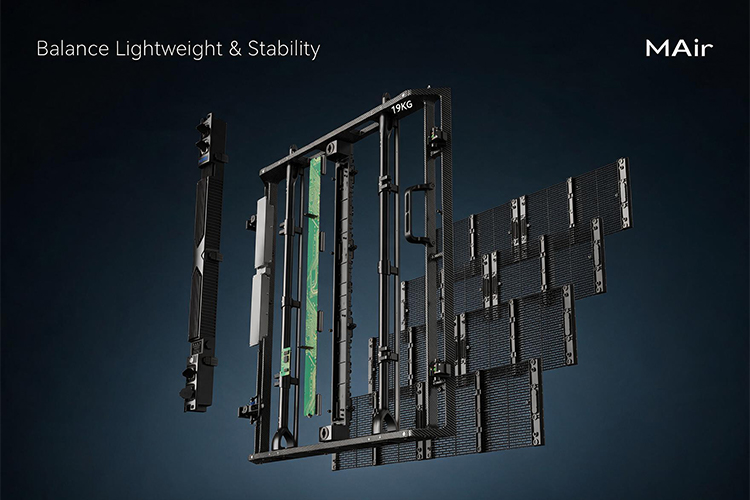
MAir also introduces an integrated and cable-free cabinet concept. By optimizing the internal structure and reducing unnecessary components, the cabinet becomes cleaner, simpler, and easier to operate. Combined with the quick-lock system, MAir reduces cable connections and minimizes installation steps, helping rental teams complete setup faster and more efficiently. For touring productions and outdoor events, installation speed is just as important as display performance. A transparent LED display that is easy to transport but complicated to install cannot fully meet modern rental requirements.
Through the combination of carbon fiber material, integrated cabinet design, and efficient locking technology, MAir creates a new balance between mobility and stability. The value of a professional transparent LED display is not measured only by how lightweight it is. It is measured by how well it performs throughout the entire rental process — from transportation and installation to operation and repeated use.
MAir represents this design philosophy:
Lightweight. Stable. Fast installation.
By combining advanced materials with intelligent structural design, MAir demonstrates that transparency, strength, and efficiency can coexist in one transparent LED rental solution. The future of transparent LED displays is not simply about making cabinets lighter. It is about creating smarter structures that deliver maximum performance with minimum complexity.


+86-(0)731-84539619


Hunan Yestech Optoelectronic Co., Ltd. Terms of Service Privacy Policy Powered by szweb


